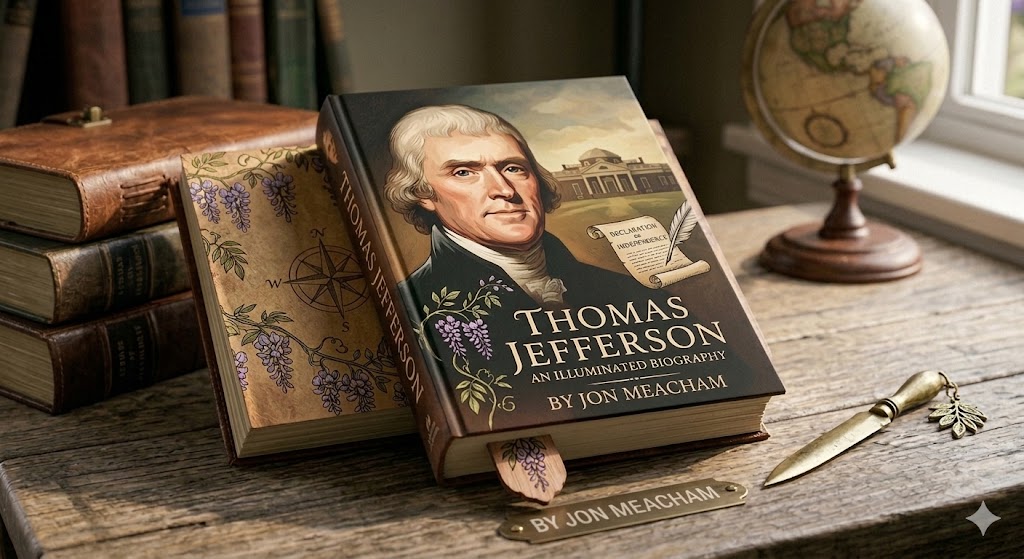
Book Review: Thomas Jefferson: The Art of Power
By Jon Meacham
Rating: ⭐⭐⭐⭐⭐ (5/5)
In Thomas Jefferson: The Art of Power, Jon Meacham presents Jefferson as a brilliant but deeply complicated leader, defined by the constant tension between his Enlightenment ideals and his practical use of political power. The biography explores how Jefferson’s vision of liberty often conflicted with his personal actions — particularly as a slaveholder — while also highlighting his extraordinary abilities as both a philosopher and a political strategist.
Thomas Jefferson emerges as a masterful and contradictory figure. Meacham demonstrates that Jefferson’s greatest political strength was his ability to reconcile lofty ideals with the realities of governing. That balance produced both remarkable achievements and enduring contradictions. His handling of political alliances, the Louisiana Purchase, and his rivalries with figures like Alexander Hamilton and John Adams shows how Jefferson’s legacy rests not on perfection, but on his understanding of how power works and how to wield it effectively.
Jefferson’s Dual Nature
One of the book’s greatest strengths is its portrayal of Jefferson as both a visionary thinker and a skilled political operator. He disliked direct confrontation, yet excelled at persuasion, quiet alliances, and strategic maneuvering behind the scenes. Meacham also does not shy away from Jefferson’s less admirable qualities. At times, he could be petty, overly sensitive to criticism, and politically evasive.
Reading this biography after books on Washington or Adams makes Jefferson’s personality stand out even more sharply. Where Washington projected steadiness and Adams confrontation, Jefferson often appeared cerebral, strategic, and elusive. His leadership was defined by the constant balancing act between idealism and practical governance.
Revolutionary Era
Jefferson’s place in American history was secured early through his authorship of the Declaration of Independence, which articulated revolutionary ideals of liberty and equality. Meacham makes clear that Jefferson’s strength was not public speaking, but writing and intellectual persuasion. Unlike Adams, Jefferson’s influence came largely through the written word.
Before becoming president, Jefferson served as governor of Virginia, minister to France, and Secretary of State under George Washington. Enlightenment philosophy heavily shaped his political worldview. He favored limited government, agrarian democracy, and skepticism toward concentrated federal power. Yet Meacham repeatedly highlights the irony that Jefferson often exercised strong executive authority whenever he believed national interests required it.
Presidency (1801–1809)
Jefferson became the third president of the United States after a bitter and highly partisan election against Adams. Though Jefferson rarely attacked Adams publicly himself, many of his political allies and newspapers did so aggressively, and Jefferson largely allowed it to continue. Meacham presents this less as personal betrayal and more as a reflection of the brutal political climate of the era.
As president, Jefferson oversaw one of the most significant expansions in American history through the Louisiana Purchase in 1803, which doubled the size of the nation. He also commissioned the expedition of Meriwether Lewis and William Clark, dramatically expanding American understanding of the western territories.
Foreign policy, however, proved far more difficult. The Embargo Act, intended to keep the United States out of the European wars raging between Britain and France, badly damaged the American economy. Meacham frames this as one of the clearest examples of Jefferson’s political philosophy colliding with real-world consequences.
Rivalries and Political Power
Jefferson’s rivalry with Hamilton helped define the earliest battles over the future direction of the United States. The two men clashed repeatedly over federal power, finance, and the national bank. Hamilton enjoyed Washington’s confidence on financial matters, often leaving Jefferson frustrated and politically outmaneuvered.
Eventually, Jefferson resigned as Secretary of State, due in large part to these growing tensions. Yet even while championing limited government and states’ rights, Jefferson repeatedly expanded executive authority when it suited national priorities. Meacham’s central argument becomes increasingly clear throughout the book: Jefferson understood power exceptionally well, even when exercising it contradicted his stated ideals.
Contradictions
No discussion of Jefferson can avoid the contradictions that continue to define his legacy.
He advocated liberty while enslaving people throughout his life. His relationship with Sally Hemings remains one of the clearest examples of the divide between Jefferson’s public ideals and private actions.
Meacham does not attempt to excuse these contradictions. Instead, he presents Jefferson as a profoundly complicated figure — a champion of freedom who simultaneously participated in and benefited from slavery. That tension sits at the center of both Jefferson’s life and his historical legacy.
Legacy
Jefferson remains one of the most influential and debated figures in American history — remembered as a Founding Father, president, political philosopher, and architect of American expansion.
What makes him enduringly fascinating is precisely what makes him controversial: the collision between his ideals and his actions.
Meacham frames Jefferson as a man who understood power intimately — how to acquire it, how to use it, and how to shape a nation through it. His life becomes a study in brilliance, ambition, political instinct, and contradiction.
Ultimately, Thomas Jefferson: The Art of Power succeeds because it refuses to simplify Jefferson into either hero or villain. Instead, it presents a nuanced portrait of a deeply influential man whose achievements and flaws remain inseparable from the story of the United States itself.
Final Rating: ★★★★★ (5/5)
This is one of the most engaging and balanced biographies of Jefferson I have read. Meacham explores Jefferson’s intelligence, political genius, and historical importance without ignoring the contradictions that complicate his legacy.
The writing is accessible, thoughtful, and deeply researched, making this an excellent read for anyone interested in early American history, political leadership, or the Founding Fathers.
Critical Reception When Released
Upon release, Thomas Jefferson: The Art of Power received widespread critical acclaim from historians, literary reviewers, and general readers. Critics praised Meacham for presenting Jefferson as a fully human figure rather than either a flawless icon or a one-dimensional hypocrite.
Reviewers especially highlighted:
- Meacham’s balanced and nuanced portrayal of Jefferson
- The accessibility of the writing despite the depth of research
- The strong focus on political strategy and leadership
- The willingness to confront Jefferson’s contradictions directly
Many readers and historians considered the biography one of the strongest modern works on Jefferson, particularly for its emphasis on the relationship between ideals and political power.
Leave a Reply