Title
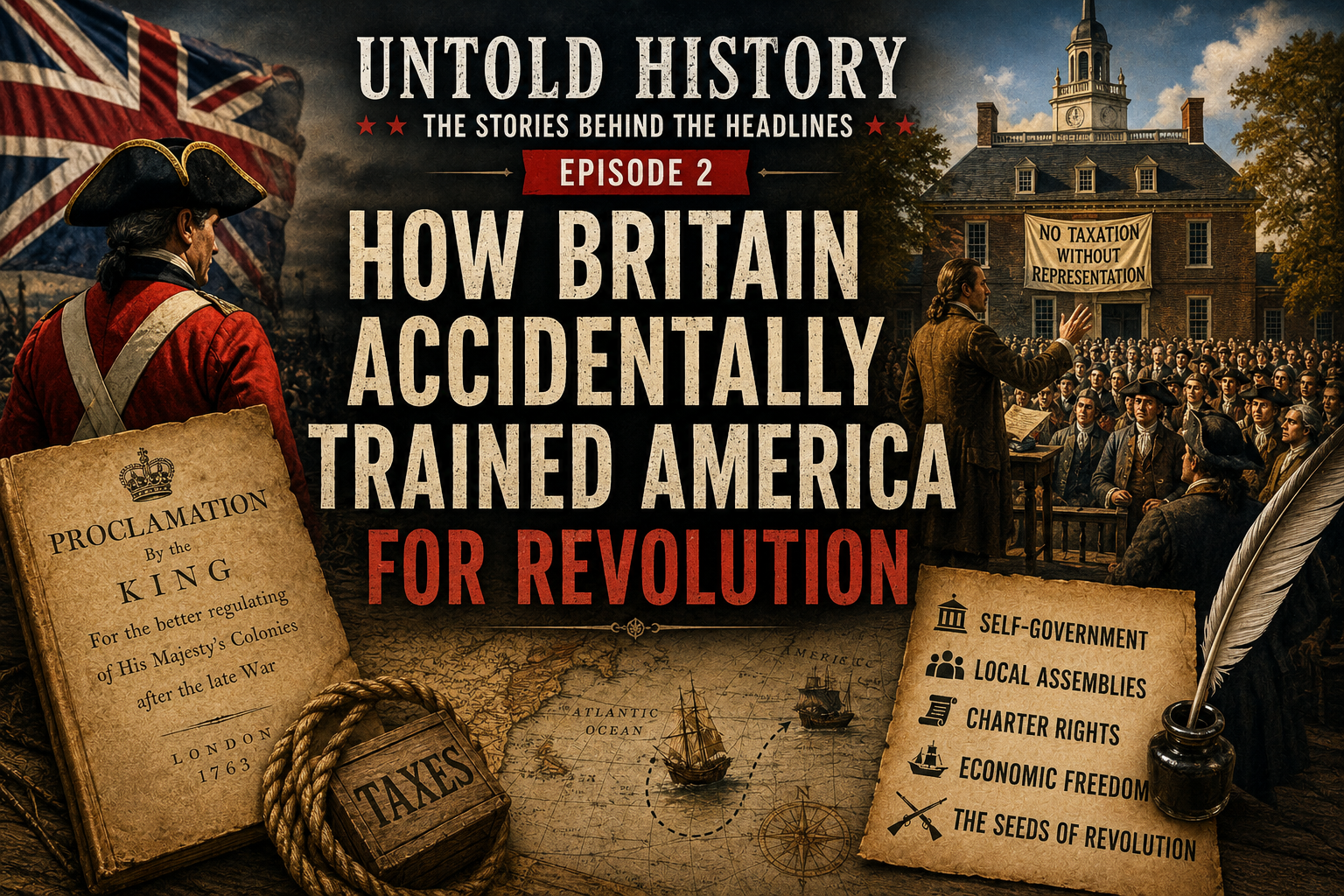
How Britain Accidentally Trained America for Revolution
Opening:
Most Americans learn the Revolution backward.
Date & event:
May 14, 1607 — The English established Jamestown in the Virginia Colony.
What happened:
We’re taught that thirteen angry colonies suddenly discovered liberty sometime around the Boston Tea Party, tossed tea into a harbor, and collectively decided taxation was unbearable unless accompanied by a tasteful parchment document and a committee meeting. History is usually messier than the brochure version.
The truth is, the American colonies spent more than a century quietly practicing self‑government before anyone talked seriously about independence. By the time the Crown tried tightening control after the French and Indian War, the colonists already had functioning assemblies, legal traditions, local political identities, and generations of experience arguing with authority. Britain didn’t create a dependent population. It accidentally built a society that had already learned how to govern itself. Which is one of history’s great ironies.
Empires are very good at creating the conditions for their own headaches. And sitting here in Rio de Janeiro, watching modern governments everywhere struggle with bureaucracy, centralization, and public distrust, it strikes me how little the human story actually changes. Different centuries. Different flags. Same recurring problem: power expands, people adapt, and eventually someone asks exactly who is supposed to be in charge.
2026 Context Update: Global data shows we’re living through a massive structural “trust recession,” with trust in national governments hovering near a historic low of roughly 50%. The tension between distant, heavy‑handed administration and local autonomy isn’t a 1776 relic — it’s the defining political friction of our decade.
The Empire That Accidentally Invented Americans
Before the Revolution, the colonies were not one unified political bloc. They operated under three different systems: Crown colonies, Proprietary colonies, and Charter colonies.
That distinction matters far more than most history classes ever bothered explaining.
These weren’t just administrative categories. They were political laboratories. Some colonies lived under direct royal control. Others were essentially private land grants run by wealthy proprietors. A few functioned with startling levels of independence that looked suspiciously close to self‑rule.
Long before the Constitution existed, Americans were already experimenting with governance.
Britain, meanwhile, was doing what empires always do: trying to maximize trade, maintain order, and collect revenue without spending more money than necessary. The colonies existed to benefit the empire — at least in theory. Reality on the Atlantic coast became something very different. Distance weakens authority. It forces improvisation. It pushes local people to solve local problems because nobody three thousand miles away can respond quickly enough.
That practical reality became the seed of American political identity.
Britain’s Great Administrative Experiment
The three colonial systems evolved less from grand philosophy and more from practical necessity. Some colonies began as business ventures. Others as religious refuges. Others as political favors. England was building an empire on the fly, which is usually how empires operate, despite how organized their history books later pretend they were.
Crown Colonies: Friction Creates Revolution
Crown colonies were directly controlled by the monarchy. Governors were appointed by the King, and theoretically, these colonies lived under tighter imperial supervision. Virginia became a Crown colony in 1624 after the Virginia Company collapsed. Massachusetts lost much of its autonomy when its original charter was revoked, eventually becoming a Crown colony in 1691.
That detail matters.
Because Britain’s attempts to centralize authority often produced the exact resentment it hoped to suppress. Royal governors vetoed local laws. Troops appeared in cities. Tax enforcement increased. Colonial assemblies pushed back. Conflict became routine. Ironically, some of the colonies with the strongest royal presence became the loudest centers of resistance.
Massachusetts didn’t become revolutionary because it lacked government. It became revolutionary because it had spent generations arguing with the government. There’s a difference.
Samuel Adams and the Boston radicals didn’t emerge from political chaos. They emerged from a society deeply experienced in public debate, legal rights, and local governance. Friction created political muscle. And friction has always been one of history’s greatest teachers.
Proprietary Colonies and the Art of Negotiation
Then came the Proprietary colonies — places like Pennsylvania and Maryland — where governance was essentially outsourced.
The Crown granted enormous tracts of land to proprietors who operated almost like corporate managers with aristocratic branding. William Penn is perhaps the most fascinating example.
Pennsylvania developed a culture built around negotiation, compromise, religious tolerance, and practical governance. Proprietors still answered to the Crown, but local assemblies held real influence. Governance became less about command and more about constant bargaining.
Which, frankly, sounds exhausting but also surprisingly modern.
Anyone who has dealt with condo boards, international banking paperwork, or internet service providers in Brazil already understands that civilization largely operates through prolonged negotiation disguised as procedure. These colonies normalized the idea that political authority could be debated rather than simply obeyed. That psychological shift was enormous.
By the mid‑1700s, colonists increasingly viewed government not as something imposed from above but as a contractual relationship with obligations on both sides. Once people begin thinking that way, revolutions become far easier to justify.
Charter Colonies: Democracy Before America
If Crown colonies created resistance and Proprietary colonies encouraged negotiation, Charter colonies quietly built something even more dangerous from Britain’s perspective: habitual self‑rule.
Connecticut and Rhode Island operated with extraordinary autonomy. Colonists elected their own leaders, managed local affairs, and governed themselves with minimal royal interference.
These colonies functioned almost like political corporations. And that corporate ancestry of democracy is one of the strangest underappreciated threads in American history.
Today, large institutions are often viewed as soulless bureaucratic machines with logos designed by committees and customer‑service systems apparently trained to destroy human optimism. But early charters carried a very different meaning. They established rights, structures, and governing rules independent of direct royal management. In many ways, colonial charters became prototypes for later constitutions.
People raised under these systems didn’t see liberty as an abstract Enlightenment theory. They saw it as normal daily life. That distinction changed everything. So when Britain later attempted tighter imperial control, colonists didn’t feel they were demanding new rights. They believed existing rights were being violated.
Drawing heavily from the English Bill of Rights of 1689, colonists framed themselves not as rebels but as defenders of long‑established constitutional principles. From their perspective, independence wasn’t a radical invention — it was a preservation effort.
The Dangerous Freedom of Salutary Neglect
Then came one of the most unintentionally influential policies in imperial history: salutary neglect. Which sounds like a Victorian parenting strategy but was actually Britain’s long‑standing habit of loosely enforcing colonial oversight.
For decades, London allowed colonial assemblies significant freedom because the arrangement was profitable and stable. As long as trade flowed and crises were avoided, the empire tolerated a surprising amount of local autonomy. This worked beautifully. Until it didn’t.
Every year of limited oversight strengthened colonial political confidence. Assemblies controlled taxation. Communities managed defense. Courts developed authority. Newspapers flourished. Merchants built networks. Political identity deepened. The colonies matured politically while Britain was distracted elsewhere.
Then the French and Indian War changed everything. Wars are expensive. Empires always send invoices eventually. After 1763, Britain tried to tighten administrative control, expand tax collection, and enforce imperial authority more aggressively. From London’s perspective, this made perfect sense. From the colonial perspective, it looked like constitutional betrayal.
The problem wasn’t simply taxation. The problem was timing.
Britain tried to centralize power after generations of decentralized practice. By then, colonial political culture had evolved far beyond passive obedience. The empire returned expecting dependency and instead found a population trained in self‑government. That is the central irony of the entire colonial story. Britain built the machinery that ultimately resisted Britain.
The Revolution Was Already Being Practiced
What fascinates me most about this period is how gradual the transformation actually was.
The Revolution didn’t suddenly appear in 1776. It developed slowly through assemblies, charters, town meetings, court disputes, pamphlets, and decades of political argument.
Americans often romanticize revolutions as explosive moments. History usually reveals them as long administrative evolutions interrupted by dramatic events. The colonies had been rehearsing independence long before they declared it. And maybe that’s the broader lesson modern societies keep relearning.
Institutions shape people over time. Systems create habits. Political culture forms quietly beneath the surface until one day everyone acts surprised by outcomes that were developing for generations.
We’re watching a version of this unfold today. Across global finance and digital infrastructure, we’ve seen a massive migration toward decentralized protocols — from on‑chain real‑world asset tokenization to institutional DeFi networks that bypass legacy intermediaries entirely. Just as 18th‑century colonists built parallel legal structures because London was too slow, today’s digital citizens are engineering decentralized execution frameworks because traditional institutions can’t keep up.
- Human beings adapt faster than large institutions expect.
- Empires struggle with that.
- Governments struggle with that.
- Corporations struggle with that.
- And somewhere, probably right now, another system is unintentionally training its own replacement.
Closing Section
The American colonies weren’t waiting for freedom to arrive. They were already living pieces of it. Messy pieces. Incomplete pieces. Contradictory pieces. But real enough that when Britain tried to reclaim tighter control, colonists reacted less like revolutionaries inventing a new world and more like citizens defending one they believed already existed. That’s the part history sometimes misses.
The Revolution wasn’t born overnight from abstract philosophy. It emerged from decades of practical experience: local assemblies, negotiated authority, self‑rule, and the slow realization that distant power rarely understands local reality as well as the people living it. Britain didn’t merely lose colonies. It lost control of a political culture it had accidentally allowed to mature.
History is full of these unintended consequences.
And perhaps that’s why studying the past remains useful even now, thousands of miles from where these arguments first unfolded, watching another century wrestle with power, technology, identity, and governance in entirely new forms. The scenery changes.
Human nature rarely does.
My Reading Reference
The Book: John Adams by David McCullough
- The Reference: Chapter 1: “In Inherited Freedom” and Chapter 2: “Massacre.” McCullough spends the opening chapters illustrating Braintree and Boston not as lawless towns, but as deeply legalistic, highly structured societies centered around town meetings.
The Book: A People’s History of the United States by Howard Zinn
- The Reference: Chapter 4: “Tyranny is Tyranny.” Zinn provides excellent material on the internal friction within the colonies.
The Book: Benjamin Franklin: An American Life by Walter Isaacson
- The Reference: Look at the chapters covering Franklin’s time in the Pennsylvania Assembly and his clashes with the Penn family (the proprietors), specifically around the 1750s and 1760s. ntractual, debatable relationship.
The Book: Alexander Hamilton by Ron Chernow
- The Reference: Chapter 2: “The Hurricane” and Chapter 3: “The Collegian.” Chernow describes the highly commercial nature of the colonies. Hamilton, arriving in New York from the West Indies, immediately recognized that the colonies operated fundamentally on trade infrastructure, contracts, and charter rights.
The Book: Washington: A Life by Ron Chernow
- The Reference: Chapter 6: “The Humiliations of George Washington” through Chapter 9: “The Reluctant Planter.” Chernow provides a brilliant case study of this exact pivot through Washington’s life. Washington fought for the British during the French and Indian War, expecting to be treated on a par with British officers. Instead, he faced imperial condescension.
The Book: 1776 by David McCullough. The Reference: The Introduction / Chapter 1: “Sovereign Remedies.” McCullough opens his masterpiece by shifting the camera to London, where it looks at King George III and Parliament. He details the tragic imperial disconnect—how the British government genuinely believed it was enforcing basic, rightful law and order after a costly war, entirely failing to comprehend that the Atlantic distance had allowed a parallel political culture to mature.


Leave a Reply