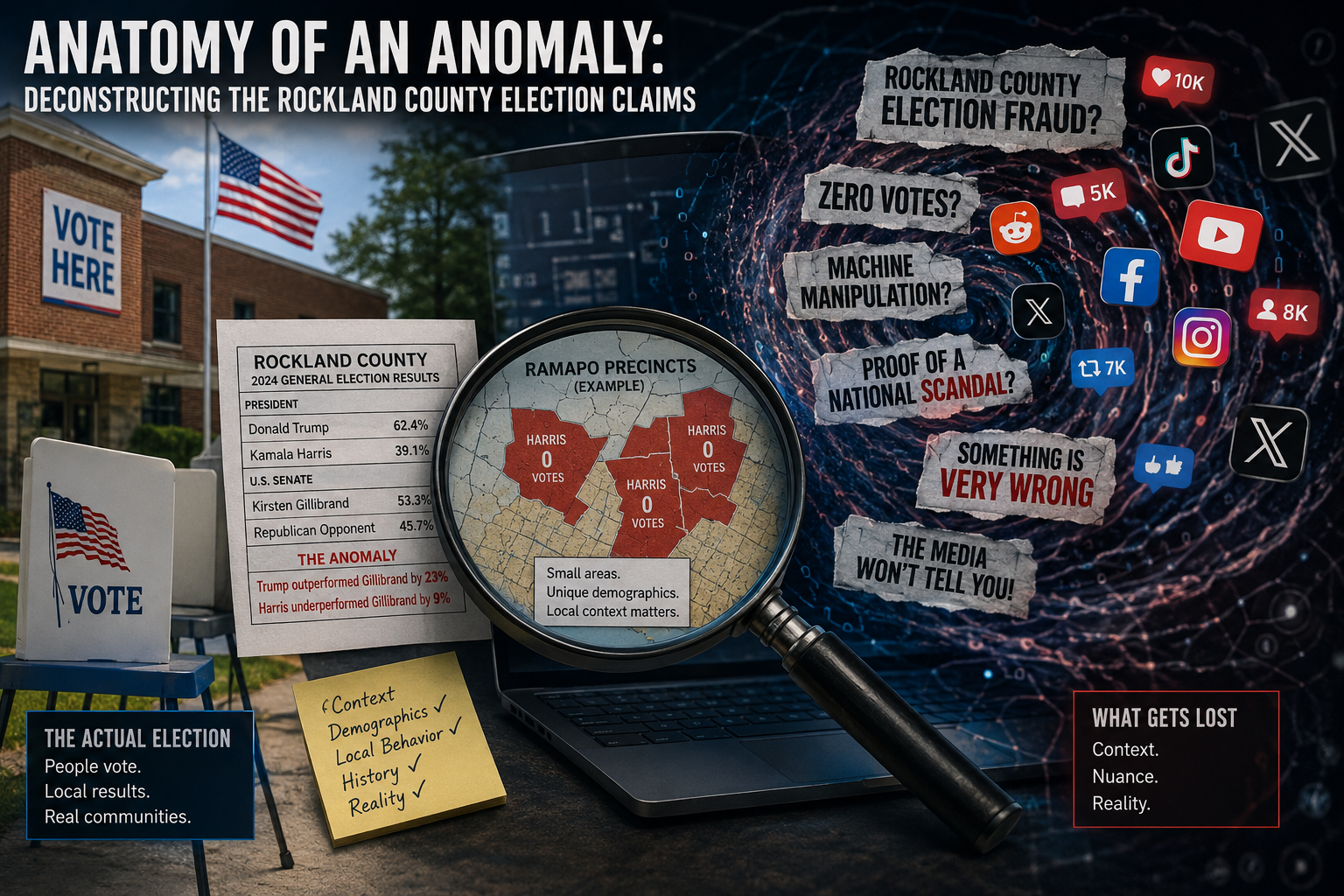
Anatomy of an Anomaly: Deconstructing the Rockland County Election Claims
This is my first post where I take a look at stories, articles, and blurbs from social media; TikTok, Instagram, SubStack, etc, and see if they are true, meaningful, or just clickbait. I try to include the topic, where it came from, and anything I did to prove, disprove, or just call out the silly. This one jumped out at me pretty quickly because of all the noise it gets today during election cycles. I never have a specific topic when I do this, I go by feel and what looks odd or interesting to take a closer look at.
Let’s be real, these days, every big election feels like it happens in two places at once. This multi-platform pipeline is exactly how a “nothingburger” gets cooked. By the time a statistic travels from a complex Substack model to a 30-second TikTok video, all the boring local context (like block voting and incumbency) is entirely stripped away, leaving only pure, uncut outrage.
This article is built to question the Substack story https://thiswillhold.substack.com/p/elon-musks-ex-ashley-st-clair-confirms
- First, the actual election.
- Then the internet election.
The claim: the 2024 election results contain statistical anomalies so extreme that they point toward machine manipulation. This is the problem created today by social media, constant news bites, and the lack of trust in government, institutions, and systems. When the smallest numbers look strange, we jump to conclusions without evaluating the evidence. Numbers don’t lie, but it depends on the story being told.
This situation revealed that one Senate candidate was performing well with solid numbers, while another, the presidential candidate, was not doing as well. That is not very unusual, and it depends on the election cycle and voter behavior. Sometimes, people look to provide a balance between parties. Parties themselves can sometimes be the issue. We can’t rely on a single small area and draw broader conclusions.
So instead of jumping to “conspiracy!” or “case closed!” maybe we just pump the brakes and see what makes sense once we dig in.
The Rockland County election narrative spread quickly. This led right into the themes we see today around election integrity. The data looked odd. People pointed to this as a “see, we knew it” moment, and we immediately went to strange statistics, sometimes called outliers, and jumped to fraud and conspiracy.
The big oddity was that Trump did better than the Senate candidate by 23%, while Harris did worse than the Senate candidate, Senator Kirsten Gillibrand, by around 9%. We typically think people vote straight-ticket Republican to Republican and Democrat to Democrat, but the numbers don’t always reflect this. It’s also possible that polls are wrong, and people don’t like to reveal their preferences. The sample is small, never ideal for broad analysis, and we often don’t consider last-minute voter changes or independent voting behavior. Going from “strange” to “fraud,” “failed machines,” or “manipulation” is a very large leap.
The story never considers that the Senate candidate has been around for over a decade, while Harris entered the presidential race very late. It is well known that many voters did not know her well enough; she became the nominee after Biden stepped aside late in the cycle, which created a trust hurdle to overcome with little time. That does not mean the machines failed or were fraudulent. Sometimes numbers simply don’t fall the way people expect.
The Four Votes That Became a National Narrative
Diane Sare claims she has sworn affidavits from 9 people who voted one way, but only 5 were reflected in the initial tally, which was real. It is still a stretch to go from a few missing votes to large-scale fraud. If we examine millions of votes in a massive national election, isolated errors can occur. Nothing is perfect, but that should not automatically lead to claims of manipulation. The story uses this as proof of something much larger, driving media attention and clicks. Humans make mistakes, machines jam, and administrative issues happen. Expecting absolute perfection in a system involving millions of ballots is unrealistic. Nothing publicly presented suggests the election was outside accepted tolerance or audit standards.
When Local Voting Patterns Look Like Anomalies
These Ramapo precincts are neighborhoods where Harris received zero votes, but we don’t know how large the areas were or how many people voted overall. This reminds me of my home state, New Hampshire, and places like Dixville Notch. They vote first in the country, and the results are reported first. I have seen stories where all votes went to candidate “X” — yes, all three or four votes in tiny communities. Something similar may be happening here, but the story often omits important context on the area’s size and demographics. That becomes sensationalism.
It is shown that some Ramapo districts are heavily Hasidic Jewish communities, and Republicans often perform very strongly in some Orthodox and Hasidic Jewish communities to the point that the numbers can look unusual from the outside. Americans vote as individuals and communities, not as mathematical blocks, and that can create statistical patterns that appear strange without indicating corruption or fraud. Jumping directly from unusual voting behavior to “machines were hacked” is a major leap.
We may not like what we see, but that is life. We don’t have to agree with it or like it, but that does not mean it is wrong. Based on the area and demographics, some of these outcomes make more sense than social media posts suggest, but that context is rarely included because it does not generate the same level of engagement. No credible evidence has demonstrated that voting machines were compromised, but that does not fit the internet speculation and outrage cycles.
The Limits of Statistical Models in Election Analysis
Another argument in the story focused on poor website maintenance and cybersecurity concerns involving the ProV testing lab. The argument suggests that because the company’s website looked outdated or poorly maintained, election systems themselves could not be trusted. This is a private company involved in certification testing. A weak public-facing website does not automatically mean that certified election infrastructure was compromised. Public marketing websites are not the same thing as federally and state-regulated election testing procedures. That is a major leap in logic — like saying the grass is too long in the yard, therefore the structure of the house is collapsing.
The article also compared 2024 to 2020 using statistical models, but never seriously considered:
- different political climates
- different candidate matchups
- different voter motivations
- different down-ballot dynamics
- entirely different race conditions
- changing turnout behavior
- late-cycle candidate replacement
Models are just models. They attempt to make predictions using the information provided, but they are only as useful as the assumptions built into them. Applying 2020 behavior directly to a 2024 model without accounting for major political and social changes yields only rough probability estimates, not proof of fraud or manipulation.
What These Claims Reveal About Online Election Narratives
When everything is examined together, the underlying data itself was not necessarily false. Some of the statistics and voting patterns were real. The issue is the narrative built around the data while excluding the broader context. Only selected information was presented to push a conclusion about hidden manipulation. Once full context disappears, myths begin to grow and social media engagement accelerates. People then latch onto isolated pieces and say, “See? This proves everything.”
Inference stacked on top of inference stacked on top of assumption.
People are not perfect, systems are not perfect, but fraud detection methods and auditing systems are built into modern elections. Recounts and audits were conducted in multiple jurisdictions across the country. Just because people dislike the result does not automatically mean fraud or conspiracy occurred; sometimes it simply means the outcome was unpopular with one side. Human behavior does not always align with statistical expectations or polling models. Polls fail, assumptions fail, and outliers exist for a reason.
The core takeaway is that the story is a classic example of social media optimization and “engagement hacking” — leveraging real, localized anomalies to aggressively drive clicks, outrage, and political fundraising.
The Verdict
1. What is Fact? (The Data)
The initial puzzle pieces are mostly real. It is a fact that:
- Kamala Harris underperformed Senator Kirsten Gillibrand in parts of Rockland County.
- There were specific precincts in Ramapo where Harris received zero or single-digit votes while Gillibrand received hundreds.
- A small handful of voters signed affidavits stating their votes for a third-party candidate were not reflected in initial precinct tallies.
2. What is Fiction? (The Conclusion)
The broader election-hacking narrative built on top of those facts is unsupported by verified evidence.
- Fiction: The “zero-vote” precincts prove a software glitch or hack.
- Fact: The results are also explainable through local voting sociology and organized bloc voting patterns within parts of the Hasidic community.
- Fiction: A poorly maintained website for a testing lab proves voting machines were compromised by malware.
- Fact: Public-facing marketing websites have no demonstrated connection to certified election-system security or tabulation infrastructure.
Is it Social Media Manipulation for Clicks?
Yes — in many ways, this case became a textbook example of how online outrage narratives are amplified. The viral narrative relied heavily on several familiar internet-era tactics:
- The “Red String” Strategy: By mixing unrelated events — a small clerical discrepancy involving a few votes, unusual but explainable local voting patterns, and concerns about a certification company website — online creators assembled a much larger conspiracy narrative that appeared more connected and authoritative than the evidence supported.
- Jargon as “Security Theater”: Terms like p-values, malware vectors, negative drop-off rates, and cybersecurity language were used in ways that sounded highly technical and intimidating to average readers. That can short-circuit critical thinking because people assume complexity automatically equals credibility, even when the underlying assumptions are incomplete.
- Exploiting the Outrage Economy: Outrage spreads faster than caution. By framing explainable local anomalies as evidence of a “stolen election” or “hidden hack,” online personalities, alternative media outlets, and political influencers generated massive engagement, social-media traffic, donations, subscriptions, and attention.
The Ultimate Conclusion
The story ultimately became far larger online than the verified evidence supported. The numbers themselves tell an interesting story about a highly unique local voting environment and ticket-splitting behavior. However, much of the internet narrative stripped away the local context in order to build a darker, more dramatic story about election hacking and machine manipulation.
In many ways, the Rockland County story says less about election fraud and more about modern human behavior online.
- A real anomaly appears.
- Social media isolates it.
- Algorithms amplify it.
- Context disappears.
- Speculation becomes certainty.
And once that cycle begins, a dramatic narrative will almost always outperform a boring institutional explanation.
Sources and References
Based on the sources referenced throughout this discussion, the following materials were repeatedly cited in connection with the broader election narrative:
Fact-Checking Articles
- AFP Fact Check — claims involving Starlink and election-rigging accusations
- AP News — election officials responding to Starlink conspiracy claims
- PolitiFact — analysis of claims involving Starlink and voting systems
- FactCheck.org — discussions regarding voting-machine claims and election-system allegations
Rockland County Lawsuit & Advocacy
- SMART Elections
- SMART Elections Substack — referenced frequently in discussions surrounding drop-off analysis and voting-system concerns
- The Economic Times — reporting on the Rockland County lawsuit and allegations regarding vote discrepancies
Academic & Technical References
- Election Integrity in Georgia (2020):
https://doi.org/10.48550/arXiv.2408.00055 - Political Fact-Checking Limitations:
https://doi.org/10.48550/arXiv.2412.13280
These sources were commonly referenced in online discussions involving election-system security, statistical voter analysis, and social-media amplification of election narratives.
Where the Narrative Spread Online
Yes, the Rockland County election story clearly spread across multiple social media platforms and alternative media ecosystems. The available evidence suggests the narrative circulated heavily through:
What emerged was less a single coordinated campaign and more a modern social-media amplification cycle:
- A real lawsuit and real anomalies existed.
- Selective statistics spread online.
- Emotional framing amplified engagement.
- Context was gradually stripped away.
- Speculation expanded faster than verified evidence.
That does not necessarily mean everyone sharing the story acted maliciously.
But it does demonstrate how modern online political narratives evolve:
- Localized disputes become national movements
- anomalies become “proof.”
- uncertainty becomes certainty
- Algorithms reward the most emotionally dramatic interpretation available
Especially on highly reactive platforms, emotionally charged election content often spreads far faster than cautious procedural analysis.
Disclaimer
Many viral videos, screenshots, social-media clips, livestreams, and online claims related to this story may later be deleted, edited, manipulated, miscaptioned, or ultimately proven false. However, the speed and scale at which they spread still provide valuable insight into modern internet culture, political distrust, algorithmic amplification, and the evolving way people emotionally process information online.
Thanks for reading BeingKevin.
In a world built on scrolling past everything in seconds, I genuinely appreciate you stopping here for a moment. If the post gave you something to think about, made you laugh, or even made you disagree, I’d love to hear from you in the comments. A quick rating helps, too, and goes a long way toward supporting the site. And if you’d like to help keep BeingKevin going, a small tip is always appreciated — never expected, but deeply valued. Thanks again for being here
Leave a Reply