
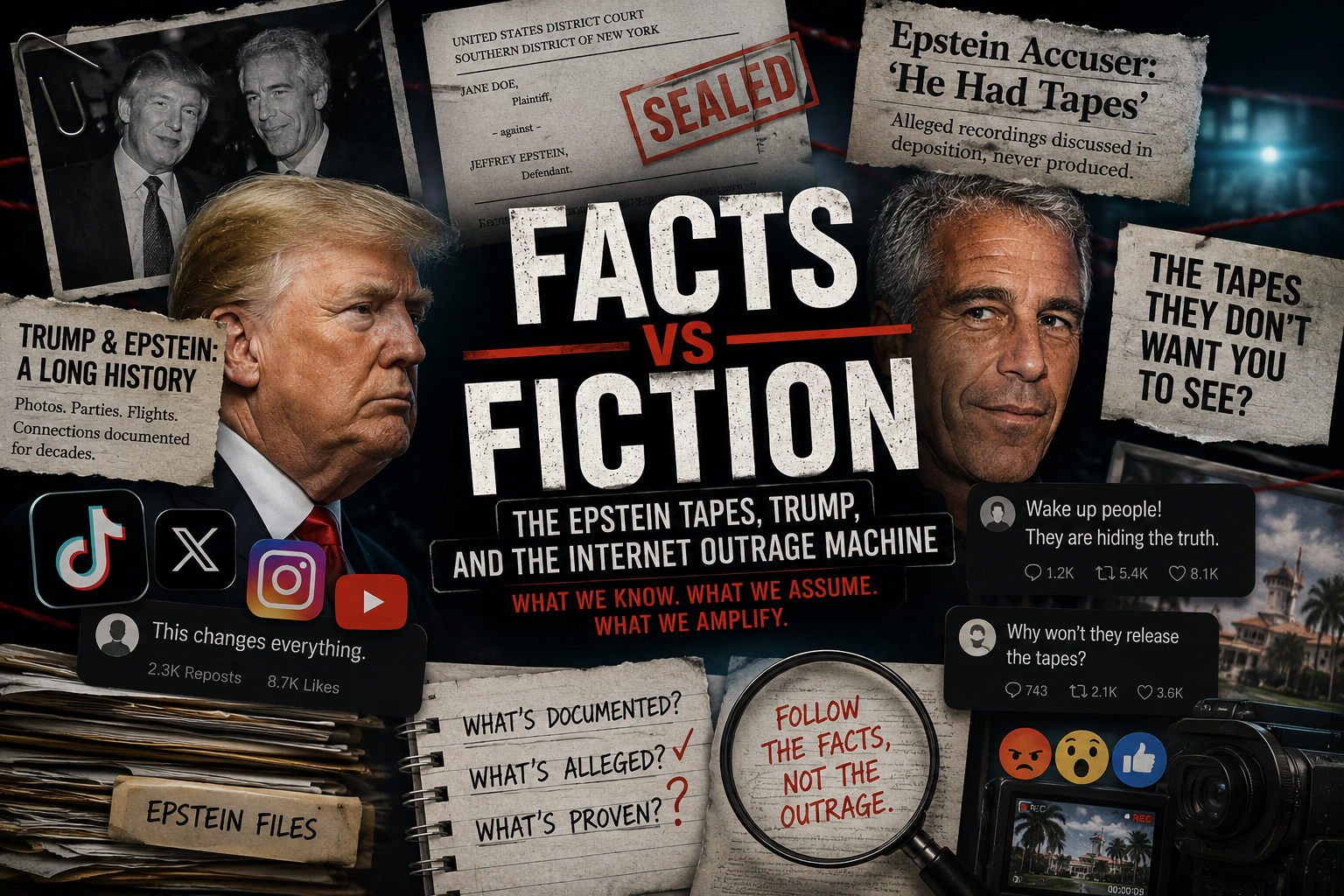
The internet tends to collapse multiple separate things into one giant narrative. This piece is based on this SubStack Post –Dr. Mike Foster MD/MS
For this piece, I took the same approach as last week’s piece. The goal is to dig into social media posts and determine what is accurate and what is clickbait. https://beingkevin.com/?p=5517
For next week, I have a very cool factual post I’ve started building. It is about a bird, the McCaw.
My Position
I want to be clear about my personal opinion and why I hold it, given the current news cycle surrounding this topic.
Personally, I think there is enough smoke around the Epstein story, Trump’s relationship with Epstein, and the ongoing lack of transparency to make people suspicious. I also think people in power, politically and institutionally, often protect themselves and one another before protecting the public trust.
That said, suspicion is not proof.
I do not have direct evidence proving that Donald Trump committed crimes related to Epstein. What I have is an opinion shaped by public behavior, documented social connections, years of reporting, and the fact that so much information surrounding this case still feels incomplete, delayed, or heavily controlled.
To me, honest people usually benefit from transparency. When information stays hidden, gets partially released, or becomes wrapped in political messaging, people naturally start filling in the blanks themselves. Social media only makes that worse. And honestly, that may be the biggest problem in all of this.
The internet takes real facts, real photos, real relationships, real court documents, and real allegations, then mixes them together with rumors, speculation, politics, clickbait, and outrage until nobody can tell where the facts stop and the assumptions begin. That is how stories like this become internet mythology. The goal of this piece is not to claim I know the truth. I don’t.
The goal is to separate what we know, what has been alleged, what has actually been proven, and how modern internet culture profits from blurring those lines. Because somewhere in the middle is usually where the truth actually lives.
Reason
I do this stuff for a few reasons. The internet can actually be useful. There are blogs, Substacks, TikToks, Instagram accounts, podcasts, YouTube channels, and independent writers doing real work, sharing useful information, and genuinely trying to be informative and helpful.
Then there’s the other side of the internet. The clickbait. The outrage economy. People take a small piece of truth, add assumptions, politics, and drama, and then present it like a settled fact just to get clicks, subscribers, attention, or money.
Now that I have the time, I enjoy sorting through what seems credible and what seems like complete nonsense. It’s interesting and entertaining, and honestly, it’s turned into a learning experience for me. I try to stay objective and think critically. I always come back to the same basic point: What we know and what we can prove are two completely different things.
I also live by another simple idea: if you did nothing wrong, then show what you’ve got and put it to bed. Same thing when somebody pleads the Fifth. Legally, people absolutely have that right, and that protection exists for a reason. But in the real world, most regular people hear that and think:
“Well, that sure doesn’t look great.”
That’s just reality, and honestly, the same thing applies here.
Trump himself has mentioned multiple times over the years that he would consider releasing Epstein-related files or information. At this point, dump the files into an AI system, redact victim names, release what is legally permissible, and let people see them. That part is not exactly rocket science anymore.
But the bigger issue is social media itself. Stories like this take some truth, some assumptions, some rumors, political bias, and a bunch of outright nonsense, mix it all together, and suddenly speculation starts getting treated like proven fact. That is how “fake news” became part of everyday life. And that leads us to this entire internet circus.
The Five W’s of This Entire Internet Circus
1. Who?
First things first. Yes, Donald Trump and Jeffrey Epstein absolutely knew each other.
That is no longer conspiracy territory. There are photographs, videos, interviews, party appearances, flight records, and years of reporting showing they moved in overlapping wealthy social circles during the 1990s and early 2000s. That part is established reality.
But there’s another “who” involved here, too: the people spreading the claims. One example I looked into was a guy online presenting himself as “Dr. Mike Foster, MD/MS.” That was my first red flag. The “MD/MS” sounds impressive, but what exactly is the master’s degree in?
So I started digging using Google and AI tools, checking credentials, affiliations, publications, and professional records. What I mostly found were personal blogs, political commentary, and Substack-style opinion writing. That’s not exactly the background you expect from someone making giant claims about criminal conspiracies and hidden evidence. That immediately lowered my confidence level.
2. What?
The giant viral claim floating around online is that there are supposedly secret tapes proving criminal behavior involving Trump and Epstein, and that powerful people are hiding them from the public. This was really the core claim behind the image and caption I originally looked into.
A lot of these “tape” stories trace back to Sarah Ransome, an Epstein accuser who years ago claimed Epstein possessed sex tapes involving powerful men. Her allegations ended up in court materials and media reporting, which is why the story keeps resurfacing online.
But one important detail tends to disappear once social media gets involved:
No tapes were publicly produced. Even more important, parts of her claims were later disputed or walked back. Now, does that automatically mean she lied about everything? No.
But it absolutely means people online acting like these tapes are sitting in a vault labeled “TRUMP CRIMES” are getting far ahead of the actual evidence.
Then there’s author Michael Wolff. Wolff says he recorded hours of conversations with Epstein before Epstein died. Some recordings have surfaced publicly where Epstein talks about Trump, wealthy social circles, gossip, allegations, and relationships.
But here’s the distinction people online often ignore:
A dead billionaire criminal talking on tape is not the same thing as verified evidence. Epstein also lied constantly. That’s what predators do.
The internet has now taken witness allegations, partial recordings, court rumors, FBI intake tips, social media speculation, and political outrage, and blended it all together into one giant narrative called:
“THEY HAVE THE TAPES.”
Meanwhile, nobody can actually produce authenticated criminal recordings proving the giant viral claims people repeat online, as if they were already settled facts. That matters.
3. Where?
Most of what I found circulated on Substack, TikTok, Instagram, X, YouTube, Reddit, Facebook, Truth Social, podcasts, political blogs, livestreams, reels, repost chains, reaction channels, and conspiracy-style commentary ecosystems.
Substack was a major source for long-form political commentary and repost chains. TikTok and Instagram pushed short emotional clips, screenshots, reels, AI narration, and dramatic edits. X amplified viral threads, clipped interviews, speculation, and hashtags. YouTube was full of podcasts, reaction videos, livestream discussions, and commentary channels presenting theories as conclusions. Reddit mixed skepticism, debate, crowd-sourced timelines, speculation, and conspiracy discussions. Facebook and Truth Social amplified political outrage and reposted claims inside ideological communities.
The specific piece I looked at was posted on Substack and had already been restacked and shared across multiple platforms, where people repeated it as fact long before much of anything had been verified. Honestly, this is how internet narratives get built now.
One dramatic claim.
One small piece of truth.
A pile of assumptions layered on top.
Then repetition slowly turns speculation into “fact.”
4. When?
The specific Substack piece I reviewed was posted on May 22, 2026.
But the broader Epstein-Trump discussion has existed for years because the social connection itself is real and documented.
The newest wave of viral claims exploded again after several interviews and public comments where Trump discussed potentially releasing Epstein-related files.
In a June 2024 Fox News interview, Trump said, “I guess I would,” when asked about releasing Epstein-related material, though he also warned about “phony stuff” harming innocent people. That clip later spread widely online, often without the full context.
During an interview with Lex Fridman, Trump also suggested Epstein-related records “probably will be” released and said he would “take a look.”
Later, Trump publicly stated he would support legislation releasing Epstein files if Congress passed it, saying things like “I’m all for it” and “Sure, I would.”
CNN Brasil also reported Trump saying, “We’d like to release everything,” while again cautioning about harming innocent people through association.
At the same time, social media kept recycling old allegations, partial documents, old recordings, edited clips, and sensational headlines every few months as if they were brand-new discoveries.
That’s another internet trick:
repackage old information with fresh outrage.
5. Why?
This part honestly feels pretty obvious.
Attention.
Clicks.
Subscribers.
Engagement.
Political outrage.
Money.
That does not automatically make every claim false, but it absolutely creates incentives to exaggerate certainty, remove nuance, and present speculation like proven fact.
Because outrage spreads faster online than caution ever will. The internet figured out a long time ago that fear spreads, anger spreads, certainty spreads, and conspiracy spreads even faster.
“Maybe” does not go viral.
6. How?
People online take something real and provable, then mix it with assumptions, rumors, politics, emotional reactions, edited clips, screenshots, selective reporting, and outright nonsense until it becomes difficult to separate fact from fiction.
That’s what’s happening here. The uncomfortable middle is probably where reality actually lives:
Epstein absolutely had elite connections.
Trump absolutely knew Epstein.
Some accusers discussed recordings.
The FBI received allegations.
Trump publicly discussed releasing files.
Powerful people protect themselves.
And Epstein may very well have collected compromising information on influential people.
But there is still no publicly authenticated evidence to support the giant viral claims people keep repeating online, as if they were already settled facts.
Right now, we are still dealing with allegations, rumors, partial documents, social connections, witness statements, speculation, edited media, internet amplification, and political narratives. That’s where we are.
But there is still a massive difference between:
“There may be hidden information.”
and
“This specific internet theory has been proven.”
Those are not the same thing. We can’t know until they are released. The question really is why not, and when, since the courts have cleared the way. That to me is guilt.
So when somebody online sounds completely certain about all of this while also asking you to subscribe, repost, panic, rage, or “wake up,” it’s probably smart to keep one hand on your wallet and the other on your common sense.
Because the internet figured out something terrifying a long time ago:
Outrage pays better than accuracy.
News References and Reporting Mentioned
Reporting About Trump Discussing Epstein File Releases
- Forbes coverage of Trump’s Fox interview comments discussing the release of Epstein-related files.
- Semafor is reporting on edited Fox interview clips and missing context.
- New York Post coverage of the Lex Fridman interview discussing possible file releases.
- CNN is reporting on scrutiny surrounding edited Trump interview clips.
- ABC News is reporting on Trump supporting legislation to release Epstein-related files.
- Axios reporting on Trump saying he would sign release legislation.
- CNN Brasil interview coverage where Trump reportedly said, “We’d like to release everything.”
Reporting That Complicates or Disputes Viral Claims
- New York Magazine reporting noting Trump appears in social and flight-related records, but stating there is no definitive public evidence tying him to Epstein’s trafficking crimes.
- Washington Post reporting reviewing conflicting public statements about Epstein evidence and alleged “client lists.”
- The Guardian is reporting on how Epstein material becomes sensationalized and politically weaponized online.
Examples of Social Media Amplification
- Reddit conspiracy discussions interpret edited interviews as proof of guilt.
- Reddit political discussions are debating whether Trump actually intended to release files.
- YouTube commentary channels presenting speculation as certainty.
- TikTok clips use dramatic narration and edited interview footage.
- Instagram reels and screenshot posts are spreading viral claims.
- X threads amplifying hashtags, clipped interviews, and political speculation.
- Substack repost chains are spreading long-form political commentary and theories.
Closing
I believe the specific article or, in this case, the picture and caption circulating, is misleading and poorly presented. It takes fragments of real information, removes context, adds certainty where none exists, and presents speculation as an established fact.
To me, that damages trust in media overall and feeds the perception of “fake news,” even when legitimate reporting and factual coverage do exist. When people constantly see exaggerated claims, emotional manipulation, selective information, and clickbait presented as truth, it becomes harder for the average person to separate serious journalism from internet outrage.
What makes it worse is that even when commenters question the claims, dispute the conclusions, or ask for evidence, there is often no meaningful response, clarification, or rebuttal presented. The post still gets liked, shared, restacked, reposted, and amplified anyway.
That is part of what makes large parts of social media a cesspool of noise, speculation, and low-effort outrage, where attention matters more than accuracy.
And over time, that does real damage. It weakens trust in institutions, weakens trust in journalism, weakens trust in facts themselves, and creates an environment where people stop asking:
“Is this true?”
and start asking:
“Does this confirm what I already believe?”
Thanks for reading BeingKevin.
In a world built on scrolling past everything in seconds, I genuinely appreciate you stopping here for a moment. If the post gave you something to think about, made you laugh, or even made you disagree, I’d love to hear from you in the comments. A quick rating helps, too, and goes a long way toward supporting the site. And if you’d like to help keep BeingKevin going, a small tip is always appreciated — never expected, but deeply valued. Thanks again for being here
Leave a Reply