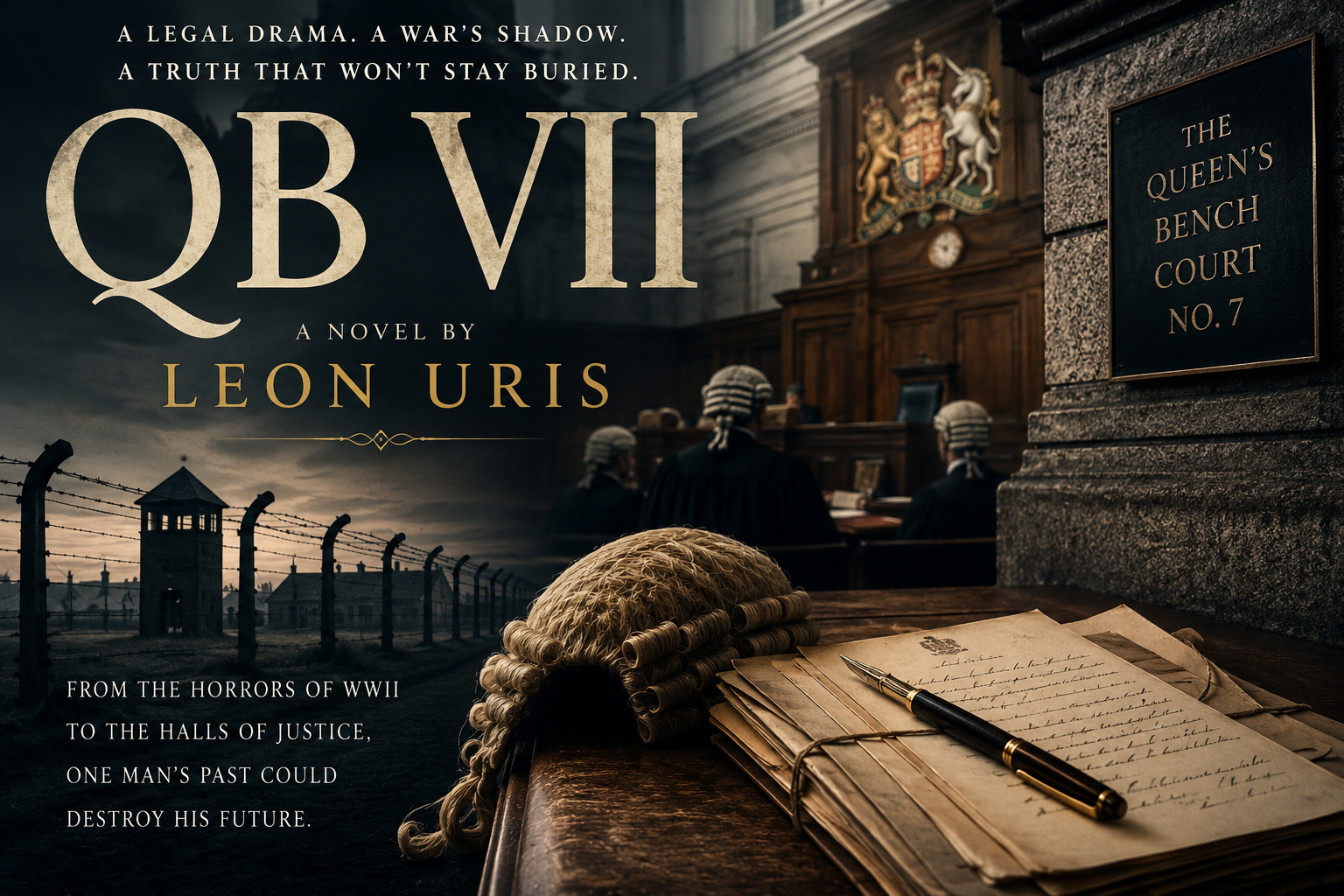
By Leon Uris
★★★★★ 5/5
I first read QB VII years ago, probably around 1987. My mother gave it to me for Christmas. She usually gave me a book or two every year, which is probably one of the reasons I enjoy reading so much today. I remembered how good the novel was, but many of the details had faded over time, so I recently repurchased it in electronic format since I no longer have the original copy.
Without giving too much away, QB VII is a legal drama that stretches from the horrors of World War II concentration camps into the mid-1960s. Despite that backdrop, it is not really a war crimes story. Instead, it is a deeply layered drama built around reputation, truth, memory, and justice. Leon Uris tells the story in a way that constantly keeps you guessing where it may lead. Just when you think you understand the direction, the narrative shifts again, leaving you uncertain of the eventual outcome.
What I found especially interesting was how Uris built what feels like a story within a story. He develops one major character and what seems like a complete arc before moving into the life of another. Over time, the paths of both characters — along with their families and histories — slowly intertwine. The structure works remarkably well and gives the novel a broad, almost epic feel.
One detail I particularly enjoyed was the inclusion of letters between characters. These passages gave the novel the feeling of genuine correspondence and added realism to the relationships and emotions within the story.
Uris also had a subtle way of dropping small comments or revelations about certain characters that suddenly made you rethink your entire perception of them. That technique gave the novel a strong psychological edge beneath the legal drama.
The title QB VII refers to “Queen’s Bench Courtroom Number Seven,” part of the British judicial system. Alongside the story itself, Uris does an excellent job explaining how the English court system works, from the procedures to the atmosphere of the buildings and courtrooms. His descriptions are vivid enough that you can almost visualize the setting as you read.
Once the characters and backstories are fully established, the real heart of the legal drama unfolds. For me, this became the most compelling part of the book. The courtroom exchanges and questioning between the lawyers constantly challenge your assumptions and leave you wondering how everything will ultimately resolve.
For me, any truly good novel needs three things: a strong opening hook, a compelling middle that keeps you turning pages, and an ending you do not fully expect. QB VII delivers on all three.
This is also another example of the kind of historical fiction I enjoy, similar in some ways to the work of Ken Follett. Leon Uris wrote many acclaimed novels, and after revisiting this one, I will certainly pick up another of his books. Next on my list is Exodus, first published in 1958.
If you enjoy well-written historical fiction, strong characters, and courtroom drama with psychological depth, I highly recommend QB VII. At roughly 450 pages, it moves surprisingly quickly. I finished it in about a week, and it was worth every page.
You can also read more about Leon Uris and his body of work.
Reception When the Book Was Released
When QB VII was published in 1970, it became a major bestseller and was widely praised for its courtroom tension, historical depth, and emotional complexity. Critics at the time noted how effectively Leon Uris blended historical fiction with legal drama, creating a novel that felt both personal and sweeping in scale.
The book was later adapted into a successful 1974 television miniseries starring Anthony Hopkins and Ben Gazzara, which further cemented its reputation as one of Uris’s most memorable works.


Leave a Reply