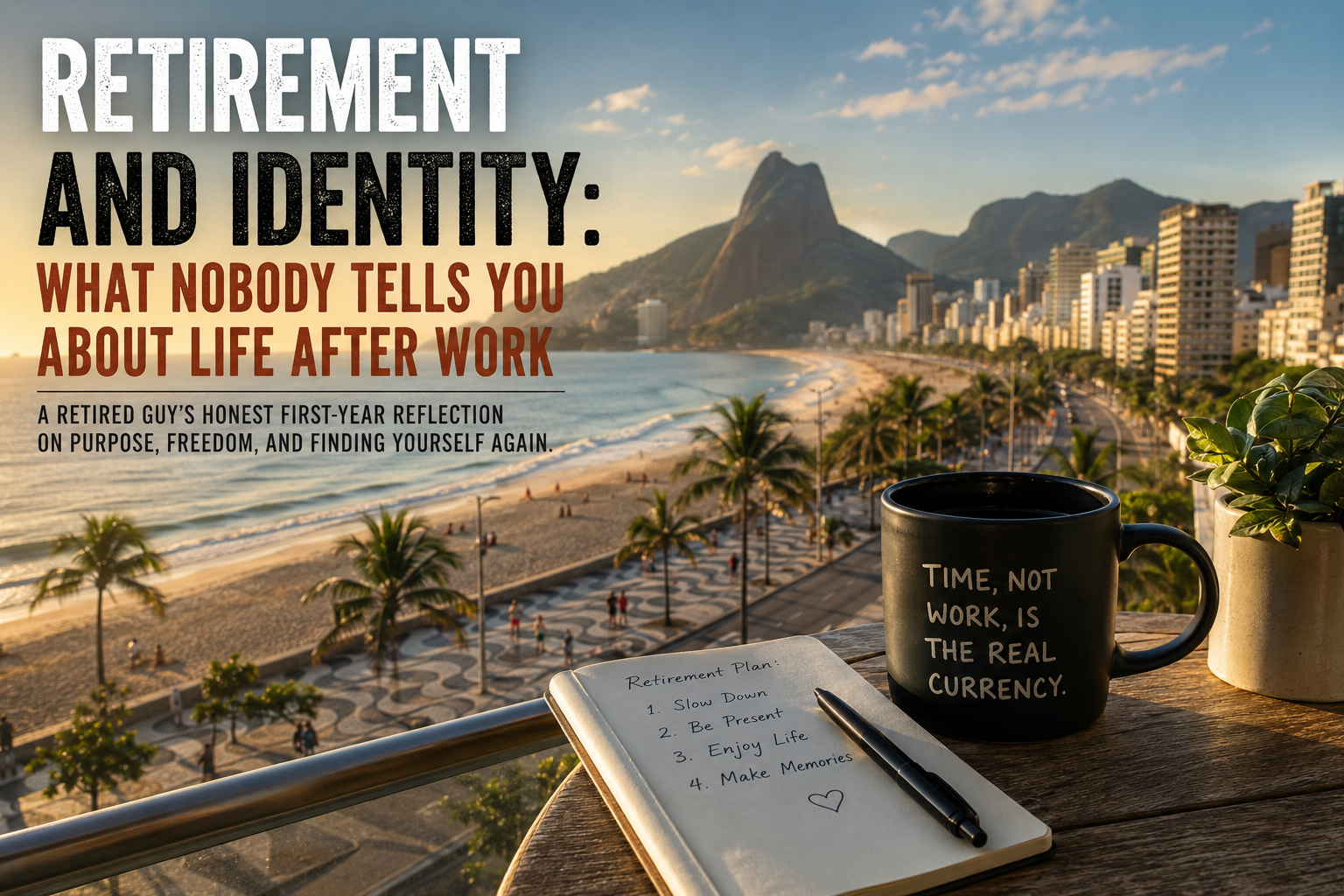
This week marks my first full year of retirement, and here is what I discovered.
Retirement, Identity, and the Quiet After Work
Core Thesis
Here is what I keep seeing:
Since retiring, I have noticed a steady stream of articles about retirement and what people supposedly experience after leaving the workforce. The theme is usually stated something like this:
Many people spend so much of adulthood being useful, productive, and responsible that they never develop a sense of self separate from work. Retirement exposes that gap.
Most of these articles talk about retirement as more than just a financial shift. They say it is a big mental shift.
I read a bunch of these retirement articles that kept popping up in my news feed. Most of them say the same thing, just in different words.
This week is my first full year retired. I thought I would share what it is really like, from someone actually living it.
Retirement is always going to be different for everyone. Some people never want to retire at all.
The statement in the core thesis is not entirely wrong, and for some people, I am sure it is very true. However, for me, this part simply describes adulthood and responsibility:
“Many people spend so much of adulthood being useful, productive, and responsible.”
That part I understand completely.
This part never entirely fit me:
“They never develop a sense of self separate from work.”
I did what was asked, even when that meant after-hours calls, weekends, or long stretches of responsibility. That was the job. But when the workday ended, and now forever, I still had things outside work that I enjoyed. Looking back, maybe that is the trick the articles are getting at.
I had the typical concerns, mainly about losing a paycheck and having to watch my budget more tightly. I was not concerned about boredom, as I am more introverted and enjoy reading, writing, and observing people. I did not even really consider losing relevance. I was not scared to retire. After 40+ years of work, I actually looked forward to the opportunity.
When you are young, work feels like a way to get ahead. You chase promotions and raises, thinking you have all the time in the world. Then retirement comes, and you realize you have more freedom but less time. It is a strange feeling.
Your priorities change. Getting ahead at work stops mattering as much as having time. The things you put off for later become things you either do now or never do.
What Retirement Actually Looks Like
So what is retirement actually like for me?
I am not traveling the world. I wish I could, but financially, it is not really realistic, even with some of you sending a few bucks through the “support the craft” tips.
I relocated from the States to Rio de Janeiro, and affordability was honestly part of the reason. But retirement also gave me the freedom to experience something completely different. I now live in a walkable city where I am learning a new culture, new routines, different food, and a different pace of life.
My mornings usually start with coffee on the balcony while the city slowly wakes up. Sometimes I walk along the beach. Sometimes I head to the coffee shop with my computer. Sometimes I eat lunch at an outdoor café or wander down to the mall just to watch people move through their day.
I have a regular barber shop now, where we somehow communicate through my terrible Portuguese, translation apps, and their equally questionable English. None of us fully understands each other, but somehow it still works and is always fun.
Life is honestly pretty good.
If the question is whether I am getting to do what I want and whether I enjoy retirement, the answer is yes. So far, I genuinely love being retired.
Living in Rio changed my routine. Life here is slower than in the States. I spend more time trying to fit in and learn, and that keeps me on my toes, even when I mess up the language.
People here do not rush as much. They seem to know that enjoying life and connecting with others matter just as much as getting things done.
Retirement does not feel like stopping. It feels more like starting over in a new place, even in your own head. You become a beginner again. You slow down and notice things you missed before.
What I Still Miss
But there is another side to it that I do miss.
When you spend four decades working, including the last seventeen years at the same place, people stop being just coworkers. Some of them become part of your life. I miss the conversations, solving problems together, the ridiculous situations, the shared pizza amid the chaos, and, oddly enough, the chaos itself.
I loved the work and the people I did it with.
A lot of retirement articles say you lose yourself when you stop working, as if your whole identity was your job. That was only partly true for me.
The job mattered deeply, but it was never the entirety of who I was.
It was what I did.
It was not all that I was.
Honestly, what most people miss is not the work itself. It is the people, the routine, and having a shared purpose.
An introvert is calm in the absence of people and activity. I do not need constant noise, activity, or social interaction to feel fulfilled. Loneliness is a lack of direction and not knowing what to do with yourself. I am not lonely. I always have something to do and enjoy each day. Solitude, for me, is about relaxing and enjoying the moment and the surroundings.
I remember when retirement actually hit me. I remember clearly walking out the door on my final day, saying goodbye to the guard at the entrance almost casually, as if nothing was really changing. Then I stepped outside, turned around, looked back at the building, and realized everything had changed.
For the first time in over forty years, nobody inside that building needed me tomorrow morning.
That feeling stayed with me longer than I expected.
The Job Never Completely Leaves You
The other thing I realized is that the job does not completely leave you.
In many ways, this blog has become my little retirement version of work. I do it because it is fun, but it also gives me structure. I write about my days, experiences, observations, satire, gripes, and the random funny things I notice now that I finally have time to notice them. My marketing goal is subscribers, not change management.
Now I read books and have time to share what I think about them. I plan what to write, schedule posts, and check what people like to read. I am still routine-driven and try to keep my posts on the same days every week, as if someone might notice if I mix it up.
So does the job mentality ever fully leave you?
Probably not.
But that does not mean it defines you.
The difference in structure is my choice. I get to decide what to do with my time, but I still need a sense of purpose. The difference now is that I mix the structure I learned from work with a purpose I control myself.
Maybe that is what people really want in retirement. Not to have no responsibility, but to have responsibility that is finally your own.
Learning How to Slow Down
The strangest part of retirement for me is probably how deeply ingrained work routines are in your brain.
I still wake up at 5 a.m. almost every day. My internal clock is apparently permanent now.
I no longer need to wake up early, but I still like those quiet hours with coffee, listening to the city wake up. My brain still thinks in workday blocks of time.
I still catch myself wondering:
Can I fit everything in today?
Do I have enough time?
Then I have to stop and remind myself:
You literally have all day.
And tomorrow.
And the next day.
There is no rush anymore.
That adjustment has been harder than I expected.
Here is something true. I never know what day it is anymore, and the month? No idea. But I still worry about time. If my haircut is at 1, I leave at noon, even though it only takes five minutes to get there.
There is a good coffee shop next door, so I end up doing what I like best: sitting with coffee and watching people.
Now, days do not really have names. Every day feels about the same in routine but different in what happens. The days are not scheduled anymore. They just happen.
There is almost never a time when I truly have to be somewhere, except maybe for a haircut, and somehow I am still always early.
Some things never change.
Still Searching for Usefulness
I also notice that because I suddenly have more free time, I constantly ask family members if they need anything while I am out. Do they need something from the store? Anything picked up? Anything handled?
Maybe part of that is still tied to usefulness.
Maybe after decades of solving problems and helping people, your brain just keeps searching for ways to remain useful even after the career part ends.
Or maybe I am just an introvert who likes solitude but still needs small purposes throughout the day. Either way, I think I probably drive my wife crazy just hanging around all the time now.
What the Retirement Articles Miss
What I think the articles sometimes miss is that retirement itself is not the problem.
The real question is whether you built a life outside work before you stopped working.
Retirement does not give you a personality, hobbies, or friends. It just shows if you had those things already, under the job title.
For me, retirement has not been about escaping work. It has been about reclaiming time.
Time to slow down.
Time to notice things.
Time to learn.
Time to sit still without feeling guilty about it.
And maybe that is the real adjustment.
Not learning how to stop working.
But learning how to simply exist without constantly proving your value through productivity.
Overall Summary
Find something you like and make time for it while you can. The clock keeps ticking, and retirement teaches you that time is the most valuable thing you have.
Thanks for reading BeingKevin.
In a world built on scrolling past everything in seconds, I genuinely appreciate you stopping here for a moment. If the post gave you something to think about, made you laugh, or even made you disagree, I’d love to hear from you in the comments. A quick rating helps, too, and goes a long way toward supporting the site. And if you’d like to help keep BeingKevin going, a small tip is always appreciated — never expected, but deeply valued. Thanks again for being here
Leave a Reply