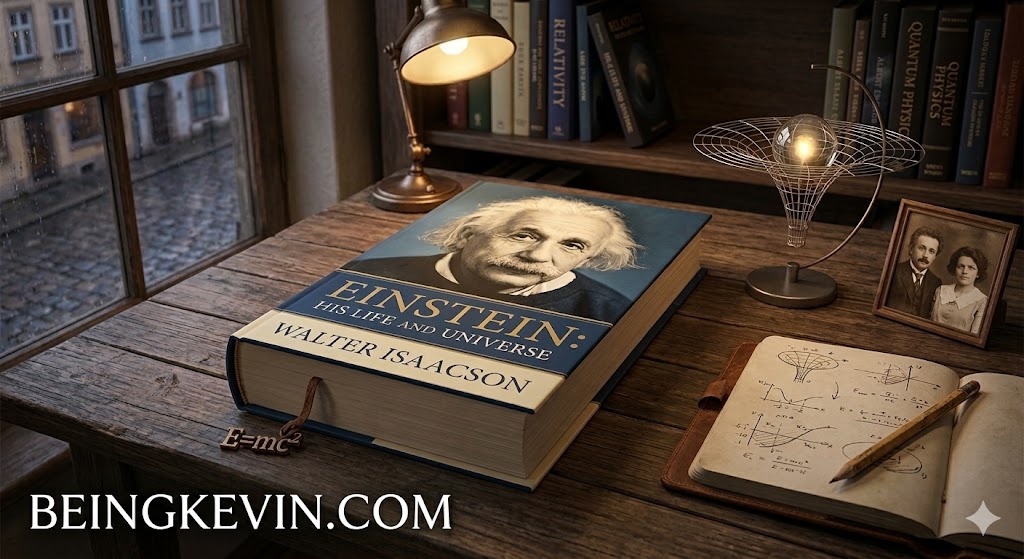
Einstein — Walter Isaacson
Rating: ⭐⭐⭐⭐⭐
Book Review: Einstein: His Life and Universe
Walter Isaacson’s Einstein is a fascinating and deeply human portrait of one of history’s most influential scientific minds. While the book occasionally becomes highly technical — especially in the early sections dealing with theoretical physics — it ultimately succeeds because it focuses not only on Einstein’s discoveries, but on the complicated, imperfect man behind them.
At times, the scientific explanations felt almost like sitting through a university physics lecture. Much like Isaacson’s biography of Leonardo da Vinci, some sections dive deeply into technical material that may challenge readers without a strong science background. I found parts of that difficult to stay engaged with. However, once the narrative shifts back toward Einstein’s life, personality, relationships, and intellectual journey, the book becomes remarkably compelling.
What emerges is not the myth of a detached super-genius, but a brilliant, stubborn, curious, emotionally complicated man whose ideas reshaped the modern world.
The Myth of the Mathematical Genius
One of the most interesting aspects of the biography is how it challenges the popular myth surrounding Einstein’s mathematical abilities.
Einstein was unquestionably brilliant and far more mathematically gifted than most people, but advanced mathematics was not always his greatest strength. His real gift was physical intuition — the ability to imagine how the universe behaved conceptually before formal mathematics could fully explain it.
As his theories became more advanced, however, Einstein realized he needed sophisticated mathematical frameworks to support and prove his ideas. He often relied on collaborations with stronger mathematicians, particularly Marcel Grossmann, whose assistance became crucial in developing aspects of General Relativity.
The book does an excellent job showing that scientific breakthroughs are often collaborative, even when history remembers only one name.
The Nobel Prize — But Not for Relativity
One surprising detail is that Einstein did not receive the Nobel Prize for the Theory of Relativity, despite it becoming his most famous achievement.
Instead, he received the 1921 Nobel Prize in Physics for his work on the photoelectric effect — research that became foundational to quantum theory and modern electronics.
Isaacson explains that relativity remained controversial for years, and some members of the scientific establishment were hesitant to formally recognize it. The Nobel Committee ultimately chose the safer and more experimentally accepted achievement.
Einstein the Man — Brilliant, Difficult, and Deeply Human
Another strength of the biography is its refusal to portray Einstein as flawless.
Einstein could be dismissive, stubborn, and emotionally distant, especially when convinced of his own intellectual correctness. His confidence sometimes alienated colleagues and complicated professional relationships. Isaacson presents him as both inspiring and frustrating — a visionary thinker who could also be insensitive to the people closest to him.
Rather than weakening the story, those flaws make Einstein feel far more real.
A Complicated Personal Life
Einstein’s private life was often turbulent and emotionally strained.
Before marrying his first wife, Mileva Marić, the couple had a daughter, Lieserl, born out of wedlock. Due to the social realities of the time, her fate remains uncertain. Historians believe she either died young or was given up for adoption, and no verified record of her adult life exists.
The biography also explores Einstein’s emotional detachment and the difficulties this created within his family relationships. His marriage deteriorated over time, and his home life became increasingly troubled.
Additional tragedy followed when his son, Eduard Einstein, was later diagnosed with schizophrenia. Isaacson does not sensationalize these struggles, but instead shows how even extraordinary intellectual achievement does not shield people from deeply human pain and dysfunction.
The Pacifist and the Atomic Bomb
One of the book’s most important clarifications involves Einstein’s relationship to the atomic bomb.
Many people mistakenly assume Einstein directly helped build the bomb. In reality, he played no role in the Manhattan Project itself.
His equation:
E=mc2
provided the theoretical understanding showing that mass could be converted into enormous amounts of energy, but Einstein himself remained deeply committed to pacifism for much of his life.
That pacifism evolved, however, with the rise of Adolf Hitler and Nazi Germany. Einstein came to believe that aggressive authoritarian regimes could not always be confronted through idealism alone. Fearing that Nazi scientists might develop nuclear weapons first, he supported warnings to the United States government about the potential danger.
The book captures this moral conflict well: Einstein wanted peace, but history forced him to confront situations in which force seemed necessary to prevent something even worse.
Science, Creativity, and Imagination
One of Isaacson’s broader themes is that Einstein’s genius came not just from intelligence, but from imagination and curiosity.
Einstein constantly questioned assumptions others accepted as fixed truths. He approached science creatively, using thought experiments and intuition in ways that often resembled artistic imagination as much as mathematical calculation.
The biography repeatedly emphasizes that innovation frequently comes from people willing to challenge accepted ideas and think differently about the world around them.
Final Rating: ★★★★★ (5/5)
Einstein is an insightful, thoughtful, and highly human biography of one of history’s most transformative figures.
The technical sections may feel dense to readers without a strong interest in physics, particularly early in the book, but the deeper exploration of Einstein’s personality, relationships, struggles, and intellectual development more than compensates.
Isaacson succeeds in portraying Einstein not as a myth or symbol, but as a complicated man — brilliant, flawed, curious, stubborn, compassionate, and occasionally difficult.
More than just a scientific biography, this becomes a story about creativity, imagination, morality, fame, and the burden of changing the world.
Highly recommended.
Critical Reception When Released
Upon release, Einstein received widespread praise for balancing scientific explanation with deeply personal biography.
Critics particularly praised:
- Isaacson’s ability to make complex science accessible
- The exploration of Einstein’s creativity and imagination
- The nuanced portrayal of Einstein’s personal flaws
- The balance between scientific achievement and human struggle
- the book’s readability for general audiences
Many reviewers considered it one of the strongest modern biographies of Einstein because it moved beyond the caricature of the absent-minded genius and presented a far more complete portrait of the man behind the science.
Leave a Reply