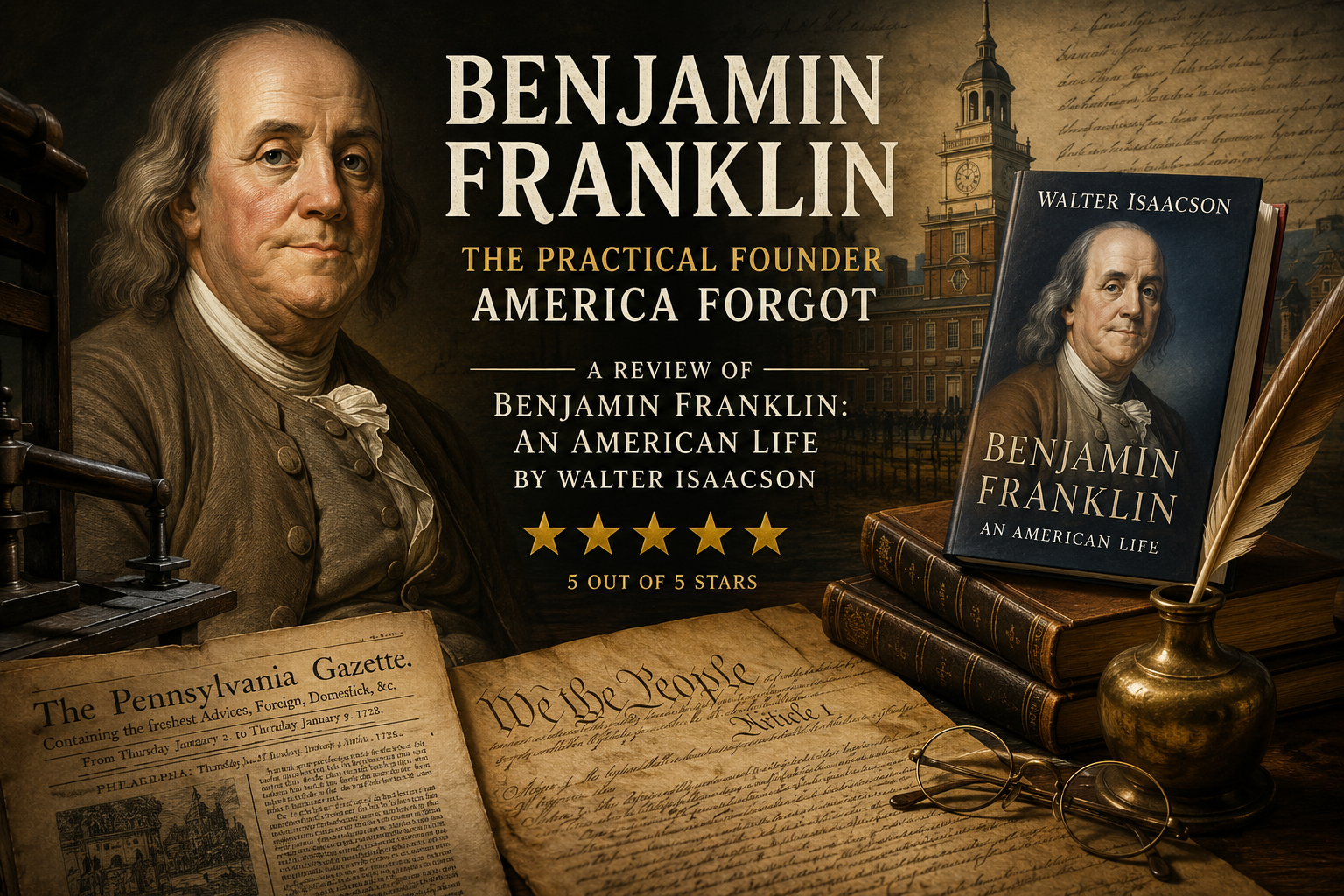
Review of Benjamin Franklin: An American Life by Walter Isaacson
★★★★★ (5/5)
I recently completed Benjamin Franklin: An American Life by Walter Isaacson and found it to be one of the more engaging and rewarding biographies I have read in quite some time. It is not only a strong historical work, but also a reminder of how complex and practical Benjamin Franklin truly was.
Franklin often feels like the overlooked member of the Founding Fathers, overshadowed by larger political personalities such as Thomas Jefferson and John Adams. Yet Isaacson presents Franklin as perhaps the most relatable and modern of them all, a self-made man grounded more in practicality than ideology.
Born in Boston in 1706 into a large working family, Franklin received very little formal education because his father simply could not afford it. Isaacson paints a clear picture of Franklin’s early struggles, including his difficult relationship with his brother James, before Franklin eventually left Boston as a teenager and made his way to Philadelphia to build a new life.
What stood out most to me throughout the book was Franklin’s ability to adapt. Isaacson shows him as a man who could shift his methods, tone, and even public identity without losing sight of his larger purpose. Franklin became a master of persuasion through his writing and, famously, used pseudonyms such as Silence Dogood to influence public debate, criticize hypocrisy, and test ideas from multiple perspectives.
Rather than presenting this as deception, Isaacson frames it as Franklin understanding something essential about public discourse: people are more willing to listen when ideas are presented in ways they can relate to. Franklin cared less about personal credit and more about moving conversations toward practical outcomes.
The biography also highlights Franklin’s transformation from a local printer into an international figure. He became deeply involved in science, philosophy, diplomacy, and civic reform. At times, however, that broader dedication to public life also distanced him from his own family. Isaacson does not ignore those flaws, which gives the biography a more balanced and believable tone.
One of the strongest sections of the book covers Franklin’s diplomatic role during the American Revolutionary War. Franklin became the key American representative in France and helped secure critical French support for the American cause. At the same time, he quietly maintained back-channel communications with the British while pursuing peace negotiations.
That balance is what makes Franklin fascinating. He was rarely trapped by rigid ideology. He preferred negotiation over fanaticism and compromise over paralysis. Isaacson repeatedly presents Franklin as someone more interested in keeping society functioning than in achieving total political victory for one side.
The book also emphasizes one remarkable historical fact: Franklin was the only Founding Father to sign all four of the major documents tied to the founding of the United States:
- The Declaration of Independence (1776)
- The Treaty of Alliance with France (1778)
- The Treaty of Paris (1783)
- The United States Constitution (1787)
Isaacson also argues that Franklin’s experiences in Pennsylvania government and civic life helped shape many of the ideas surrounding constitutional compromise. At the Constitutional Convention, Franklin, elderly and physically suffering by that point, remained one of the convention’s strongest voices for unity and practical governance. He understood that no constitution would ever satisfy everyone completely, but believed imperfect compromise was necessary to hold a nation together.
What makes Isaacson’s portrait of Franklin so compelling is that he never comes across as elitist or detached from ordinary people. Franklin understood tradesmen, workers, printers, merchants, and laborers because he had once been one himself. Many of his civic projects — lending libraries, volunteer fire brigades, public improvements, and educational institutions — were designed to improve the lives of everyday citizens, not just political elites.
In many ways, Isaacson presents Franklin not as a philosopher or revolutionary first, but as a civic engineer, someone constantly trying to make systems work better for ordinary people.
That may ultimately be Franklin’s greatest relevance today. He believed diverse societies survive not through ideological purity, but through persuasion, negotiation, adaptability, humor, and the willingness to accept imperfect outcomes for the greater good.
This biography succeeds because it captures Franklin in all of those contradictions: ambitious yet practical, worldly yet grounded, flexible yet principled. Isaacson does not turn Franklin into a flawless hero, which makes the portrait far more convincing.
For me, this was an easy five-star read. It is informative without becoming overly academic, detailed without feeling dry, and highly readable throughout. More importantly, it offers a version of Franklin that feels remarkably modern, a man who understood that compromise was not weakness, but one of the essential tools of civilization itself.
Reception When the Book Was Released
When Benjamin Franklin: An American Life was published in 2003, it was widely praised for making Franklin accessible to modern readers without stripping away his complexity. Critics noted Isaacson’s ability to present Franklin not simply as a historical icon, but as a deeply human figure filled with ambition, wit, contradictions, and political skill.
Many reviews highlighted the biography’s readable style and balanced approach, particularly Isaacson’s focus on Franklin’s pragmatism and his talent for negotiation and diplomacy. The book was especially praised for avoiding the tendency to treat the Founding Fathers as untouchable mythological figures.
Over time, the biography has remained one of the more widely recommended modern works on Franklin and helped reintroduce him to readers who often focus more heavily on Jefferson, Washington, or Adams in discussions of early American history.
Leave a Reply