
If you haven’t read Part 1, you may want to begin there before continuing. The link is here
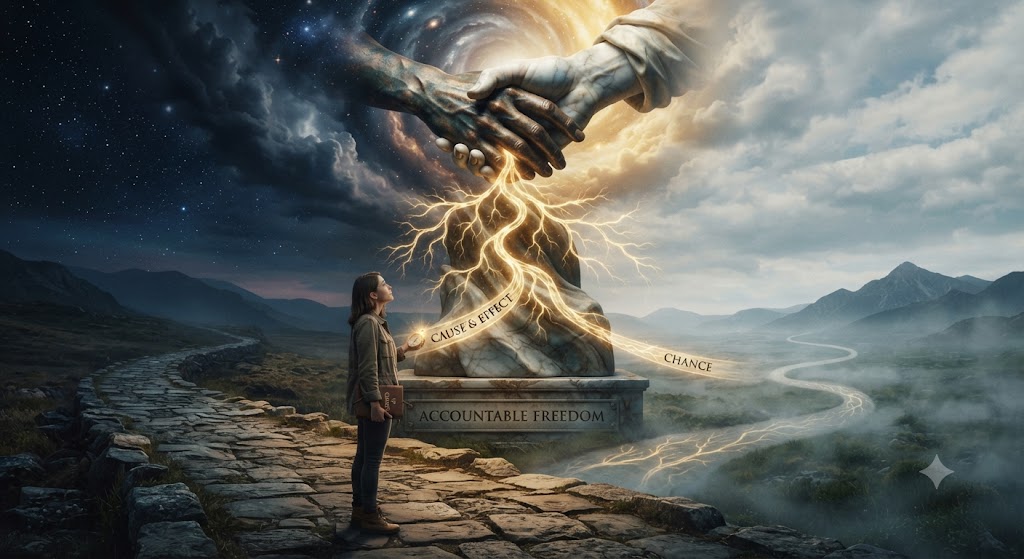
This is Part 2 of my three-part series exploring free will, predestination, and how we make decisions. In Part 1, I asked whether free will can exist if our lives are predetermined. In this article, I want to look at a different question: even if our future isn’t predetermined, are our choices ever completely free?
We often hear that free will is one of humanity’s greatest gifts. We are told our choices define us and that every decision is ultimately ours to make.
But what if free will isn’t actually free?
Before asking whether our decisions are truly free, it’s worth looking at one of the philosophical traditions that places great importance on free will.
The Deist Perspective
A Deist views God as the supreme being who created the universe and then stepped away. The deity does not intervene in human affairs. Instead, humanity is left to determine its own destiny through reason, natural law, and free will. This idea is often referred to as the Clockmaker Theory.
This philosophy gained prominence during the Enlightenment in the eighteenth century through thinkers such as Voltaire, Thomas Paine, and Thomas Jefferson. Many influential American founders referred to Providence while also embracing Enlightenment ideas about reason, individual liberty, and the laws of nature rather than believing every event was directed by divine intervention.
What If Neither View Is Correct?
What if neither perspective tells the whole story?
There is no definitive proof that God exists. Belief ultimately rests on faith rather than evidence.
Throughout history, humanity has created countless religions to answer the unknown, provide comfort, and explain the mysteries of life. Some cultures embraced many gods, while others believed in only one.
That naturally raises another question.
If there is one true God, why have so many different religions developed independently throughout history?
Perhaps each is humanity’s attempt to answer the same questions through different cultures, traditions, and experiences.
So, Do We Really Have Free Will?
Even if we set religion aside, another question remains.
Do we actually possess free will?
Or have we simply been taught that we do?
From the moment we are born until we reach adulthood, we are shaped by everything around us.
Our parents.
Our family.
Our friends.
School.
Work.
Culture.
Politics.
Religion.
Society itself.
Every experience influences how we think, what we value, and how we react. Every opinion we form is built upon the experiences that came before it.
That doesn’t necessarily mean we cannot choose.
It means the way we arrive at those choices has already been influenced by years of experience, learning, and conditioning.
You might be free to decide.
But you were never free in how the thought itself was formed.
The Role of Conditioning
Imagine a child somehow raised entirely apart from human civilization.
Without language, culture, education, religion, or social interaction, how would that person decide what is right or wrong?
What beliefs would they hold?
What values would they have?
The very framework used to make decisions comes from somewhere.
If that framework is learned rather than innate, then perhaps what we call free will is actually the product of everything that shaped us long before we made our first conscious decision.
Psychology Raises the Same Question
Psychologists describe cognitive dissonance as the discomfort we experience when new evidence conflicts with deeply held beliefs.
That doesn’t prove free will is an illusion, but it does suggest that changing our minds is often much harder than we like to believe.
When confronted with information that challenges our worldview, we often reject it, reinterpret it, accept it, or become emotionally paralyzed.
But if our strongest beliefs were formed through years of conditioning, experience, and repetition, where exactly does completely independent free will enter the picture?
The Religious Question
Religion often teaches that God gave humanity free will.
But many religions also teach that failing to follow God’s path carries consequences.
That presents an interesting philosophical question.
Is a choice completely free if one option includes the possibility of punishment?
Or is it better described as freedom within boundaries?
A Question Worth Considering
Perhaps free will exists.
Perhaps it doesn’t.
Or perhaps what we call free will is simply our ability to make choices using a mind that has already been shaped by biology, family, education, culture, religion, and every experience we’ve ever had.
Maybe we are free to choose.
But maybe we were never completely free in how we became the person making those choices.
That question, more than any answer, is what fascinates me.
A Final Thought
You are always free to make a choice or a decision.
But how you arrive at that choice may not be free at all. It is shaped by a lifetime of experiences, interactions, education, successes, failures, beliefs, and everything you have learned along the way.
Think of it this way. If you had to choose between something you knew and something you knew nothing about, you would almost certainly choose what you knew. Your decision wouldn’t be random. It would be influenced by your knowledge and experience.
Now imagine someone else making that same decision without any prior knowledge of either option. In one sense, that person is actually freer than you because neither choice carries the weight of past experience or learned preference. Their decision begins with far less influence.
I think of it the same way I think about common sense. We often say something is “common sense,” but common to whom? What seems obvious to one person may be completely foreign to someone raised in a different culture, a different environment, or with different life experiences. If common sense depends on what we have learned, then perhaps our choices do as well.
Maybe free will isn’t about whether we are free to choose.
Maybe the better question is whether we are ever truly free from everything that taught us how to choose in the first place.
That is the question I keep coming back to.
You are free to make a decision.
You are not free in how you became the person making it.
Thanks for reading BeingKevin.
In a world built on scrolling past everything in seconds, I genuinely appreciate you stopping here for a moment. If the post gave you something to think about, made you laugh, or even made you disagree, I’d love to hear from you in the comments. A quick rating helps, too, and goes a long way toward supporting the site. And if you’d like to help keep BeingKevin going, a small tip is always appreciated — never expected, but deeply valued. Thanks again for being here
Leave a Reply