
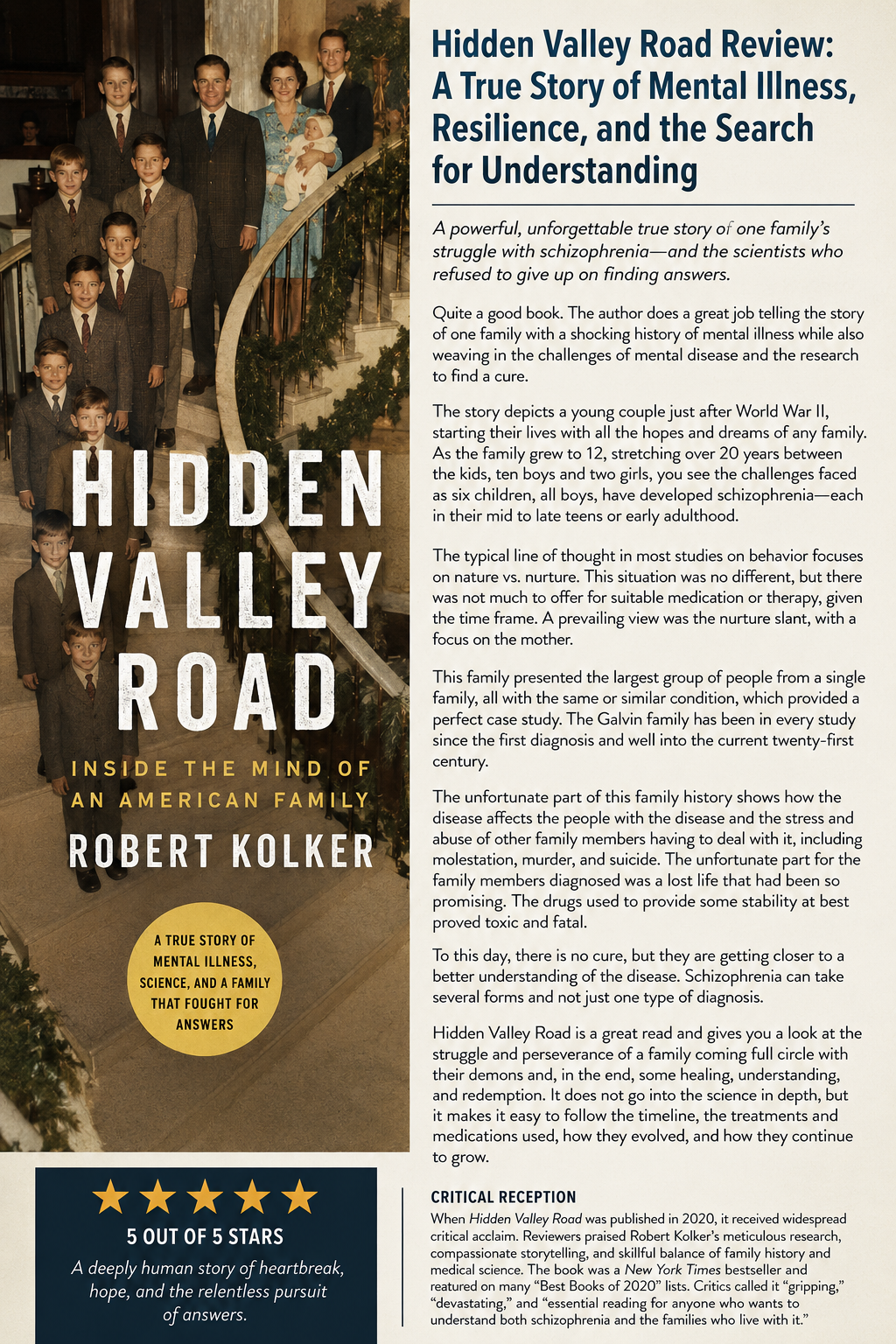
By: Robert Kolker
Rating: ⭐⭐⭐⭐⭐ (5/5)
Hidden Valley Road: Inside the Mind of an American Family by Robert Kolker is quite a remarkable book. Kolker does an excellent job telling the story of one family with a shocking history of mental illness while also weaving together the larger story of schizophrenia research and the long search for treatment and understanding.
The book follows a young couple as they begin their lives just after World War II, with all the hopes and dreams of a growing American family. Over two decades, the family expands to twelve children, ten boys and two girls, before tragedy slowly takes hold. Six of the sons develop schizophrenia, each during their mid-to-late teens or early adulthood.
What makes the story so compelling is how it balances the deeply personal suffering of the Galvin family with the evolving science surrounding mental illness. For decades, much of the thinking around behavioral disorders centered on the nature-versus-nurture debate. At the time, there were few effective medications, limited therapy options, and a prevailing belief that family dynamics, particularly the role of the mother, were to blame.
Because so many members of one family were affected, the Galvins became one of the most significant case studies in schizophrenia research. Their participation in studies stretched from the first diagnosis well into the twenty-first century, helping researchers better understand the disease and its many forms.
The book also refuses to romanticize the damage schizophrenia caused within the family. Beyond the illness itself, the story reveals the emotional strain, trauma, abuse, molestation, violence, suicide, and shattered relationships that affected nearly everyone connected to it. For the sons diagnosed with schizophrenia, there is a constant sense of lost potential and lives interrupted before they ever had the chance to fully begin.
One of the strongest aspects of the book is how accessible it remains despite the complexity of the subject matter. It does not dive too deeply into technical science, but it explains the timeline of treatments, medications, institutional care, and changing medical theories in a way that is easy to follow and understand. You see both the progress made and the painful reality that there is still no cure, even as researchers continue to move closer to fully understanding the illness.
In the end, Hidden Valley Road is not simply a book about schizophrenia. It is a story about family, endurance, guilt, survival, and ultimately some measure of healing and redemption. It is heartbreaking, frustrating, and deeply human.
★★★★★ 5/5 Stars
I used ChatGPT for the critical reception because I could not know what was said when the book came out.
Critical Reception
When it was released in 2020, Hidden Valley Road received widespread acclaim from critics and readers alike. The book became a bestseller and was praised for its compassionate storytelling, historical depth, and ability to make a complicated psychiatric subject accessible to general audiences. Many reviewers highlighted Kolker’s balance between investigative journalism and emotional storytelling, calling it one of the most important nonfiction books written about mental illness in recent years.
Thanks for reading BeingKevin.
In a world built on scrolling past everything in seconds, I genuinely appreciate you stopping here for a moment. If the post gave you something to think about, made you laugh, or even made you disagree, I’d love to hear from you in the comments. A quick rating helps, too, and goes a long way toward supporting the site. And if you’d like to help keep BeingKevin going, a small tip is always appreciated — never expected, but deeply valued. Thanks again for being here

Leave a Reply