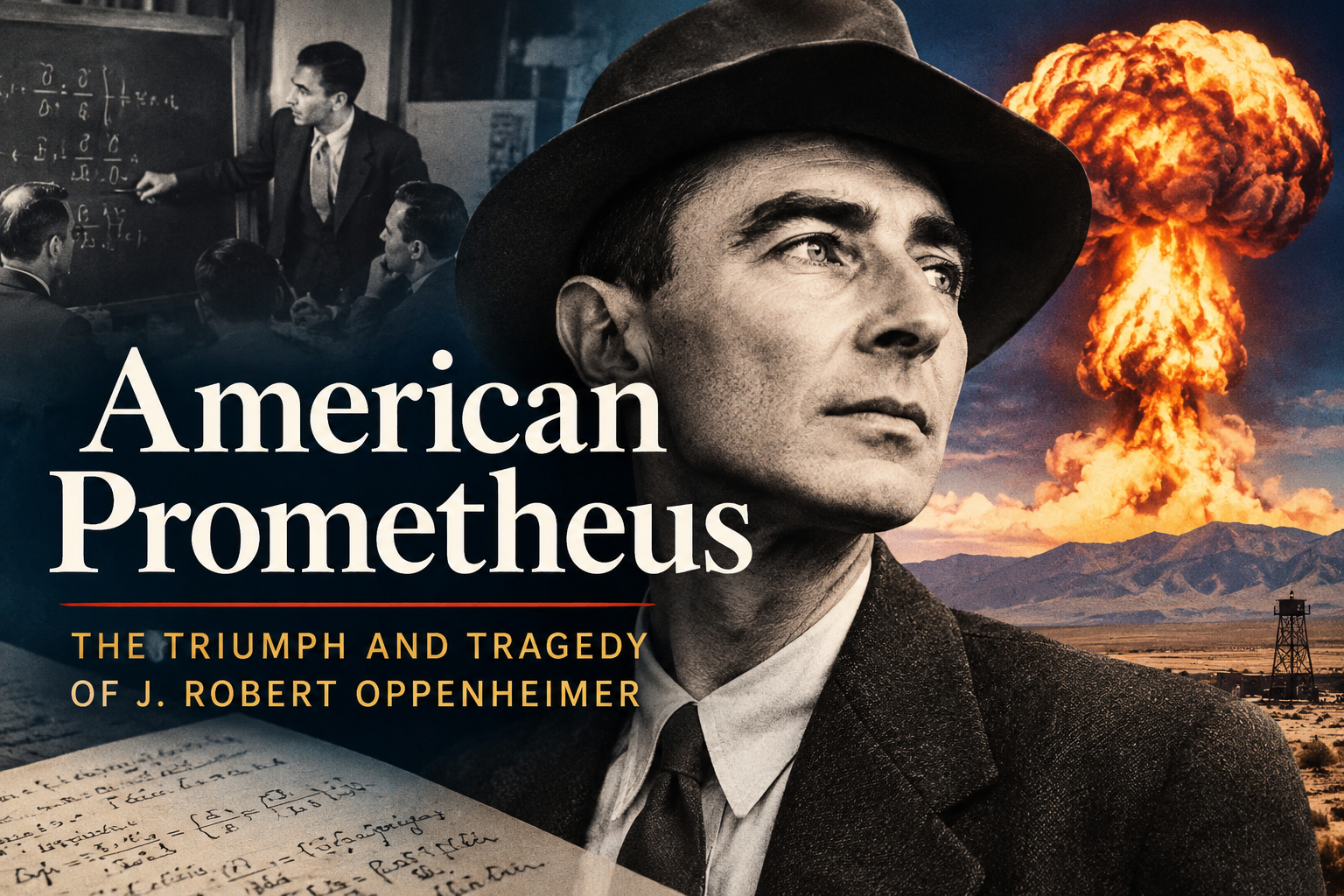
American Prometheus Review: Oppenheimer, the Atomic Bomb, and the Man Behind the History
By: Kai Bird (Autor), Martin J Sherwin (Autor)
Rating: ★★★★★ (5/5)
Opening Hook
This was a very large book in scale, and it covered the life of arguably the most famous physicist of the 20th century. J. Robert Oppenheimer never won the Nobel Prize, but he directed the Los Alamos Laboratory during the Manhattan Project, where the atomic bomb was developed. That project still has a profound impact on daily life more than 80 years later.
Oppenheimer was a brilliant and fascinating man, and his story left us with almost daily conversations about his life, his legacy, and the weapon he helped develop, while also warning us about what that weapon could mean for the world.
Book Overview
The book details the life of J. Robert Oppenheimer from his youth and his time at the Ethical Culture Fieldston School in New York, which helped shape his philosophical thought process. It also covers his personal and complicated life, including his early psychological struggles.
The book shows a brilliant and complicated man, not only in his personal life and relationships but also in his work. It explains how some of the actions he took were intended to protect the project and his friends, but also how the times he lived in and the jealousies of others were eventually used against him.
One of the central themes is the difficult position Oppenheimer found himself in. Some of the decisions he made were meant to protect the Manhattan Project and the people involved, but those same decisions and relationships later became part of the case against him. The book does a good job of showing how a complicated man, living in an extraordinary and dangerous period, could have his own actions turned against him.
What Worked
I did not find anything that could have been done better here. When the authors set out to cover this time period, this man, and the people around him, given the historical circumstances, everything was needed. There is no fluff here, which helps explain why it took years to write and more than a thousand pages to tell.
It covers Oppenheimer’s life from early childhood through his death and tells the story of the man both personally and professionally. It also shows how his family came to the U.S. along with other brilliant scientists and how immigration benefited the country by bringing some of the world’s brightest minds here.
For a book this large, it never felt like the authors were simply filling pages. The detail was there because the story required it.
Strong Ideas
Since this is a biography that covers one of the most critical times in world history and the invention of the most destructive weapon man has ever produced, the times and ideas speak for themselves. They are all strong, along with how these events shaped not only the geographical landscape of countries but also the geopolitical fallout from these decisions.
Some of the ideas surrounding the post-World War II world and how the nuclear age could have gone were especially interesting. The book leaves you thinking that some bad decisions may have been made based on false assumptions, fear, and the pursuit of power. It makes you wonder how different the world might look today if some of those decisions had gone another way.
Strong Characters
All the characters were strong, even those in smaller roles, simply because of who they were and the roles they played in this story. From Leslie Groves, who hired Oppenheimer to lead the Los Alamos laboratory, to the numerous scientists who are well known today, like Richard Feynman, Enrico Fermi, Albert Einstein, Hans Bethe, and Edward Teller.
Then there are people like Lewis Strauss, who became such an important figure in Oppenheimer’s later life, and his brother Frank Oppenheimer, who was also a scientist and became an important part of the story. There are also the political figures and government officials who shaped the decisions surrounding Oppenheimer and the nuclear program.
A time and project of this scope naturally brings a lot of strong characters into the story. Even when some of them appear only briefly, their reputations and roles in history make them important to the story.
Strong Writing
I will only say the writing is great and very detailed, considering the scope, the people, the project, and the time period covered. Telling this story from the beginning to the end with this level of clear detail was fantastic.
Turning this into the movie most people know could have easily been far longer than three hours. The book is far better for understanding the full story and should be a read for anyone who wants to understand the man and the times in which he lived.
This book will definitely do that. What else can I say about the writing? It did the job exceptionally well.
What Didn’t Work
Everything worked. There is nothing in this book that can be improved in my opinion.
Modern Relevance
The fact that we still discuss the use of nuclear weapons and that they remain part of military strategy is scary. The authors showed that these questions were being discussed almost as soon as the bomb was invented. The wording, along with agreements and warnings made more than 70 years ago about how nuclear weapons should never become a first option, really makes you think.
A project designed to help end one war has a legacy that remains front and center every day, more than 80 years later. The fact that we are still having these conversations shows just how relevant the story of Oppenheimer and the nuclear age remains.
Final Verdict
Rating: ★★★★★
This is a five-star book and should be a must-read for anyone interested in history. I’m a strong believer that movies based on history can be great entertainment, but they can never tell the full story.
The movie based on this book was great, but like any historical movie or TV show, it should drive interest to go read about the actual events for better context and detail. There is simply no way a movie can portray the depth, detail, and full story in the way a book like this can.
If you watched the movie and thought you understood Oppenheimer, this book will show you just how much more there was to the man, the project, and the times in which he lived.
Leave a Reply