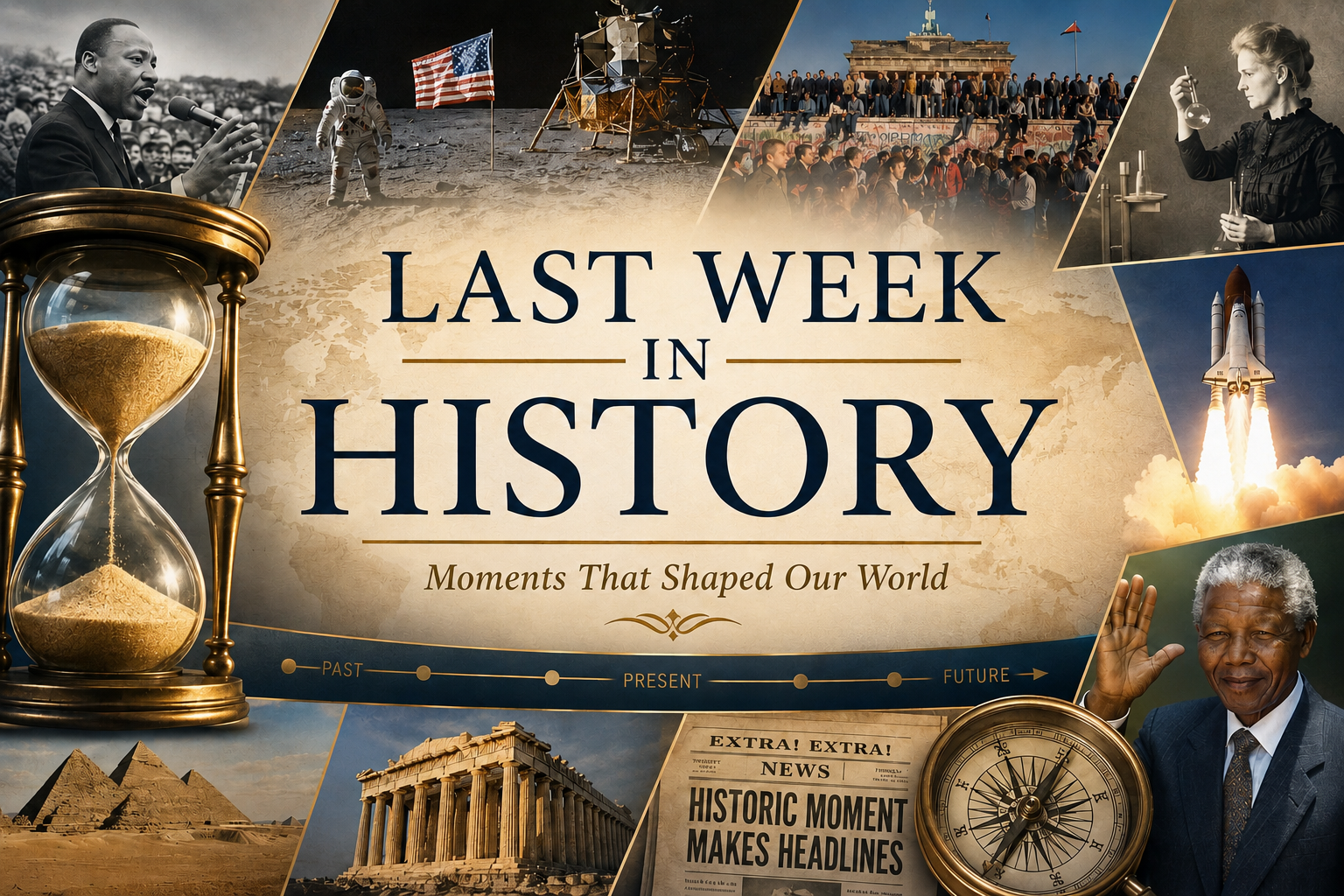
Last Week in History
Week 21 of the Year
- May 18: Day 138 of the year
- May 19: Day 139 of the year
- May 20: Day 140 of the year
- May 21: Day 141 of the year
- May 22: Day 142 of the year
- May 23: Day 143 of the year
- May 24: Day 144 of the year
Intro
History doesn’t sit still—and neither should we. Each week, we look back at the moments that shaped the world: the breakthroughs, the disasters, the turning points, and the stories that still echo today. Here’s what happened last week in history.
Opening
History has a remarkable habit of compressing humanity’s greatest achievements and darkest moments into the same narrow windows of time. The third week of May is one of those stretches where invention, tragedy, ambition, politics, and culture all seem to collide. Between May 18 and May 24, the world witnessed scientific breakthroughs that changed medicine forever, political upheavals that reshaped nations, engineering marvels that connected cities, and cultural milestones that still echo through television, film, and sports today.
What makes these dates fascinating is not simply the events themselves, but how deeply they continue to influence modern life. From vaccines and aviation to international football and instant communication, many of the systems we now take for granted were born, tested, or transformed during this single week in history.
Politics & World Events
The political structure of Europe changed dramatically on May 23, 1618, during the Second Defenestration of Prague. Furious Protestant nobles threw Catholic officials from the windows of Prague Castle, igniting the catastrophic Thirty Years’ War. While the act itself sounded almost absurdly theatrical, the consequences were devastating. The conflict reshaped Europe politically and religiously, eventually leading to the Peace of Westphalia, which established the foundation for the modern nation-state system that still governs international diplomacy today.
Another transformational moment arrived on May 24, 1844, when Samuel Morse sent the first official telegraph message between Washington and Baltimore. “What hath God wrought” became far more than a biblical phrase. It marked the birth of instantaneous long-distance communication. Every modern text message, email, video call, and social media post owes something to that first electrical signal crossing the wires.
On May 21, 1904, representatives from seven European nations formed FIFA in Paris. What began as an administrative effort to standardize football rules eventually became the governing body for the world’s most popular sport. Today, the World Cup is among the largest shared global experiences on Earth, demonstrating how sports can transcend language, politics, and borders.

Major Tragedies or Turning Points
One of the most devastating natural disasters in recorded history struck on May 22, 1960, when the Great Chilean Earthquake hit near Valdivia. Measuring 9.5 on the Richter scale, it remains the most powerful earthquake ever recorded. Entire communities were destroyed, and tsunamis swept across the Pacific Ocean, reaching Hawaii and Japan. The catastrophe fundamentally changed international disaster preparedness and led directly to the development of the Pacific Tsunami Warning System, which continues saving lives today.
On May 18, 1980, the eruption of Mount St. Helens dramatically altered the American landscape and public understanding of volcanic threats. The blast killed dozens, flattened forests, and forced major improvements in geological monitoring and emergency management systems across the United States.
Another heartbreaking turning point occurred on May 18, 1927, with the Bath School disaster, the deadliest school-related mass murder in American history. The tragedy exposed vulnerabilities in public safety systems and remains part of ongoing national discussions surrounding school security and crisis prevention.
Medical Breakthroughs
Modern medicine changed forever on May 18, 1796, when English physician Edward Jenner conducted the first successful smallpox vaccination. By using cowpox material to build immunity, Jenner introduced the foundational concept of vaccination. His work ultimately led to the eradication of smallpox and laid the groundwork for every modern immunization program that followed.
Another major milestone came on May 20, 1747, when James Lind began one of history’s first controlled clinical trials aboard a British naval ship. His experiments with citrus fruits identified a treatment for scurvy and helped establish evidence-based medicine. Modern clinical research, pharmaceutical testing, and scientific trial procedures all trace part of their origins back to Lind’s work.
The twentieth century added yet another life-changing advancement when Jonas Salk’s polio vaccine entered widespread public use in the 1950s. The fear surrounding polio had gripped entire generations, and the success of vaccination campaigns became one of the defining public health victories of modern history.
Technology Milestones, Inventions, and Breakthroughs

Few moments symbolize human ambition more than Charles Lindbergh’s flight on May 21, 1927. Flying the Spirit of St. Louis nonstop from New York to Paris, Lindbergh proved long-distance aviation was not merely possible, but practical. Commercial air travel soon transformed tourism, business, migration, and global diplomacy.
Five years later, on May 21, 1932, Amelia Earhart became the first woman to fly solo across the Atlantic Ocean. Beyond aviation, her accomplishments challenged social norms and inspired generations of women to pursue careers previously dominated by men.
Technology also took a major leap forward on May 22, 1990, when Microsoft released Windows 3.0. The software helped bring personal computing into homes and offices around the world, accelerating the digital revolution that now shapes nearly every aspect of modern life.
Even fashion experienced its own technological breakthrough on May 20, 1873, when Levi Strauss and Jacob Davis patented riveted blue jeans. Originally designed as durable workwear, jeans evolved into one of the most recognizable and democratic forms of clothing ever created.
Sports Milestones
The founding of FIFA on May 21, 1904, transformed football from scattered regional competitions into a truly global sport. The organization eventually built the World Cup into one of humanity’s most-watched events, uniting billions of viewers every four years.
This period of May also frequently revisits Jesse Owens’s achievements, whose record-breaking performances in 1935 foreshadowed his historic triumphs at the 1936 Berlin Olympics. Owens’ victories carried significance far beyond athletics, directly challenging racist ideologies promoted by Nazi Germany and reshaping conversations about race and equality in sports.
Sports milestones endure because they often reflect broader social movements. Athletes become symbols of national pride, resistance, progress, and unity in ways few political speeches ever accomplish.

Entertainment & Cultural Highlights
Film history changed forever on May 21, 1980, with the release of The Empire Strikes Back. The sequel to Star Wars deepened cinematic storytelling with darker themes, emotional complexity, and one of the most famous plot twists in movie history. The film helped establish the blockbuster franchise model that still dominates Hollywood today.
Television experienced its own historic moment on May 24, 1983, when the final episode of M*A*S*H aired. “Goodbye, Farewell and Amen” became one of the most-watched television broadcasts ever. The show proved comedy and tragedy could coexist within the same series, influencing generations of television writers and reshaping how serious subjects were portrayed on screen.
On May 19, 1962, Marilyn Monroe famously sang “Happy Birthday” to John F. Kennedy at Madison Square Garden. The moment blurred the lines between celebrity culture and politics in ways that now feel entirely normal in the media age.
Meanwhile, the release of Star Wars: Episode I – The Phantom Menace on May 19, 1999 demonstrated the growing power of internet-driven fandoms and global entertainment marketing as the world entered the digital era.
Historical Moments in The United States
On May 24, 1883, the Brooklyn Bridge officially opened, connecting Manhattan and Brooklyn for the first time. Designed under the leadership of Washington and Emily Roebling, the bridge became a symbol of American industrial ambition and engineering excellence. More than a century later, it remains one of the most recognizable structures in the world.
Another uniquely American historical moment occurred on May 19, 1780, during the mysterious “Dark Day” in New England, when skies turned nearly black during daylight hours. Many believed the apocalypse had arrived. Scientists later connected the phenomenon to wildfire smoke and atmospheric conditions, but at the time, it reflected how quickly fear and uncertainty could spread in the absence of scientific understanding.
These moments still matter because they capture the evolving American identity: ambitious, innovative, anxious, resilient, and constantly reinventing itself.
Historical Moments in Brazil
Brazil’s historical memory this week often turns to the long struggle over centralized government, democracy, and constitutional authority. On May 18, 1965, during Brazil’s military government era, institutional reforms significantly altered the balance between federal authority and regional political power. The effects of those changes continue to influence modern Brazilian debates over judicial independence, executive authority, and federalism.
The broader month of May also remains deeply connected to Brazil’s reckoning with slavery and inequality following the signing of the Lei Áurea in 1888 by Princess Isabel. As the final nation in the Western Hemisphere to abolish slavery, Brazil continues grappling with the lasting social and economic consequences of that history.
These historical currents remain visible throughout modern Brazilian society, from politics and education to race relations, labor issues, and cultural identity.
Closing Reflection
Looking back across the dates of May 18 through May 24 reveals how history often advances through moments that initially seem isolated or ordinary. A telegraph message sent across wires, a bridge opened to the public, a vaccine tested on a single patient, or a lone airplane crossing the Atlantic all became turning points that reshaped the modern world.
At the same time, disasters such as earthquakes, volcanic eruptions, and war remind us of how fragile societies can be when confronted with forces larger than themselves. Yet humanity repeatedly responds with innovation, adaptation, and resilience.
That may be the real lesson of this week in history. Civilization moves forward unevenly, often through conflict and hardship, but also through creativity, courage, and imagination. The echoes of these events still surround us every day—in our technology, our medicine, our entertainment, our politics, and even the ways we communicate with one another across the globe.
Outro
History is never just about the past—it’s a running commentary on where we are today.
Some of these moments changed the world overnight. Others took years to reveal their impact. All of them are reminders that any given week can leave a lasting mark. Check back next week for another chapter.
Thanks for reading BeingKevin.
In a world built on scrolling past everything in seconds, I genuinely appreciate you stopping here for a moment. If the post gave you something to think about, made you laugh, or even made you disagree, I’d love to hear from you in the comments. A quick rating helps, too, and goes a long way toward supporting the site. And if you’d like to help keep BeingKevin going, a small tip is always appreciated — never expected, but deeply valued. Thanks again for being here
Last Week in History
Week 21 of the Year
- May 18: Day 138 of the year
- May 19: Day 139 of the year
- May 20: Day 140 of the year
- May 21: Day 141 of the year
- May 22: Day 142 of the year
- May 23: Day 143 of the year
- May 24: Day 144 of the year
Intro
History doesn’t sit still—and neither should we. Each week, we look back at the moments that shaped the world: the breakthroughs, the disasters, the turning points, and the stories that still echo today. Here’s what happened last week in history.
Opening
History has a remarkable habit of compressing humanity’s greatest achievements and darkest moments into the same narrow windows of time. The third week of May is one of those stretches where invention, tragedy, ambition, politics, and culture all seem to collide. Between May 18 and May 24, the world witnessed scientific breakthroughs that changed medicine forever, political upheavals that reshaped nations, engineering marvels that connected cities, and cultural milestones that still echo through television, film, and sports today.
What makes these dates fascinating is not simply the events themselves, but how deeply they continue to influence modern life. From vaccines and aviation to international football and instant communication, many of the systems we now take for granted were born, tested, or transformed during this single week in history.
Politics & World Events
The political structure of Europe changed dramatically on May 23, 1618, during the Second Defenestration of Prague. Furious Protestant nobles threw Catholic officials from the windows of Prague Castle, igniting the catastrophic Thirty Years’ War. While the act itself sounded almost absurdly theatrical, the consequences were devastating. The conflict reshaped Europe politically and religiously, eventually leading to the Peace of Westphalia, which established the foundation for the modern nation-state system that still governs international diplomacy today.
Another transformational moment arrived on May 24, 1844, when Samuel Morse sent the first official telegraph message between Washington and Baltimore. “What hath God wrought” became far more than a biblical phrase. It marked the birth of instantaneous long-distance communication. Every modern text message, email, video call, and social media post owes something to that first electrical signal crossing the wires.
On May 21, 1904, representatives from seven European nations formed FIFA in Paris. What began as an administrative effort to standardize football rules eventually became the governing body for the world’s most popular sport. Today, the World Cup is among the largest shared global experiences on Earth, demonstrating how sports can transcend language, politics, and borders.
Major Tragedies or Turning Points
One of the most devastating natural disasters in recorded history struck on May 22, 1960, when the Great Chilean Earthquake hit near Valdivia. Measuring 9.5 on the Richter scale, it remains the most powerful earthquake ever recorded. Entire communities were destroyed, and tsunamis swept across the Pacific Ocean, reaching Hawaii and Japan. The catastrophe fundamentally changed international disaster preparedness and led directly to the development of the Pacific Tsunami Warning System, which continues saving lives today.
On May 18, 1980, the eruption of Mount St. Helens dramatically altered the American landscape and public understanding of volcanic threats. The blast killed dozens, flattened forests, and forced major improvements in geological monitoring and emergency management systems across the United States.
Another heartbreaking turning point occurred on May 18, 1927, with the Bath School disaster, the deadliest school-related mass murder in American history. The tragedy exposed vulnerabilities in public safety systems and remains part of ongoing national discussions surrounding school security and crisis prevention.
Medical Breakthroughs
Modern medicine changed forever on May 18, 1796, when English physician Edward Jenner conducted the first successful smallpox vaccination. By using cowpox material to build immunity, Jenner introduced the foundational concept of vaccination. His work ultimately led to the eradication of smallpox and laid the groundwork for every modern immunization program that followed.
Another major milestone came on May 20, 1747, when James Lind began one of history’s first controlled clinical trials aboard a British naval ship. His experiments with citrus fruits identified a treatment for scurvy and helped establish evidence-based medicine. Modern clinical research, pharmaceutical testing, and scientific trial procedures all trace part of their origins back to Lind’s work.
The twentieth century added yet another life-changing advancement when Jonas Salk’s polio vaccine entered widespread public use in the 1950s. The fear surrounding polio had gripped entire generations, and the success of vaccination campaigns became one of the defining public health victories of modern history.
Technology Milestones, Inventions, and Breakthroughs
Few moments symbolize human ambition more than Charles Lindbergh’s flight on May 21, 1927. Flying the Spirit of St. Louis nonstop from New York to Paris, Lindbergh proved long-distance aviation was not merely possible, but practical. Commercial air travel soon transformed tourism, business, migration, and global diplomacy.
Five years later, on May 21, 1932, Amelia Earhart became the first woman to fly solo across the Atlantic Ocean. Beyond aviation, her accomplishments challenged social norms and inspired generations of women to pursue careers previously dominated by men.
Technology also took a major leap forward on May 22, 1990, when Microsoft released Windows 3.0. The software helped bring personal computing into homes and offices around the world, accelerating the digital revolution that now shapes nearly every aspect of modern life.
Even fashion experienced its own technological breakthrough on May 20, 1873, when Levi Strauss and Jacob Davis patented riveted blue jeans. Originally designed as durable workwear, jeans evolved into one of the most recognizable and democratic forms of clothing ever created.
Sports Milestones
The founding of FIFA on May 21, 1904, transformed football from scattered regional competitions into a truly global sport. The organization eventually built the World Cup into one of humanity’s most-watched events, uniting billions of viewers every four years.
This period of May also frequently revisits Jesse Owens’s achievements, whose record-breaking performances in 1935 foreshadowed his historic triumphs at the 1936 Berlin Olympics. Owens’ victories carried significance far beyond athletics, directly challenging racist ideologies promoted by Nazi Germany and reshaping conversations about race and equality in sports.
Sports milestones endure because they often reflect broader social movements. Athletes become symbols of national pride, resistance, progress, and unity in ways few political speeches ever accomplish.
Entertainment & Cultural Highlights
Film history changed forever on May 21, 1980, with the release of The Empire Strikes Back. The sequel to Star Wars deepened cinematic storytelling with darker themes, emotional complexity, and one of the most famous plot twists in movie history. The film helped establish the blockbuster franchise model that still dominates Hollywood today.
Television experienced its own historic moment on May 24, 1983, when the final episode of M*A*S*H aired. “Goodbye, Farewell and Amen” became one of the most-watched television broadcasts ever. The show proved comedy and tragedy could coexist within the same series, influencing generations of television writers and reshaping how serious subjects were portrayed on screen.
On May 19, 1962, Marilyn Monroe famously sang “Happy Birthday” to John F. Kennedy at Madison Square Garden. The moment blurred the lines between celebrity culture and politics in ways that now feel entirely normal in the media age.
Meanwhile, the release of Star Wars: Episode I – The Phantom Menace on May 19, 1999 demonstrated the growing power of internet-driven fandoms and global entertainment marketing as the world entered the digital era.
Historical Moments in The United States
On May 24, 1883, the Brooklyn Bridge officially opened, connecting Manhattan and Brooklyn for the first time. Designed under the leadership of Washington and Emily Roebling, the bridge became a symbol of American industrial ambition and engineering excellence. More than a century later, it remains one of the most recognizable structures in the world.
Another uniquely American historical moment occurred on May 19, 1780, during the mysterious “Dark Day” in New England, when skies turned nearly black during daylight hours. Many believed the apocalypse had arrived. Scientists later connected the phenomenon to wildfire smoke and atmospheric conditions, but at the time, it reflected how quickly fear and uncertainty could spread in the absence of scientific understanding.
These moments still matter because they capture the evolving American identity: ambitious, innovative, anxious, resilient, and constantly reinventing itself.
Historical Moments in Brazil
Brazil’s historical memory this week often turns to the long struggle over centralized government, democracy, and constitutional authority. On May 18, 1965, during Brazil’s military government era, institutional reforms significantly altered the balance between federal authority and regional political power. The effects of those changes continue to influence modern Brazilian debates over judicial independence, executive authority, and federalism.
The broader month of May also remains deeply connected to Brazil’s reckoning with slavery and inequality following the signing of the Lei Áurea in 1888 by Princess Isabel. As the final nation in the Western Hemisphere to abolish slavery, Brazil continues grappling with the lasting social and economic consequences of that history.
These historical currents remain visible throughout modern Brazilian society, from politics and education to race relations, labor issues, and cultural identity.
Closing Reflection
Looking back across the dates of May 18 through May 24 reveals how history often advances through moments that initially seem isolated or ordinary. A telegraph message sent across wires, a bridge opened to the public, a vaccine tested on a single patient, or a lone airplane crossing the Atlantic all became turning points that reshaped the modern world.
At the same time, disasters such as earthquakes, volcanic eruptions, and war remind us of how fragile societies can be when confronted with forces larger than themselves. Yet humanity repeatedly responds with innovation, adaptation, and resilience.
That may be the real lesson of this week in history. Civilization moves forward unevenly, often through conflict and hardship, but also through creativity, courage, and imagination. The echoes of these events still surround us every day—in our technology, our medicine, our entertainment, our politics, and even the ways we communicate with one another across the globe.
Outro
History is never just about the past—it’s a running commentary on where we are today.
Some of these moments changed the world overnight. Others took years to reveal their impact. All of them are reminders that any given week can leave a lasting mark. Check back next week for another chapter.
Thanks for reading BeingKevin.
In a world built on scrolling past everything in seconds, I genuinely appreciate you stopping here for a moment. If the post gave you something to think about, made you laugh, or even made you disagree, I’d love to hear from you in the comments. A quick rating helps, too, and goes a long way toward supporting the site. And if you’d like to help keep BeingKevin going, a small tip is always appreciated — never expected, but deeply valued. Thanks again for being here
Thanks for reading BeingKevin.
In a world built on scrolling past everything in seconds, I genuinely appreciate you stopping here for a moment. If the post gave you something to think about, made you laugh, or even made you disagree, I’d love to hear from you in the comments. A quick rating helps, too, and goes a long way toward supporting the site. And if you’d like to help keep BeingKevin going, a small tip is always appreciated — never expected, but deeply valued. Thanks again for being here


Leave a Reply