Last Week in History
May 25, 2026 – May 31, 2026
Week Number: 22
Day Numbers:
May 25 – Day 145
May 26 – Day 146
May 27 – Day 147
May 28 – Day 148
May 29 – Day 149
May 30 – Day 150
May 31 – Day 151
Intro
History doesn’t sit still—and neither should we Each week, we look back at the moments that shaped the world: the breakthroughs, the disasters, the turning points, and the stories that still echo today. Here’s what happened last week in history.
Opening
Welcome back to Last Week in History, where we take a look at the strange, brilliant, catastrophic, and occasionally inspiring events tied to this exact week on the calendar. The final days of May have given the world everything from collapsing empires to groundbreaking inventions, from riots in opera houses to rockets docking in space. It is one of those weeks where history feels less like a tidy timeline and more like humanity improvising under pressure with mixed results.
Across these seven days, civilizations shifted course, scientists redefined possibility, artists broke conventions, and governments wrestled with power, fear, and survival. Some events pushed humanity forward. Others served as painful reminders of how quickly arrogance, greed, or hatred can undo decades of progress. Together, they form a remarkable snapshot of the human condition—ambitious, flawed, creative, and stubbornly persistent.
Politics & World Events
Few events in world history rival the significance of May 29, 1453, when the Ottoman Empire under Sultan Mehmed II captured Constantinople after a 53-day siege. The fall of the Byzantine capital effectively ended the Eastern Roman Empire and transformed global trade, religion, and geopolitics. Europe’s search for alternative trade routes to Asia accelerated in the aftermath, helping launch the Age of Discovery and reshaping the modern world map.
More than five centuries later, on May 26, 1972, a very different kind of geopolitical turning point was reached when U.S. President Richard Nixon and Soviet leader Leonid Brezhnev signed the Anti-Ballistic Missile Treaty in Moscow. At the height of the Cold War, both superpowers realized that unlimited missile defense systems might actually make nuclear war more likely, not less. The treaty became one of the foundational agreements in nuclear arms control and continues to influence strategic military thinking today.
On May 25, 1963, African leaders gathered in Addis Ababa to form the Organization of African Unity, the precursor to today’s African Union. Newly independent nations recognized that political fragmentation had historically left Africa vulnerable to outside influence and exploitation. The organization’s creation represented a major effort toward continental cooperation and post-colonial self-determination.
Another extraordinary Cold War moment arrived on May 28, 1987, when a young German pilot named Mathias Rust somehow flew a small aircraft through Soviet air defenses and landed near Red Square in Moscow. The stunt humiliated Soviet military leadership and exposed weaknesses inside one of the world’s most feared superpowers just years before the Soviet Union’s collapse.
Major Tragedies or Turning Points
History often advances through moments of tragedy, and this week carries several painful reminders of that reality. On May 31, 1921, white mobs destroyed the prosperous Black neighborhood of Greenwood in Tulsa, Oklahoma, in what became known as the Tulsa Race Massacre. Hundreds were killed, businesses were burned to the ground, and generations of Black wealth vanished almost overnight. For decades, the event was largely erased from public education and historical discussion, making its modern rediscovery a lesson not only about racial violence, but also about the dangers of selective memory.
Another devastating disaster occurred on May 31, 1889, when the South Fork Dam failed above Johnstown, Pennsylvania. The resulting flood killed more than 2,200 people and exposed shocking negligence by the wealthy industrialists responsible for maintaining the dam. The tragedy permanently changed conversations about corporate responsibility, engineering oversight, and disaster liability.
Aviation history was forever altered on May 25, 1979, when American Airlines Flight 191 crashed shortly after takeoff from Chicago’s O’Hare Airport, killing all aboard. The investigation revealed maintenance failures that led to major reforms in aircraft inspection and airline safety standards. Modern commercial aviation remains one of the safest forms of transportation, partly because disasters like this have forced the industry and regulators to confront uncomfortable truths.
On May 30, 1431, Joan of Arc was executed for heresy in Rouen at just nineteen years old. Condemned in her own time, she later became one of history’s most enduring symbols of national identity and resistance. History has a habit of revising reputations after the politics cool down.
Medical Breakthroughs
This week highlights both the triumphs and ethical failures that shaped modern medicine. On May 31, 1852, German microbiologist Julius Richard Petri was born. His invention of the Petri dish revolutionized laboratory science by allowing researchers to safely isolate and study bacterial cultures. More than a century later, the Petri dish remains one of the most recognizable and essential tools in medical research and disease control.
The darker side of medical history also emerged during this week. On May 30, 1943, Josef Mengele became chief medical officer at Auschwitz’s Romani camp, where horrific and unethical human experimentation took place under Nazi rule. The atrocities committed during World War II eventually helped establish the Nuremberg Code, which became the foundation for modern medical ethics and protections for human research subjects worldwide.
This week also reflects the increasingly blurred line between medicine and technology. On May 25, 2023, human trials involving Neuralink brain implants received regulatory approval, raising enormous questions about neurological treatment, artificial intelligence, and the future relationship between humans and machines. The science still feels futuristic, but so did antibiotics and organ transplants at one point.
Technology Milestones, Inventions, and Breakthroughs
Late May has repeatedly showcased humanity’s obsession with pushing boundaries. On May 28, 1936, mathematician Alan Turing submitted his groundbreaking paper, On Computable Numbers, which introduced the theoretical concept now known as the Turing Machine. The paper laid the intellectual foundation for modern computing, artificial intelligence, and essentially every device now demanding software updates at the worst possible moment.
On May 25, 2012, SpaceX’s Dragon spacecraft successfully docked with the International Space Station, becoming the first commercial spacecraft to achieve the feat. It marked a dramatic shift in space exploration from purely government-driven missions to an era increasingly shaped by private industry. Humanity went from national space races to billionaires launching rockets with company logos on the side.
Engineering history also took center stage on May 27, 1937, when the Golden Gate Bridge officially opened in San Francisco. Built during the Great Depression, the bridge became both an engineering marvel and a symbol of national optimism during one of America’s hardest economic periods.
Financial technology changed forever on May 26, 1896, with the publication of the first Dow Jones Industrial Average. The index created a standardized way to measure industrial growth and market performance, helping shape the modern financial systems that now dominate global economics.
Meanwhile, on May 29, 1953, Edmund Hillary and Tenzing Norgay became the first climbers confirmed to reach the summit of Mount Everest. It was not a technological invention in the traditional sense, but it represented the extraordinary combination of planning, equipment, logistics, and human endurance that defines modern exploration.
Sports Milestones
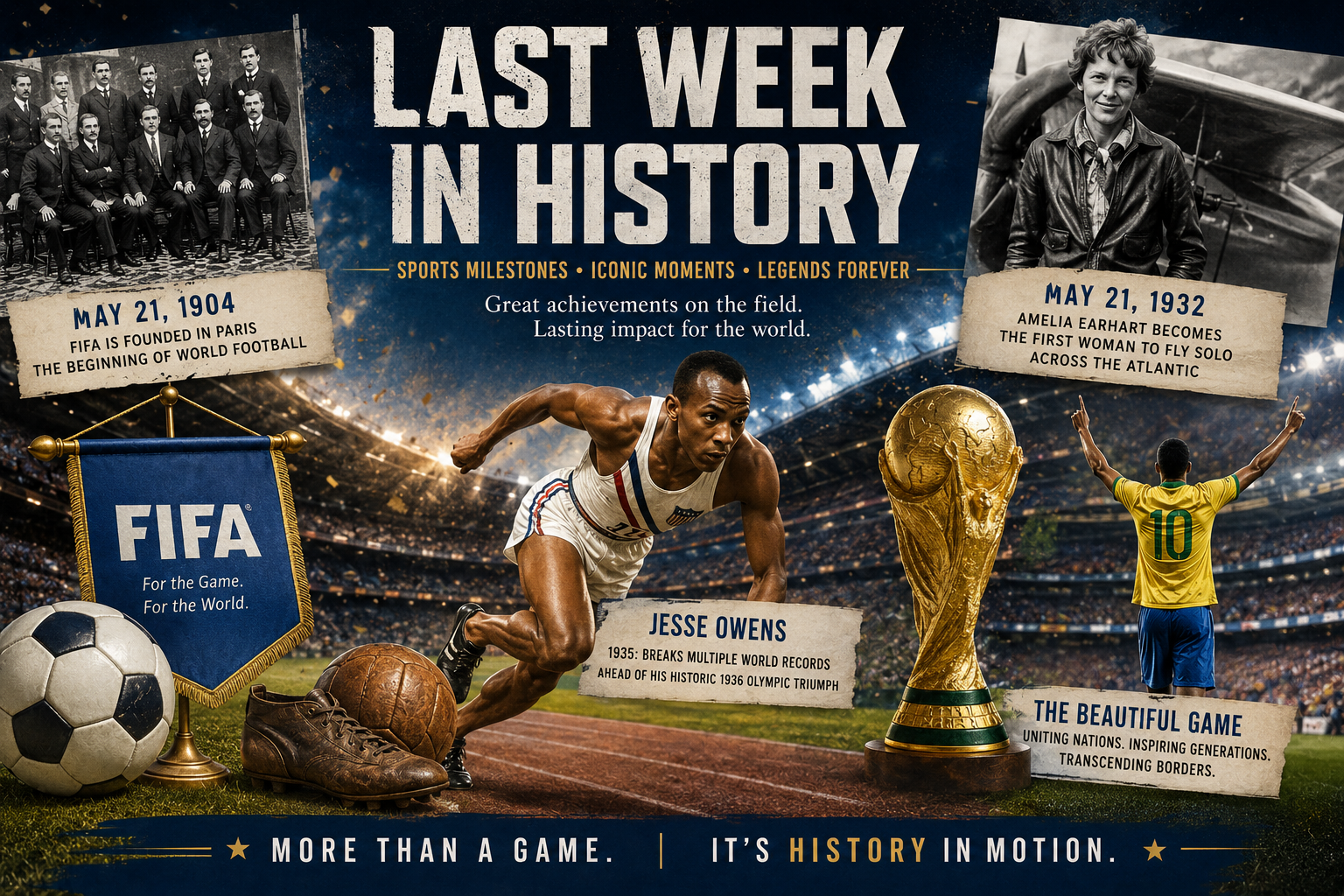
Sports history during this week reflects both physical brilliance and cultural transformation. On May 25, 1935, Jesse Owens delivered one of the most astonishing athletic performances ever recorded at the Big Ten Championships in Michigan. In less than an hour, Owens broke three world records and tied a fourth, cementing his place among the greatest athletes in history. His later triumphs at the 1936 Berlin Olympics would become a direct challenge to Nazi racial ideology on the world stage.
On May 30, 1911, the first Indianapolis 500 was held at the Indianapolis Motor Speedway. What began as a grueling endurance race evolved into one of the world’s premier motorsport events while also serving as a testing ground for automotive safety and engineering innovations.
The successful ascent of Mount Everest on May 29, 1953, also deserves recognition as one of history’s greatest feats of endurance sport and human resilience. Climbing at extreme altitude requires a level of physical and mental discipline that makes ordinary exercise routines feel like a leisurely walk to buy coffee.
Football culture also resonates strongly during this week, particularly in Brazil, where the sport functions somewhere between national identity and organized emotional chaos. World Football Day observances in late May celebrate the game’s global influence and its unique power to unite entire populations in collective joy or despair.
Entertainment & Cultural Highlights
The final week of May has produced some of the most influential cultural moments of the modern era. On May 25, 1977, Star Wars premiered in theaters and permanently transformed blockbuster filmmaking. George Lucas created not just a movie franchise, but an entertainment empire that reshaped visual effects, merchandising, fan culture, and Hollywood economics itself.
A decade earlier, on May 26, 1967, The Beatles released Sgt. Pepper’s Lonely Hearts Club Band is an album that revolutionized studio recording and elevated the concept album into a legitimate artistic form. Modern music production still carries the fingerprints of that release.
Classical music experienced its own revolution on May 29, 1913, when Igor Stravinsky’s The Rite of Spring debuted in Paris. The performance famously triggered outrage and near-rioting among audience members shocked by its aggressive rhythms and unconventional choreography. Art occasionally advances by making people deeply uncomfortable first.
Late-night television history also changed on May 25, 1992, when Jay Leno officially became host of The Tonight Show following Johnny Carson’s retirement. At the time, late-night television was still a major force in shaping American pop culture and political conversation, back when people argued over comedians at work instead of fighting strangers online at two in the morning.
Historical Moments in The United States
On May 29, 1790, Rhode Island became the final of the original colonies to ratify the United States Constitution after securing assurances of a future Bill of Rights. The moment helped solidify the young republic while also highlighting America’s long-running tension between federal authority and states’ rights—a debate the country still has not fully settled centuries later.
May 31, 1955, brought the Supreme Court’s Brown v. Board of Education II ruling, ordering public school desegregation to proceed “with all deliberate speed.” The vague wording revealed both the importance of the ruling and the fierce resistance that still existed throughout much of the country. The struggle for equal access to education remains a defining issue in American society.
Memorial Day also frequently falls during this week, honoring U.S. military personnel who died in service. Originally known as Decoration Day after the Civil War, the observance evolved into one of the nation’s most solemn commemorations.
Historical Moments in Brazil
This week also holds important milestones in Brazilian history and state development. On May 26, 1824, the United States formally recognized the independence of the Empire of Brazil from Portugal. The recognition strengthened Brazil’s international legitimacy during its formative years as an independent nation and helped establish diplomatic relations that continue to shape the Western Hemisphere today.
On May 29, 1936, President Getúlio Vargas established the National Statistics Institute in Rio de Janeiro, later renamed the Brazilian Institute of Geography and Statistics, or IBGE. The institution became essential for understanding Brazil’s population, economy, territory, and infrastructure in a country so vast it often feels like several nations operating under one flag.
In Brazil, football observances during late May carry particular cultural weight. In cities like Rio de Janeiro, the sport is woven into daily life with an intensity that can turn an ordinary match into something resembling a national referendum conducted entirely through yelling.
Closing Reflection
The final week of May reminds us that history is rarely neat or predictable. Empires collapse while bridges rise. Scientific breakthroughs save lives while ethical failures force humanity to rewrite its moral boundaries. Artists shock audiences before becoming legends. Athletes redefine what the human body can endure. Politicians sign treaties they hope future generations will not have to test in war.
And through all of it, humanity continues its strange habit of stumbling forward—sometimes wisely, sometimes recklessly, occasionally brilliantly.
Looking back at these seven days, one lesson becomes impossible to ignore: progress is never permanent. Every generation inherits systems built by the people before them, and every generation eventually decides whether to strengthen those systems, neglect them, or set them on fire and hope for the best.
Outro
History is never just about the past—it’s a running commentary on where we are today. Some of these moments changed the world overnight. Others took years to reveal their impact. All of them are reminders that any given week can leave a lasting mark. Check back next week for another chapter.
References
General Historical Research
- History.com
- Encyclopaedia Britannica
- Library of Congress
- Smithsonian Institution
- National Archives (U.S.)
Politics & World Affairs
Military History & Global Conflict
- Imperial War Museums
- U.S. Holocaust Memorial Museum
- National WWII Museum
- The Avalon Project – Yale Law School
Science, Medicine & Innovation
- National Institutes of Health (NIH)
- Centers for Disease Control and Prevention (CDC)
- World Health Organization (WHO)
- Nature
- Scientific American
Technology, Space & Engineering
Sports History
- Olympics Official Site
- FIFA
- ESPN Sports History
- Baseball Hall of Fame
Entertainment & Cultural History
- Academy of Motion Picture Arts and Sciences
- Rock & Roll Hall of Fame
- The Kennedy Center
- British Film Institute
- The Beatles Official Site
United States History
- National Constitution Center
- U.S. Senate Historical Office
- White House Historical Association
- Library of Congress American History Collections
Brazil History & Culture
- IBGE – Brazilian Institute of Geography and Statistics
- National Library of Brazil
- Museu Nacional (Brazil)
- Government of Brazil
- Brasil Escola
Date-Based “This Day in History” Research
- On This Day
- HistoryNet – Today in History
- BBC History
- The Fact Site
This weekly series is curated using historical archives, academic references, government records, and cultural institutions, including Britannica, History.com, NASA, the Library of Congress, IBGE, the United Nations, and other publicly available historical resources.
Thanks for reading BeingKevin.
In a world built on scrolling past everything in seconds, I genuinely appreciate you stopping here for a moment. If the post gave you something to think about, made you laugh, or even made you disagree, I’d love to hear from you in the comments. A quick rating helps, too, and goes a long way toward supporting the site. And if you’d like to help keep BeingKevin going, a small tip is always appreciated — never expected, but deeply valued. Thanks again for being here
Leave a Reply