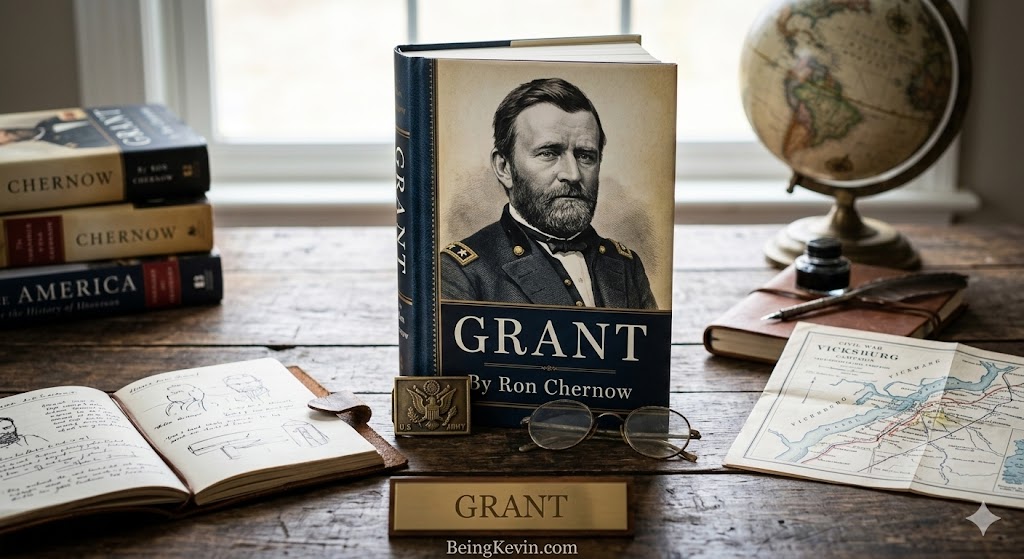
Book Review: Grant – A Flawed, Decent, and Essential American
By Ron Chernow
Rating: ⭐⭐⭐⭐⭐ (5/5)
Ulysses S. Grant is often remembered as the quiet general who forced Robert E. Lee’s surrender and brought the American Civil War to an end. But in Grant, Ron Chernow presents a far more layered, human, and compelling figure, a man shaped by failure, strengthened by loyalty, and driven by a moral conviction that set him apart during one of the most turbulent periods in American history.
Chernow’s biography is sweeping in scope while remaining deeply personal in detail. Rather than portraying Grant as a distant monument, the book reveals a man who stumbled repeatedly, learned painfully, and ultimately rose to greatness when history demanded it.
A Life Built on Failure — Until It Wasn’t
Grant’s early life was marked by modest beginnings and a long string of disappointments. Born in Ohio in 1822, he was shy, reserved, and deeply uncomfortable with conflict. He attended West Point reluctantly and drifted through his early military career without standing out.
After leaving the army in 1854 — partly due to struggles with alcohol — Grant entered one of the darkest periods of his life. He tried farming, real estate, selling firewood, and several business ventures, failing at nearly all of them. Chernow makes it clear that Grant’s greatest weakness was not laziness or incompetence, but trust. He believed in people too easily, a trait that would follow him throughout his life. By the eve of the Civil War, Grant was largely viewed as a man who had failed to fulfill his potential.
The Civil War: Grant Finds His Purpose
When the war began, Grant returned to military service almost by accident. Yet once back in uniform, something changed. The same man who struggled in civilian life quickly emerged as the Union’s most effective commander.
Chernow highlights Grant’s defining victories:
- Fort Donelson — where he demanded “unconditional surrender.”
- Shiloh — a brutal test of endurance and resolve
- Vicksburg — a strategic masterpiece that split the Confederacy
- Chattanooga — where Union forces broke Confederate control of the Deep South
By 1864, Abraham Lincoln appointed Grant General-in-Chief of the Union Army. His strategy was relentless: maintain constant pressure, absorb losses when necessary, and destroy the Confederacy’s ability to continue fighting. Critics labeled him a butcher, but Chernow argues that Grant understood the grim realities of modern war better than any of his contemporaries.
That leadership culminated in Lee’s surrender at Appomattox, where Grant’s restraint and generosity helped begin the difficult process of national reconciliation.
Grant the Man: Honest, Loyal, and Too Trusting
One of the biography’s greatest strengths is its portrayal of Grant as a man full of contradictions:
- personally humble, yet capable of extraordinary leadership
- gentle in temperament, yet relentless in war
- honest to a fault, yet surrounded by corruption
- underestimated, yet indispensable
Grant’s greatest flaw — and greatest vulnerability — was his trusting nature. He instinctively believed the best in people, which made him beloved by soldiers and loyal friends, but also left him vulnerable to manipulators, political opportunists, and corrupt associates. That weakness would later haunt his presidency.
The Presidency: Reconstruction and Civil Rights
Grant served two presidential terms from 1869 to 1877, and Chernow strongly argues that his presidency deserves far more respect than it traditionally receives.
His greatest achievements included:
- aggressively enforcing Reconstruction
- using federal power to combat the Ku Klux Klan
- supporting the 15th Amendment and Black voting rights
- protecting enslaved people, when much of the country wanted to abandon Reconstruction entirely
Grant believed deeply in racial equality — an unusually strong position for a 19th-century president — and he used presidential authority to defend it. Chernow makes a compelling case that Grant was among the strongest defenders of Black civil rights in 19th-century American history.
At the same time, his presidency was repeatedly damaged by corruption scandals. Grant himself remained personally honest, but his tendency to trust friends and political allies often blinded him to misconduct around him. He appointed people who betrayed his confidence, defended corrupt subordinates too long, and fell victim to businessmen who manipulated him financially.
Chernow’s portrayal is balanced: Grant was never corrupt himself, but he was often a poor judge of character.
The Final Chapter: Ruin, Redemption, and Literary Greatness
After leaving office, Grant suffered financial ruin after being swindled by a Wall Street fraudster. At nearly the same time, he was diagnosed with terminal throat cancer.
Rather than collapsing under the combined weight of illness, poverty, and betrayal, Grant undertook what became one of the most remarkable final acts in American literary history. Encouraged and published by Mark Twain, Grant wrote his Personal Memoirs, now considered one of the finest works of American nonfiction ever produced.
He completed the final pages only days before his death in 1885. The book’s success saved his family financially and permanently reshaped his historical reputation.
Legacy: A Flawed but Essential American
One of Chernow’s central arguments is that Grant’s reputation has long been misunderstood. For decades he was dismissed as a mediocre president and an unsophisticated general who simply overwhelmed the Confederacy with manpower. Modern historians, however, have increasingly restored Grant to a far more significant place in American history.
Grant emerges as:
- a brilliant military strategist
- a defender of Black civil rights
- a leader of deep moral conviction
- a man who preserved the Union
- a human being shaped by failure rather than defined by it
His flaws were real, but his virtues were greater.
Ultimately, Grant’s story becomes a powerful reminder that greatness often grows from resilience, humility, loyalty, and the willingness to continue forward even after repeated failure.
Final Rating: ★★★★★ (5/5)
Grant is one of the finest American biographies I have read. Chernow restores Grant as a central and transformative figure in American history while never ignoring his weaknesses or contradictions.
The biography is deeply researched, highly readable, emotionally compelling, and remarkably human. More than just a military history or presidential study, it becomes the story of a decent man repeatedly tested by war, politics, betrayal, and personal failure — and who kept going anyway.
This is absolutely essential reading for anyone interested in American history, leadership, the Civil War, or the complexities of character.
Critical Reception When Released
Upon release, Grant received widespread critical acclaim from historians, literary reviewers, and readers alike. Critics praised Chernow for reexamining Grant’s legacy and challenging decades of outdated historical portrayals that minimized both his military brilliance and his commitment to civil rights.
Reviewers especially highlighted:
- Chernow’s balanced portrayal of Grant’s strengths and flaws
- The rehabilitation of Grant’s presidential legacy
- The detailed examination of Reconstruction and Black civil rights
- the emotional depth and readability of the narrative
- The powerful treatment of Grant’s final years and memoir writing
Many historians considered the biography one of the definitive modern works on Grant and a major contribution to the reassessment of Reconstruction-era history.
Leave a Reply