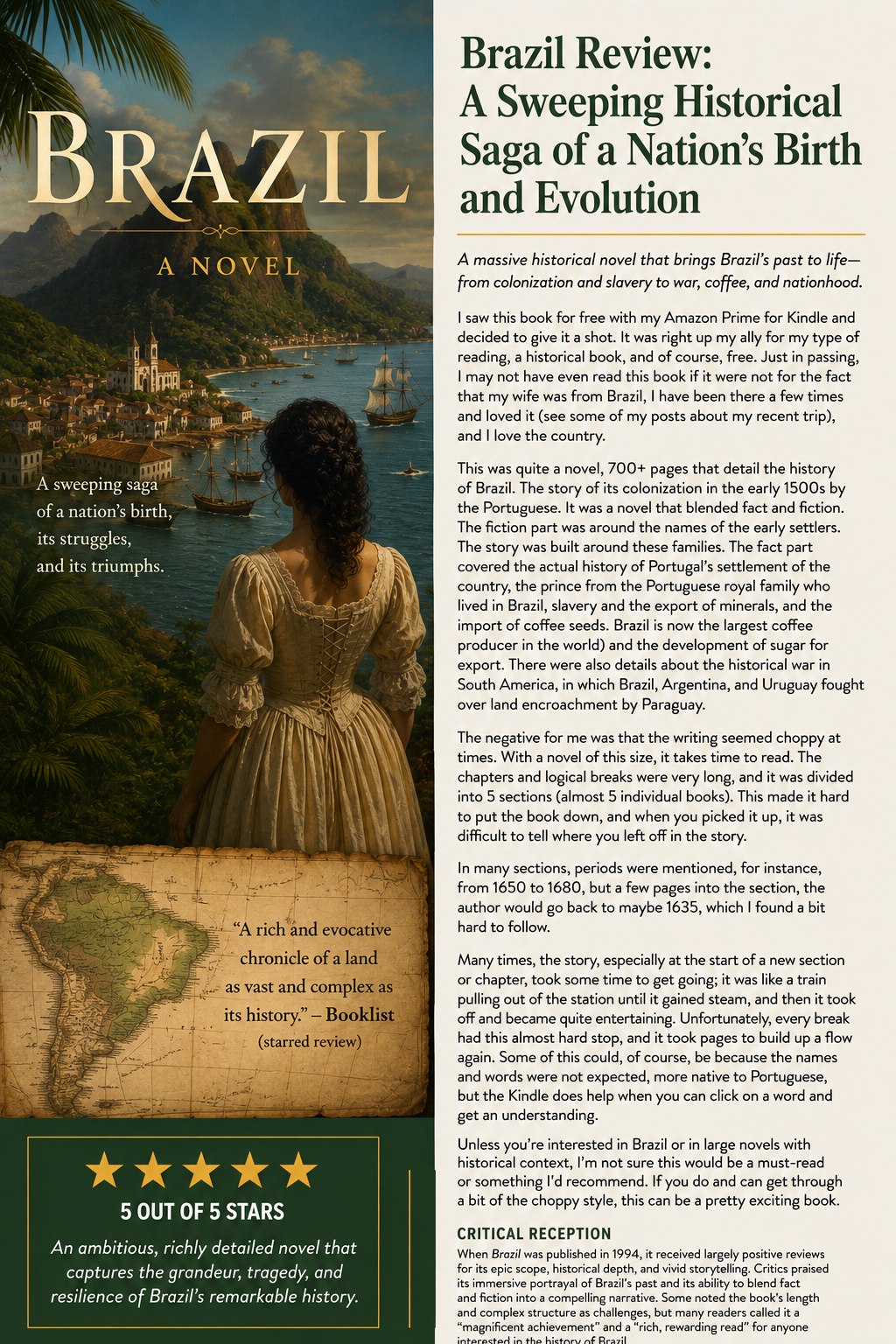
By Errol Lincoln Uys
Rating: ⭐⭐⭐⭐⭐ (5/5)
I originally came across Brazil by Errol Lincoln Uys as a free selection through Amazon Prime for Kindle and decided to give it a chance. It immediately fit the type of books I enjoy most — historical fiction with real historical depth — and the fact that it was free certainly did not hurt. I also suspect I may never have picked it up had it not been for my personal connection to Brazil. My wife was from Brazil, I have traveled there several times, and I genuinely love the country and its culture.
This is an ambitious novel of more than 700 pages that attempts to tell the broader history of Brazil through a blend of fiction and historical fact. The fictional side of the story centers around generations of settlers and families, while the historical portions trace the colonization of Brazil by the Portugal beginning in the early 1500s.
The book explores major moments in Brazilian history, including the role of the Portuguese royal family in Brazil, slavery, mineral exports, the development of sugar production, and the introduction of coffee cultivation — which eventually helped Brazil become the world’s largest coffee producer. It also touches on regional conflict in South America, including the devastating war involving Brazil, Argentina, Uruguay, and Paraguay over territory and regional power.
What makes the novel interesting is the sheer scope of its storytelling. It attempts to capture centuries of Brazilian history and the growth of the country from colony to emerging nation. At its best, the book becomes immersive, educational, and highly entertaining.
That said, the novel was not without flaws for me. The writing style could feel choppy at times, especially given the book’s enormous length. The structure is divided into five major sections that almost feel like separate novels, and the chapters and narrative breaks are often extremely long. This occasionally made it difficult to stop reading and then easily return to the story later without losing your place in the timeline.
I also found some of the chronology slightly confusing. At times, the author would establish a specific historical period — for example, 1650 to 1680 — only to shift backward in time a few pages later. While not a major issue, it occasionally interrupted the flow and required some effort to reorient yourself within the story.
The pacing could also be uneven. Many chapters started slowly, almost like a train gradually leaving the station before finally building momentum and becoming genuinely engaging. Unfortunately, each major section often reset that momentum, creating a stop-and-start feeling throughout the novel.
Some of this difficulty may also come from the unfamiliar Portuguese names, places, and terminology woven into the narrative. Fortunately, reading on Kindle helped considerably since unfamiliar words and references could quickly be looked up while reading.
Overall, unless you have a strong interest in Brazilian history or enjoy long historical epics, I am not sure this would qualify as a universal must-read. However, if you appreciate large-scale historical fiction and can work through some uneven pacing and structure, Brazil can become a fascinating and rewarding read.
For me, the historical insight into a country I have grown to appreciate made the experience worthwhile.
★★★★★ 5/5 Stars
Critical Reception
When Brazil was released, readers who enjoy sweeping historical fiction often praised the novel for its ambitious scope and rich historical detail. Many appreciated how it blended fiction with real historical events to create an accessible introduction to Brazilian history. Some critics, however, noted the same challenges I experienced — uneven pacing, dense sections, and structural complexity due to the novel’s large scale and multi-generational narrative.


Leave a Reply