
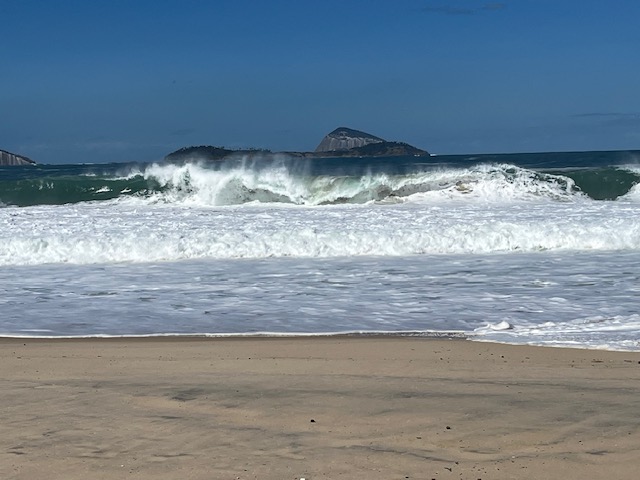
A Thought about Waves
After spending years on beaches in New Hampshire, Massachusetts, and Florida, I noticed something different about Rio. At Leblon, the waves often seem to sweep diagonally down the shoreline instead of marching straight in. It turns out this isn’t my imagination. Oceanographers call this the angle of wave approach, and it is influenced by distant storms, the shape of the coastline, and the way waves bend as they move into shallow water.
One reason this fascinates newcomers is that it challenges what we think we’re seeing.
We look at a beach and assume the waves are coming straight in. But they are actually carrying information from distant storms, ocean depths, and the shape of the coastline itself.
A wave breaking at your feet on Leblon may have begun its journey days earlier in a storm hundreds or thousands of kilometers away. By the time it reaches Rio, its direction has been altered by the curvature of the coast and the contours of the ocean floor.
The wave looks simple. The journey behind it is anything but.
Waves in Rio often arrive at an angle because of where the swells are generated in the South Atlantic, the shape of the coastline, underwater geography, and the way wave energy bends as it approaches the shore.
Why Waves Hit Rio Beaches at an Angle
If you stand on Leblon Beach or Ipanema Beach and watch carefully, the waves often seem to sweep down the beach rather than crash directly onto it.
Several factors create this effect:
1. The South Atlantic Is Sending Waves From Far Away
Many of Rio’s waves begin hundreds or even thousands of kilometers away. Storms in the South Atlantic generate swells that travel enormous distances before reaching Brazil.
Those swells are rarely aimed perfectly perpendicular to the shoreline. Instead, they approach from the southeast or southwest, striking the coast at an angle.
Think of throwing a pebble across a pond toward a dock. Unless you throw it perfectly straight, the ripples reach the dock at an angle.
2. Rio’s Coastline Isn’t Straight
The coastline around Rio curves dramatically.
From Copacabana Beach to Ipanema and Leblon, the beach orientation changes.
A swell that appears straight offshore may meet one section of beach head-on while reaching another section at an angle.
3. Underwater Geography Bends Waves
As waves enter shallower water, the part of the wave that reaches first slows down.
The deeper portion keeps moving faster.
This causes the wave to bend, a process called wave refraction.
The result is that the wave may start out traveling one direction offshore but arrive at the beach from a different angle.
4. Longshore Currents
When waves hit a beach at an angle, they push water sideways along the shore.
This creates a longshore current.
If you’ve ever entered the water in one spot at Leblon and found yourself 100 meters down the beach a few minutes later, you’ve experienced this firsthand.
Why It Feels Different Than New England
The beaches of New Hampshire and Massachusetts generally face more directly toward the open Atlantic.
While angled waves certainly occur there, many beaches are oriented differently relative to the dominant swell directions.
Florida can also receive angled waves, but many beaches have a straighter coastline and a different mix of swell sources.
Rio’s combination of:
- Curved coastline
- Large headlands and mountains
- South Atlantic swell patterns
- Underwater contours
often makes the angled approach much more obvious to someone standing on the sand.
These are excellent sources because they explain the actual physics in plain English and are considered authoritative.
Sources
NOAA: Longshore Currents
Key point:
Waves do not typically reach the beach perfectly parallel to the shoreline. Rather, they arrive at a slight angle. (National Ocean Service)
NOAA: How Waves Behave Near Shore
Good background on wave formation and what happens as waves approach shallow water.
NOAA – Waves and Coastal Currents
Explains how wave energy changes as waves move toward shore. (National Ocean Service)
Thanks for reading BeingKevin.
In a world built on scrolling past everything in seconds, I genuinely appreciate you stopping here for a moment. If the post gave you something to think about, made you laugh, or even made you disagree, I’d love to hear from you in the comments. A quick rating helps, too, and goes a long way toward supporting the site. And if you’d like to help keep BeingKevin going, a small tip is always appreciated — never expected, but deeply valued. Thanks again for being here


Leave a Reply