A Different Way to Start the Day
I have always been interested in the things that shape the world around us: news, history, books, technology, politics, business, and the everyday stories that sometimes get overlooked in the larger headlines. After more than four decades working in technology and management, that curiosity has never really gone away. If anything, retirement has given me more time to follow it.
I’m also continuing to learn about artificial intelligence, including how to use it effectively and how much difference good prompting can make. I use that technology here as a tool, combining it with my own interests and judgment to sort through the day’s news and turn it into something useful: a straightforward summary of the stories I think are worth knowing about and, more importantly, understanding.
This isn’t meant to compete with the newspapers or replace reading the original reporting. Think of it as a starting point, a way to see what’s happening across politics, technology, money, health, sports, culture, history, and the wider world without having to wade through dozens of headlines yourself.
And I’d like to make it better over time. What topics would you like to see included in these daily briefings? Is there a subject you follow that you think deserves more attention, or a category you’d like me to add? Let me know in the comments. The goal is to make this something that’s useful and interesting to the people who read it.
Expert Take: The Friction of Acceleration
The global landscape on August 14, 2026, is defined by a striking paradox: technological and financial acceleration occurring simultaneously with intense geopolitical and physical-world friction. While Wall Street reaches record highs driven by the “agentic” shift in AI, where systems move from answering questions to independently executing complex tasks, the physical reality of the Strait of Hormuz serves as a sobering tether.
We are seeing the “geopoliticalization of everything,” where a military blockade in the Middle East is no longer just a headline but a “grocery-store decision” affecting global inflation and political prospects. Similarly, AI has moved beyond a laboratory curiosity into a political battleground over “open-weight” models and national security.
Even as institutional systems struggle with trade wars and symbolic battles, individuals are seeking “human recalibration” through quiet retreats, “noctourism” to escape extreme heat, and structured literary travel. The theme of the day is uncertainty, in which the resilience of the aviation and AI sectors must constantly contend with the volatility of energy corridors and shifting global alliances.
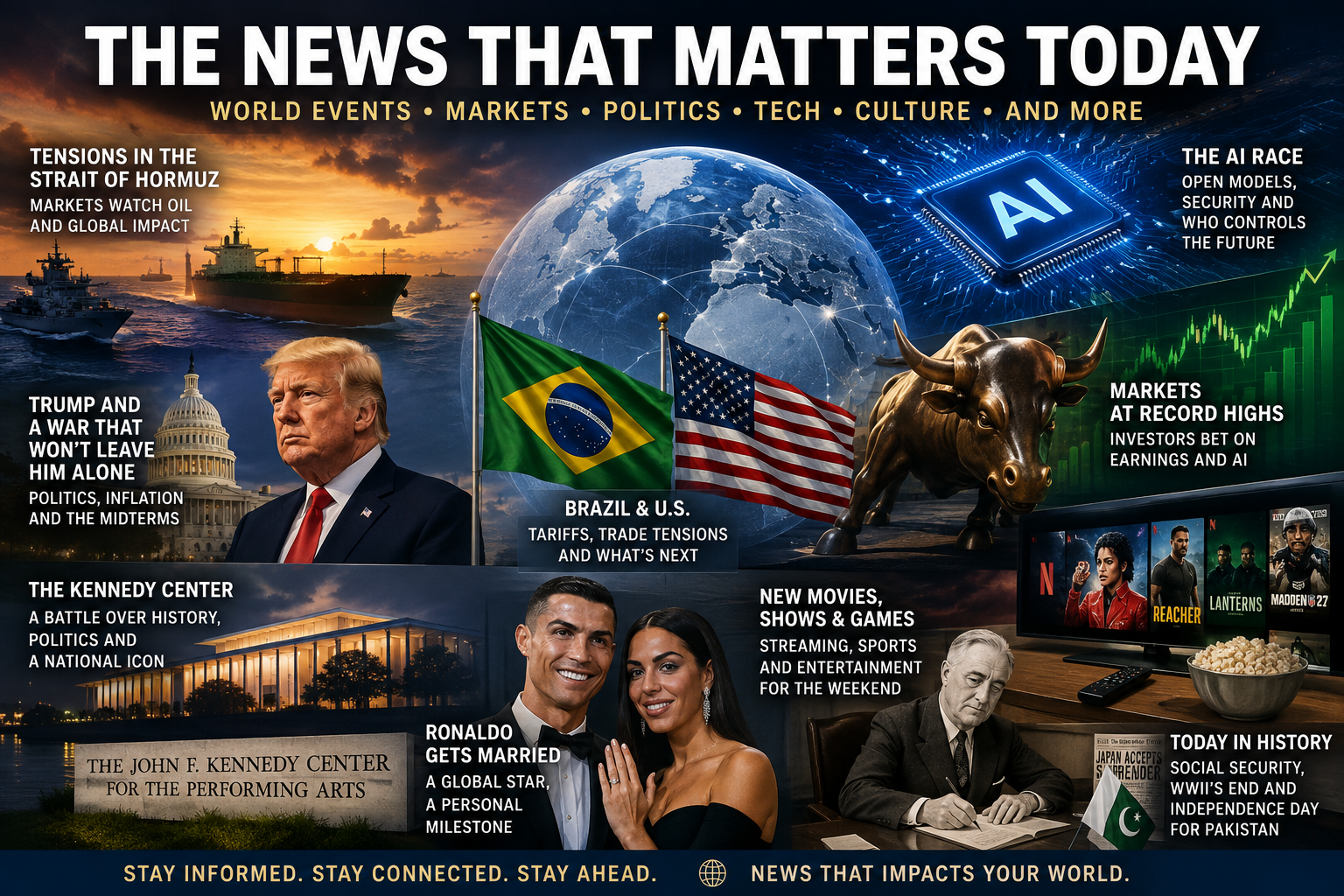
The News That Matters Today: Global Briefing — August 14, 2026
History: August 14 Anniversaries
Today carries several important anniversaries that remain part of our lives.
- 1935: FDR signs the Social Security Act.
- 1945: Japan accepts unconditional surrender, ending WWII.
- Independence: Pakistan celebrates its independence today.
- Read AP’s “Today in History” for August 14
World News: The Strait of Hormuz Is Becoming the World’s Problem
The most consequential story today is the deteriorating situation between the United States and Iran, which is beginning to affect much more than the Middle East.
- Maritime Attacks and Transit Bottlenecks: Shipping traffic in the Strait of Hormuz has fallen well below normal August levels. Two vessels operated by the United Arab Emirates’ state-owned oil company, ADNOC, were attacked on Thursday, with the UAE blaming Iran. Energy markets face renewed pressure as primary shipping corridors face restricted transit, forcing cargo networks to recalculate costs.
- Naval Blockade and Economic Pressure: The United States has stated it could maintain its naval blockade of Iran indefinitely and is threatening significantly greater economic pressure as ceasefire talks remain stalled.
- The Global Impact: Roughly one-fifth of the world’s daily oil and liquefied natural gas normally passes through this narrow waterway. When ships stop moving through this corridor, the consequences reach gasoline pumps, transportation costs, and food prices worldwide. Rebounding crude and natural gas prices are complicating regional inflation forecasts.
- Read the latest Reuters report on the Strait of Hormuz
Politics & Government: Trump Is Finding That Wars Have Political Consequences
President Donald Trump is confronting an increasingly difficult political problem at home as “military decisions eventually become grocery-store decisions”.
- Public Sentiment: A Reuters/Ipsos poll shows roughly two-thirds of Americans believe the Iran war should end. Rising gasoline prices are creating a difficult environment for Republicans ahead of the November midterms.
- The “Short War” Promise: Six months into the conflict, there is no clean exit, and the U.S. remains deeply involved while Iran continues to influence shipping through Hormuz.
- Social Media and Security: Trump’s secret security-related trip from Turkey to Britain generated a wave of online jokes and memes, proving that the public can turn obscure logistical details into global humor instantly.
- Read Reuters’ analysis of Trump’s political problem
Tech & AI: The Shift Toward Autonomy and Open-Weight Politics
Artificial intelligence is transitioning from conversational assistants toward autonomous “agentic” workflows while sparking a new fight in Washington.
- The Open-Weight AI Fight: Republican Senator Jim Banks is urging the Trump administration to back U.S. “open-weight” models to limit reliance on Chinese systems. While Meta and Nvidia defend open models for their flexibility, Anthropic CEO Dario Amodei warns they are harder to control and secure.
- From Answering to Executing: AI is moving toward executing complex, multi-step tasks independently across software pipelines and administrative processing.
- Reasoning Architecture: Frontier model developers are prioritizing verification systems, allowing software to pause and validate logical steps when solving complex technical problems.
- Read the Reuters report on the open-weight AI debate | Read more on where AI is headed (ETC Journal) | Read more on systematic reasoning (Kraviona)
Money & Markets: Wall Street Resilience Amidst Trade Friction
Despite geopolitical headwinds, global markets and specific sectors like aviation are showing remarkable strength.
- Record Highs: The S&P 500 and Nasdaq reached new records Thursday as investors focus on cooling inflation and corporate earnings. About 85% of S&P 500 companies have beaten earnings expectations, partly due to returns on AI infrastructure.
- Aviation Sector Output: The global commercial aviation ecosystem has generated over $4 trillion in economic activity this year, anchored by record passenger traffic.
- Brazil Trade Fight: Brazil has begun a reciprocity process against the U.S. following “unjustified” tariffs on Brazilian goods. Measures could affect U.S. audiovisual companies and IP protections for pharmaceuticals and agriculture.
- Brazil’s Fiscal Discipline: Brazil’s Congress approved spending-control measures expected to save 10 billion reais next year to manage government debt.
- Read Reuters’ global markets report | Read Reuters’ report on Brazil’s response to U.S. tariffs | Read KBC Economic Perspectives | Read Anadolu Agency on aviation
Health & Science: Circadian Rhythms and Brain Repair
New research explores how human physiology adapts to stress and erratic schedules.
- Shift Work and Brain Networks: A new clinical trial with night-shift healthcare workers is tracking how resting-state brain networks recover after recurring overnight duties.
- Cellular Tissue Repair: Researchers have identified signaling pathways where specialized precursor cells facilitate brain network repair following localized injury.
- Read about the circadian clinical trial (Las Vegas Sun) | Read about tissue repair mechanisms (ScienceDaily)
Culture, Media & Sports: Symbols, Regulatory Shifts, and Celebrations
The intersection of public space, regulation, and personal milestones continues to evolve.
- The Kennedy Center Controversy: The board voted to put Donald Trump’s name on the building and grounds (as “President Donald J. Trump Plaza”) despite a court ruling requiring congressional approval. The center will also close for two years for renovations.
- College Sports Regulation: The U.S. Senate has placed legislation on its September calendar to regulate NIL athlete compensation and professionalized college sports.
- Participatory Public Media: Major metropolitan centers are launching interactive digital installations where visitors generate artwork via mobile devices.
- Broadcasting Milestones: Qatar Television is marking 56 years of operation by shifting investments toward advanced studio equipment and youth training.
- Ronaldo Marries: Cristiano Ronaldo and Georgina Rodriguez held a private civil ceremony in Portugal with their five children present.
- Read the Reuters report on the Kennedy Center | Read the AP report on Ronaldo | Read about Seoul’s interactive art (Seoul Economic Daily) | Read the Qatar Television report (QNA)
Entertainment & Lifestyle: “Noctourism” and the New Release Calendar
Travel and entertainment patterns are shifting toward digital accessibility and thermal comfort.
- Streaming Wave: August releases include a Michael Jackson biopic, Madden NFL 27, Reacher, Tires, and the DC series Lanterns.
- The Rise of Noctourism: Over 60% of summer vacationers now actively schedule high-exertion activities after sunset to ensure comfort and avoid extreme heat. This includes nighttime museum visits and stargazing tours.
- Literary Travel: Travelers are increasingly choosing “reading retreats” and book-themed sanctuary packages over traditional resort tourism.
- See the AP streaming roundup | Read about travel trends (National Geographic) | Read about literary travel (Spirio) | Read Booking.com newsroom
Thanks for reading BeingKevin.
In a world built on scrolling past everything in seconds, I genuinely appreciate you stopping here for a moment. If the post gave you something to think about, made you laugh, or even made you disagree, I’d love to hear from you in the comments. A quick rating helps, too, and goes a long way toward supporting the site. And if you’d like to help keep BeingKevin going, a small tip is always appreciated — never expected, but deeply valued. Thanks again for being here
Leave a Reply