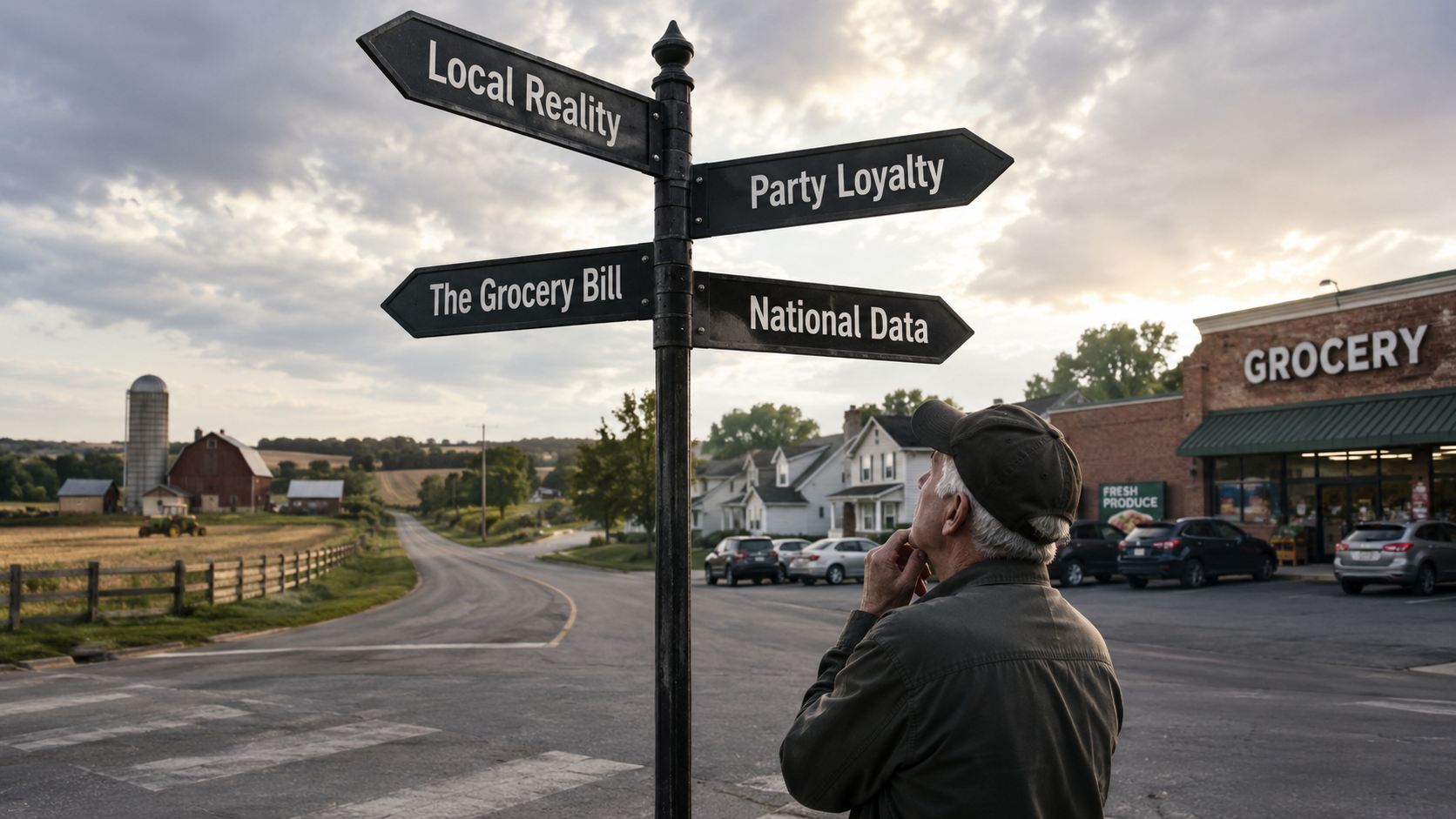
Opening
I recently came across a Newsweek article showing Donald Trump’s approval ratings by state. At first glance, it seemed like just another political map. But the longer I looked at it, the more a simple question began bothering me.
If voters are judging politicians based on performance, especially economic performance, why does the approval map look so much like the election map?
That question sent me down a rabbit hole that led far beyond Trump, Republicans, Democrats, or even politics itself.
It led me to a broader question about how people form opinions.
The Starting Assumption
Most politicians want voters to judge them based on results.
Jobs.
Wages.
Inflation.
Growth.
Cost of living.
That seems fair enough.
If economic conditions improve, support should rise.
If economic conditions deteriorate, support should fall.
At least that is how many people assume voters behave.
When I looked at Trump’s strongest approval states, some of the patterns made sense.
States such as Wyoming, Oklahoma, North Dakota, and West Virginia have economies tied closely to energy production. Oil, natural gas, coal, and resource extraction remain important parts of those economies.
Policies that emphasize domestic energy production and reduced regulation may provide direct economic benefits to many people living there.
In those cases, support and economic interests can align.
But then I ran into a contradiction.
The Agriculture Problem
Agricultural states complicated the story.
During Trump’s second term, tariffs led to retaliatory actions from major trading partners. Many American farmers experienced reduced export opportunities, particularly in commodities such as soybeans.
Government assistance programs helped offset some of the losses, but the underlying economic pressure was real.
That raised a question.
If economics is the primary driver of political support, why didn’t agricultural states dramatically shift away from Trump?
States such as Iowa, Nebraska, and Kansas remained largely supportive despite measurable economic challenges connected to trade policy.
That does not mean tariffs were universally unpopular.
It does not mean all farmers were harmed equally.
It simply suggests that economics alone cannot fully explain political support.
The Question That Wouldn’t Go Away
The deeper I looked, the more I began wondering whether people are actually making political decisions based primarily on economics at all.
At first, that sounds absurd.
Politics is often discussed as though voters are constantly calculating costs and benefits.
But real life rarely works that way.
Support often remains remarkably stable even when economic conditions change.
Why?
The Comfort Trap
One possibility is what I call the comfort trap.
People tend to focus on what they know.
What they understand.
What they experience directly.
What feels familiar.
This is not necessarily about intelligence.
It is about being human.
Most people spend their lives dealing with immediate realities:
- their job
- their bills
- their family
- their neighborhood
- their grocery store
These things are real and unavoidable.
The further an issue moves away from everyday experience, the less influence it often has on political opinions.
Most people do not wake up thinking about global supply chains.
They think about whether they can afford groceries.
They think about their mortgage payment.
They think about their paycheck.
The immediate tends to outweigh the abstract.
We Don’t All Live in the Same Economy
This led me to another realization.
Politicians and commentators often talk about “the economy” as though everyone experiences the same economy.
They don’t. Most people do not have any part of the stock market.
A one-dollar increase in the price of bread means very different things depending on where someone stands financially.
If a person earns $150,000 a year, they may barely notice.
If a person earns $30,000 a year, they almost certainly will.
The inflation rate is identical.
The experience is not.
The statistics are the same.
The impact is completely different.
This may explain why political discussions about the economy often feel disconnected.
One person says the economy is doing great.
Another says the economy is terrible. See my post on the American Dream
Both may be accurately describing their own reality.
A retired homeowner with investments may be thriving.
A renter struggling with housing, food, and insurance costs may be under enormous pressure.
They are living in the same country but experiencing different economies.
Education Doesn’t Explain Everything
Many political analyses rely heavily on education as an explanation.
I think that is often incomplete.
Education and economic experience are not the same thing.
A college graduate earning $40,000 and a business owner without a degree earning $200,000 are likely experiencing economic conditions very differently.
Likewise, two people with identical educational backgrounds may have completely different financial realities.
Education matters.
But it does not fully explain how economic pressure is experienced.
Are People Uninformed?
This is where things become uncomfortable.
One possible explanation is that many people simply lack sufficient information to evaluate policy outcomes.
That may be true in some cases.
But I do not think it is the entire answer.
Some people may not know.
Some people may know and not care.
Some people may know and prioritize other issues.
Some people may know and simply reach different conclusions.
The data cannot tell us which explanation applies to any individual voter.
What it does suggest is that people are not behaving as though economic self-interest is the only factor driving political support.
Political Identity and Loyalty
The more I thought about it, the more politics began to resemble sports fandom.
Most sports fans do not switch teams after one bad season.
They complain.
They criticize.
They blame management.
But they remain fans.
Political affiliation often works the same way.
People do not always ask:
“Which politician maximizes my economic interests this year?”
Instead, they often ask:
“Which side represents people like me?”
Or:
“Which side shares my values?”
Once that identity becomes established, economic outcomes may influence opinions on the margins, but they rarely produce a complete political realignment.
The Information Environment Has Changed
There is another factor that cannot be ignored.
The media environment itself has changed dramatically.
Traditional news organizations have become increasingly polarized, often appealing to audiences that already agree with them.
At the same time, social media has transformed how information spreads.
Today, people receive information from:
- traditional journalists
- cable news
- podcasts
- YouTube channels
- influencers
- independent commentators
- social media feeds
Some sources are excellent.
Some are terrible.
Many exist somewhere in between.
The challenge is that attention has become a business model.
Clicks matter.
Views matter.
Engagement matters.
A carefully researched article often competes against a sensational headline designed to trigger an emotional reaction.
A complex story may lose attention to a simple story.
Nuance frequently loses to certainty.
This is not a problem isolated to the political left or the political right.
Misinformation exists across the political spectrum.
Partisan framing exists across the political spectrum.
Selective reporting exists across the political spectrum.
Many people now consume information from sources that reinforce what they already believe.
As a result, two people can look at the same event and walk away with entirely different understandings of what happened.
The Polling Question
Polling itself introduces another complication.
People do not always tell pollsters exactly what they think.
Some hide unpopular opinions.
Some avoid controversial answers.
Some simply refuse to participate.
Polling remains useful, but it is not perfect.
Yet even allowing for polling error, one fact remains difficult to ignore.
The approval map continues to look remarkably similar to the election map.
What I Think Is Happening
After reviewing the data, I have become skeptical that economic performance alone drives political support.
Economics matters.
Inflation matters.
Jobs matter.
Wages matter.
Cost of living matters.
But they appear to be only one part of a much larger equation.
Political opinions seem to be shaped by a combination of:
- personal experience
- financial circumstances
- identity
- loyalty
- habit
- familiarity
- values
- media consumption
- social media influence
- information quality
The result is that support often remains more stable than the economic conditions surrounding it.
My Conclusion
The more I examined the approval data, the less convinced I became that approval ratings primarily measure economic performance.
Instead, they may be measuring something deeper.
People naturally focus on what is immediate, familiar, and personally relevant.
A grocery bill has more emotional impact than a trade report.
A monthly budget has more influence than a global supply chain.
A political identity developed over the years may be stronger than a temporary economic setback.
And in today’s world, our understanding of events is increasingly filtered through media organizations, social media platforms, commentators, influencers, and algorithms that compete for our attention.
If economics were the dominant driver of political support, we would expect approval maps to change dramatically as economic conditions change.
Instead, what we often see is remarkable stability.
That stability suggests political identity may be the foundation, while economic outcomes move support up or down around the edges.
The most interesting question may not be whether voters are right or wrong.
The most interesting question may be this:
If the approval map continues to resemble the election map, are voters evaluating performance—or are they evaluating reality through the lens of identity, experience, and the information sources they trust?
Sources
Primary Article
- Newsweek: Map Shows Donald Trump’s Approval Rating in Every State on His Birthday
https://www.newsweek.com/map-donald-trump-approval-rating-every-state-birthday-12065769
Polling Data
- Civiqs Daily Tracking Polls – Presidential Approval
https://civiqs.com/results/approve_president_trump
Additional National Polling
- Reuters U.S. Politics Coverage and Polling
https://www.reuters.com/world/us/
Agriculture and Tariff Data
- USDA Economic Research Service (ERS)
https://www.ers.usda.gov/ - USDA Foreign Agricultural Service (FAS)
https://www.fas.usda.gov/
Media, Information, and Democracy
- Anne Applebaum – Author Website
https://www.anneapplebaum.com/
Suggested Books by Anne Applebaum
- Twilight of Democracy: The Seductive Lure of Authoritarianism (2020) I have a review coming on this.
Additional Research Topics to Reference
- Pew Research Center – Political Polarization and Media Consumption
https://www.pewresearch.org/ - Gallup – Presidential Approval and Public Opinion Research
https://www.gallup.com/ - Brookings Institution – Political Behavior and Public Opinion Research
https://www.brookings.edu/ - National Bureau of Economic Research (NBER) – Economic and Political Research Papers
https://www.nber.org/
Leave a Reply