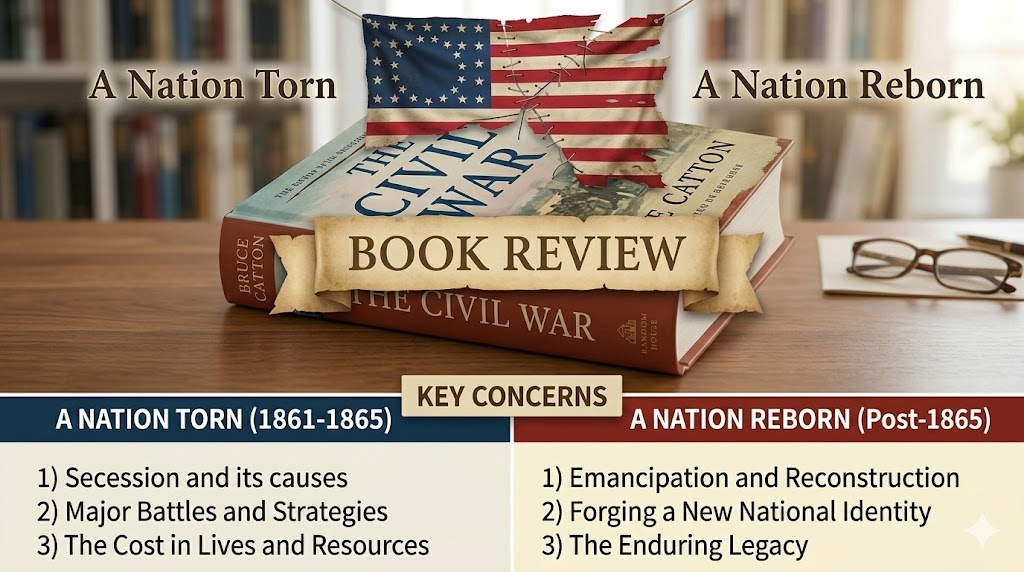
Book Review: The Civil War by Bruce Catton — A Nation Torn, A Nation Reborn
Bruce Catton
Rating: ⭐⭐⭐⭐⭐ (5/5)
The American Civil War wasn’t just a clash of armies — it was a battle for the nation’s identity and future. In his classic single‑volume history, Bruce Catton brings this defining conflict to life with unmatched clarity and narrative power. The Civil War is a sweeping human story that blends politics, culture, and the experiences of ordinary people in extraordinary times.
What struck me most in Catton’s writing is how alive the war feels under his pen. He moves effortlessly from the halls of Congress to the muddy fields of Antietam, from the fiery rhetoric of abolitionists to the quiet suffering of soldiers on both sides. Catton reminds us that the Civil War was not only about who won or lost — it was about how America was forever transformed.
A Master Storyteller: Catton’s Scope and Style
Catton covers the war’s full arc, from the secession crisis and fighting in 1861 to Appomattox in 1865. His work stands out because he turns history into a human saga rather than a dry chronology.
He balances:
- vivid battlefield storytelling
- political and social context
- portraits of leaders and everyday people
- The emotional weight of a nation at war with itself
Catton writes with a novelist’s eye and a historian’s discipline, making this one of the most accessible and compelling Civil War histories.
The Road to War: Causes and Early Tensions
Catton begins by exploring deep national fractures before the war began. He traces conflict roots to:
- The expansion of slavery
- competing visions of states’ rights and federal authority
- The collapse of political compromise in the 1850s
- violent flashpoints like Bleeding Kansas
Catton shows that the war was not inevitable. Once compromise failed, the nation quickly slid toward conflict. Bleeding Kansas, a “tragic prelude,” exposed divisions over slavery and the collapse of compromise. Kansas itself was split by the issue.
Leaders and Campaigns: The War’s Defining Figures
One of Catton’s strengths is his ability to bring historical figures to life. He paints vivid portraits of:
- Abraham Lincoln, steady and sorrowful, carrying the weight of the Union
- Ulysses S. Grant, relentless and unshakable
- Robert E. Lee was brilliant, yet he fought for a doomed cause.
- William Tecumseh Sherman, whose march reshaped the meaning of total war
- Jefferson Davis, rigid and embattled
Catton’s descriptions of major battles — Bull Run, Antietam, Gettysburg, Vicksburg, Sherman’s March to the Sea — are gripping without being overly technical, showing how leadership, geography, and innovation shaped the outcome.
The Human Dimension: Ordinary People in Extraordinary Times
What elevates Catton’s work is his attention to the human cost of war. He writes not only about generals and strategies, but also about:
- soldiers marching through mud and snow
- families divided by loyalty
- enslaved people seizing freedom as Union armies advanced
- civilians enduring shortages, fear, and devastation
Catton captures the sacrifice, suffering, and resilience of those who lived through the conflict. He shows how the war transformed ideas of freedom, union, and democracy — not just in Washington, but across the nation.
Outcome and Legacy: A Nation Remade
Catton ends with Union victory, emancipation, and the nation’s somber aftermath. He frames the Civil War as both:
- a rebirth of American ideals, redefining freedom and citizenship
The war ended slavery, preserved the Union, and began Reconstruction—but left wounds shaping American identity for generations.
Catton shows the Civil War’s legacy still shapes debates on equality, federal power, and national purpose.
⭐ Final Verdict
Bruce Catton’s The Civil War remains one of the most readable, insightful, and emotionally resonant accounts of America’s defining conflict. It captures sweeping history without losing sight of the people. Catton’s storytelling makes the war feel immediate and human, reminding us it was a battle over America’s meaning.
For anyone seeking a single‑volume introduction to the Civil War that is both accessible and profound, Catton’s work is essential.
A classic that endures. Essential reading. Five stars.


Leave a Reply