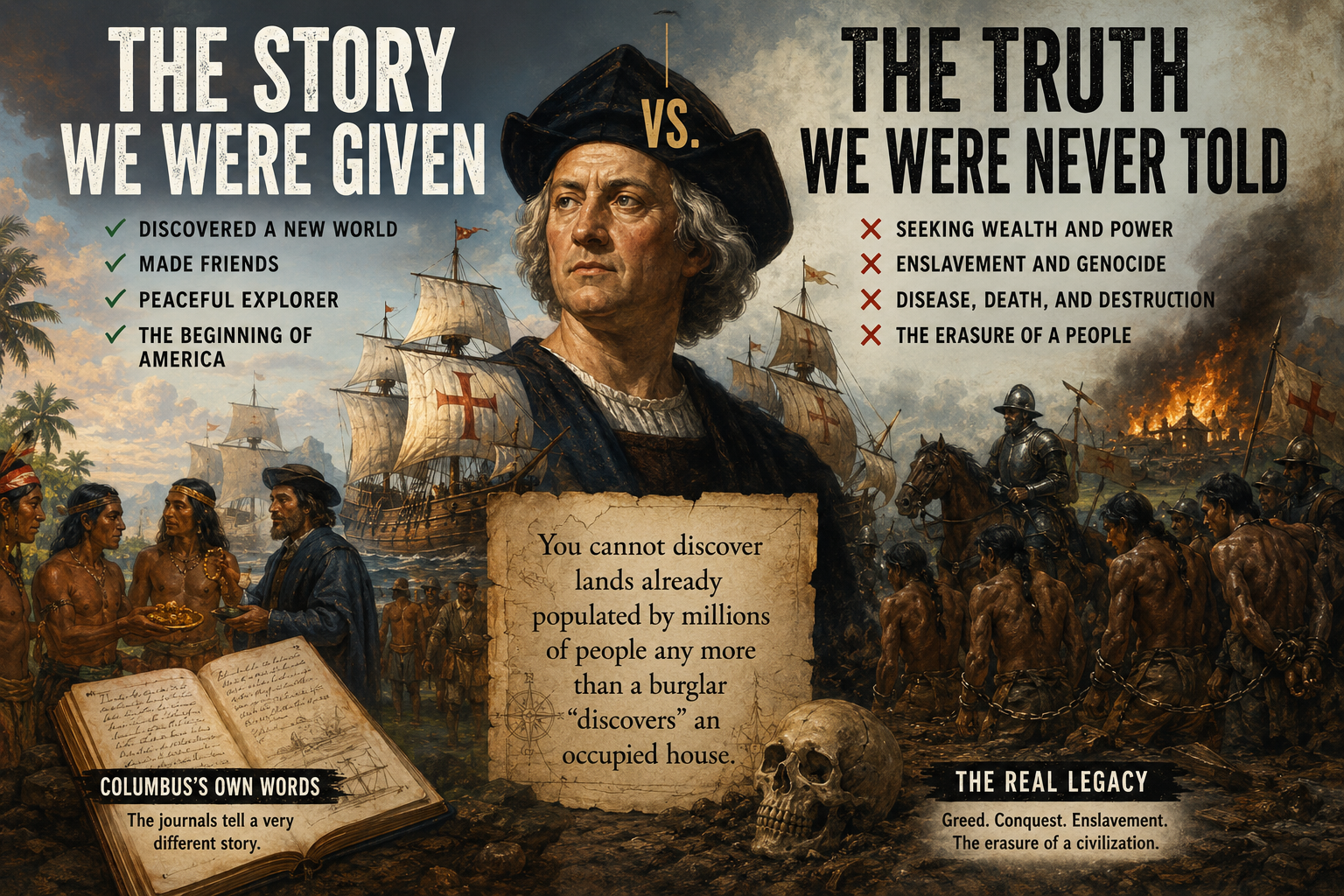
Core Thesis for the Blog
Christopher Columbus did not set out to discover a “New World”; he sought a western route to Asia in a desperate search for wealth to bring back to Spain. What was marketed as an expedition of discovery was, in reality, the accidental inception of ruthless imperial colonization. Columbus died completely unaware that a new continent even existed, miscalculating the size of a round world that scholars had long understood.
Introduction — The Story We Were Given
In school, kids are fed a fantasy, a cute, sanitized myth about three ships and a miraculous discovery. We’re told he made friends with the Indians, and “America” was born. In reality, it was the Americas, not America, and the feel-good story designed to make us happy completely ignores the raw greed and thirst for power that followed.
We’ve packaged this history into neat paid holidays. We even loop in traditions like Thanksgiving to paint a picture of a nation built on wonderful beginnings and benevolence. But we rarely hear of the death, destruction, or enslavement. We don’t hear the word genocide or look at the ugly stuff because you can’t sell ugly stuff. Everything is perception. None of the actual journals from the voyage—written in Columbus’s own hand—paints the peaceful picture we invented to make ourselves feel good. As author Howard Zinn calls out in A People’s History of the United States, the contradictions are glaring.
The classroom teaches us what is easy and comforting because confronting cruelty, expansionism, and conquest is hard. Then adulthood hits. If you choose to look at the truth, you start to ask questions. You become aware, and you feel almost hurt and disappointed by the fantasy. It forces an uncomfortable realization: we might not be as good as we think we are. Progress always leaves a trail, and it is usually not pretty.
Columbus Was Looking for Wealth, Not a New World
Columbus’s mission was never about anything more than finding a faster route to Asia. This wasn’t a cruise ship business like Princess Cruises; this was about gold, power, and ultimately, enslavement.
The biggest obstacle was selling the plan. He pitched his idea to several European nations, and they didn’t balk because they were benevolent or opposed to conquest. They balked at funding the trip because they did the math and realized his calculations were dangerously wrong. They thought it was throwing good money after bad for a voyage doomed to fail in the middle of an empty ocean.
That is, until Queen Isabella and King Ferdinand of Spain stepped in. You might wonder: why not Italy? After all, Columbus was Italian. But “Italy” at the time was a fractured collection of warring city-states; they weren’t a unified country focused on global voyages of wealth. Columbus essentially became an independent contractor, selling his skills to the highest bidder—not much different from a contract tech worker today.
Spain finally jumped on the idea ten years after Columbus started his door-to-door sales pitch. The timing was deliberate. Spain had just finished a long, exhausting war; its treasury was drained, and it was falling further behind its chief rival, Portugal. In the late 1400s, Spain and Portugal were the primary global explorers; England and France hadn’t yet fully entered the scene. So, Spain gave him a lucrative deal: a massive portion of whatever wealth he found, a noble title, and full financing. Given their precarious financial position, it was a desperate gamble. Just like today, big gambles either win big or fail big. Spain chose to be the ultimate risk-taker, and Columbus was their guy.
Good ole Chris could have used some Elon Musk satellite help here—or at least a cheap GPS—since he missed Asia by a whopping 10,000 miles. But hey, it was all good, because the real “fun” was about to start. Columbus was about to stumble into far more than just a quick trade route, fancy silk jammies, and a geisha to walk on his back.
Columbus stumbled onto Hispaniola, not a Peking Dragon fast-food restaurant. It was the first of several voyages, and it immediately set the stage for how he would deal with the natives, what they had, and exactly what he could take.
Columbus soon discovered the Indians were incredibly peaceful, had no real weapons, and were remarkably friendly. To the original exploiter, what else could that possibly mean? It meant it was time to cozy up, make friends, and strip them of everything they owned. After all, in his mind, white Europeans were superior—it was their divine right, and everyone else be damned. It’s a grimly familiar script, echoing the exact same mentality the United States would use 300 years later during the Trail of Tears.
So, Chris made his notes, left a crew behind to hold the fort, loaded up his ships, and headed home to Spain with grand plans for his next “Princess Cruise.” The era of brutal exploitation had officially begun—in a land he didn’t even know existed.
The Arawaks: The People Missing from the Hero Story
The people Columbus encountered were described as open, generous, and curious. Unfortunately for them, those are terrible survival traits when an empire lands on your shore carrying steel, disease, and debt.
Who were these people? They were the Taíno, a branch of the Arawak culture. Far from being “savages,” they had a thriving, organized society. They were expert farmers and fishermen, traded generously with neighboring islands, and settled their internal disputes peacefully.
But what happens when a culture built on trust and community meets a war machine? To the Spanish empire, peacefulness didn’t command respect; it signaled weakness. It meant a population that was easy to dominate, subjugate, control, and enslave.
And what a bonus that was for the contractor. Columbus didn’t just find the land; he found a captive workforce. The moment he noticed small gold rings hanging from their ears, their fate was sealed. The Spanish wouldn’t just extract the island’s riches; they would force the very people who welcomed them to dig them out of the earth. When a society doesn’t know conflict and refuses aggression, it quickly becomes hunted, owned, and brutally exploited.
Enslavement Began Almost Immediately
Americans often resist revisiting Columbus because the issue is no longer about the man himself. It’s about what happens when a nation’s founding mythology begins to crack.
When you strip away the sanitized legend, wouldn’t we just call Columbus the world’s first global bully? Isn’t that exactly what a bully does—sense a vulnerability and ruthlessly exploit it for personal gain? Suddenly, the holiday, the parades, and the beautiful fall day off don’t sound so great when you confront the reality of what we are celebrating.
“Bad-ass Chris” immediately forced the Taíno into slavery on their own ancestral land. Resistance was practically impossible; they had no steel, no guns, and none of the military technology of the Old World. They were trapped in a brutal system of forced labor, ordered to dig up their own natural resources and hand them over to their captors.
Sure, they could try to refuse—but the price of refusal was death. When the Taíno tried to run, the exploiters hunted them down on horseback and with attack dogs. When caught, they were brutally mutilated; the Spanish systematically chopped off hands or feet as an example to the others. Fear was the ultimate means of control, and Columbus used it without hesitation.
To add ultimate insult to catastrophic injury, the ships brought unseen killers: smallpox, measles, and influenza, along with the rats and vermin nesting in the hulls. Starved, overworked, and possessing zero immunity to these European diseases, the Taíno died by the thousands. Those who managed to survive the plagues and the mines were packed into cargo holds and shipped back to Spain in chains. Long before the transatlantic slave trade began stealing lives from Africa, the route was perfected in reverse—trafficking human beings from the Americas to Europe.
Discovery Implies Nobody Was Here
You cannot discover a continent already populated by millions of people any more than a burglar “discovers” an occupied house.
Isn’t it funny how good ole Chris was revered for “discovering” America? What exactly did he stumble upon, and what did he discover? It was already populated. It was already a thriving place. It always brings me back to that classic exchange on Seinfeld:
George: I like DeSoto.
Jerry: DeSoto? What did he do?
George: Discovered the Mississippi.
Jerry: Oh, like they wouldn’t have found that anyway.
Jerry nailed it. You can’t discover something that is already discovered, populated, and a place where people have lived for centuries. But that raw reality doesn’t make for the pretty picture, the paid holiday, and the feel-good story we feed to schoolchildren.
Instead, we have glorified a man for destroying a civilization out of pure greed, obliterating a language, and erasing a culture. The end result? We minimized the Taíno and Arawak to the point that most people don’t even know they existed. They became a non-entity—humans lost to history because it’s more convenient to tell an easy story of greatness. It’s a clean beginning that allows people to enjoy the world they live in today without ever acknowledging the catastrophic price others paid for it.
This isn’t an isolated incident in history, but 1492 was the blueprint. It forces us to ask: Is expansionism the inevitable cost of progress? Or is it just the lazy, brutal way to get what you want without doing the real work of finding a better path for everyone? This is the ultimate dark side of human nature. We say “the strong survive,” but does it have to be at all costs? We like to think of humans as the pinnacle of evolution in the animal kingdom. But maybe we aren’t—because even animals don’t systematically dominate and obliterate whole systems of their own kind.
Why This Chapter Changed American Historical Conversation
Critics often complain that Howard Zinn paints his historical perspective with an improper frame, and he intentionally selects specific evidence to build a biased narrative that fits his modern message.
Maybe so. But didn’t traditional history paint this era in a blindingly rosy way for over 300 years? For centuries, we were sold a manufactured story of a daring explorer who found a vacant new land through a brilliant, grand plan, a fairy tale that neatly paved the way for a free and great nation.
Perhaps Zinn didn’t distort the story; perhaps he just balanced the scales.
Typically, when people are suddenly confronted with a difficult truth that violently challenges everything they thought they knew, they don’t willingly accept the alternative. It is deeply uncomfortable to admit you were wrong. It is even harder to admit that the foundation of your collective identity was built on a myth. But if we ever want to understand who we actually are, we have to stop buying the sanitized perception and finally start looking at the receipt.
Conclusion
The uncomfortable truth is that you can’t easily sell something bad, ugly, or violent. So, what do we do? We pretty it up. We manufacture a narrative that makes us feel good because comfort is easy to digest, teach, and market. We see this brand of cultural marketing all through American history. Even during the darkest days of the Civil War, Abraham Lincoln established Thanksgiving as a national holiday using a beautifully packaged tradition as a unifying rally cry to bring a fractured nation together, a brilliant political move detailed in Jon Meacham’s biography, And There Was Light.
Decades before Lincoln, the United States took a page straight out of the Columbus playbook to justify its bloody march westward. The government systematically took land, decimated indigenous populations, and flipped the script, framing the conquest as “civilized settlers” defending themselves against “savages.” As Meacham chronicles in his Andrew Jackson biography, American Lion, this ruthless expansionism culminated in the Trail of Tears, a tragic, shameful era of forced relocation and mass death.
The United States was primarily built by white European powers that enslaved Black people and destroyed Indigenous nations. That is an uncomfortable, painful fact of history. Because it is so agonizing to look at directly, we wrap it in pretty pictures and frame it as the messy but necessary “cost of a greater plan.”
My References
A People’s History of the United States – Howard Zinn
Andrew Jackson biography, American Lion – Jon Meacham
There Was Light – Jon Meacham
Thanks for reading BeingKevin.
In a world built on scrolling past everything in seconds, I genuinely appreciate you stopping here for a moment. If the post gave you something to think about, made you laugh, or even made you disagree, I’d love to hear from you in the comments. A quick rating helps, too, and goes a long way toward supporting the site. And if you’d like to help keep BeingKevin going, a small tip is always appreciated — never expected, but deeply valued. Thanks again for being here
Leave a Reply