Welcome to my blog!

I hope you enjoy the post. Please leave a comment or Like.

AI Impact -What’s Next Part 1

A Perspective After 40 Years in Technology

AI isn’t as new as the headlines suggest. While it feels like it arrived overnight, the foundations have been around for decades, mostly in specialized labs for testing and experimentation. We’ve actually been using early forms of AI for years; think of “Hey Siri” or the grammar checkers that suggest better ways to word your sentences.

It’s Not a Better Search Engine—It’s a Different Engine Entirely

Many people think of AI as a smarter version of Google, but this is a misconception. When searching online, you receive an index of links to websites. Using AI involves “Prompt Engineering,” which means crafting a detailed request so the AI can synthesize real data into specific, cohesive answers rather than a list of sites.

Meet the Major Players

There are many types of AI; some make music, others create videos, but the most popular today are Large Language Models (LLMs). You’ve likely heard these names:

  • ChatGPT: The “all-rounder” and the first to make a massive public splash.
  • Gemini (Google): Leverages the massive Google ecosystem and real-time information.
  • Copilot (Microsoft): Ideal for office tasks; it’s built directly into tools like Excel and Word.
  • Claude: Known for having a more “human” feel, often favored by writers.
  • DeepSeek: A recent entry that gained attention for performing complex computing using less hardware power (GPUs).

But with so many AI options available, a common question is: why do their responses vary?

If you give the same prompt, for example, asking for a summary of Civil War battles and their impact on Northern strategy to three different AIs, you will get three different responses.

This isn’t necessarily because one is “wrong.” It’s because they are built differently. Each model was trained on different data sets (books, articles, videos) and uses different “learning methods.” Think of it like asking three different historians the same question; their perspectives change based on the books they’ve read and their specific area of expertise.

A good prompt

The “Deep Dive” Analysis Prompt

Act as a military historian. Analyze the Battle of Gettysburg (July 1863) and provide a concise summary covering:

  1. The Tactical Turning Point: Identify the specific moment the momentum shifted.
  2. Logistical Impact: How did this battle affect the South’s ability to supply its troops for the remainder of the year?
  3. Strategic Consequence: Explain how this victory changed the North’s overarching ‘Anaconda Plan’ strategy.

Please provide the answer in a structured format suitable for a quick briefing.”

The Digital Blueprint: The Transformer

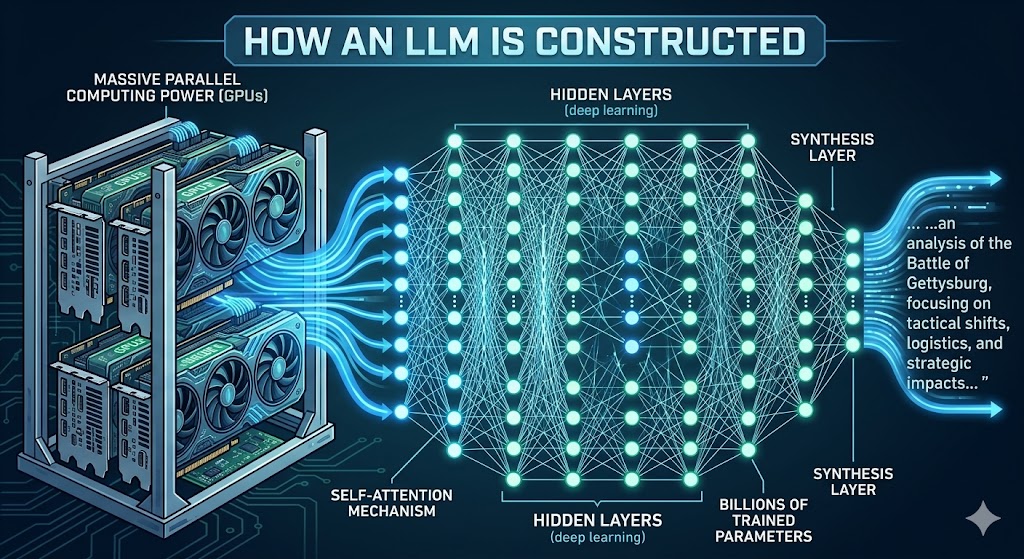
Modern AI uses a specific architecture called a Transformer. Its secret sauce is a mechanism called Self-Attention. When you give the AI a sentence, it doesn’t just read left-to-right; it looks at every word simultaneously. It assigns “weights” to words, essentially deciding which words are the most important to the meaning of the others. This allows it to understand that in the phrase “The bank of the river,” the word “bank” refers to land, not a financial institution.

The Engine: Neural Networks & Layers

An LLM is made of hundreds of these layers stacked on top of each other.

  • Input Layer: Breaks your text into “tokens” (chunks of characters).
  • Hidden Layers: This is where the actual “thinking” happens. As data passes through, it’s multiplied by billions of tiny numbers called parameters. These parameters are the model’s “experience”—they determine how the signal changes as it moves through the web.
  • Output Layer: Converts those processed numbers back into the word it predicts should come next.

The Muscle: The GPU

While a standard computer processor (CPU) is like a world-class chef who can do one complex thing at a time, a GPU (Graphics Processing Unit) is like a thousand line cooks working in parallel.

Because an LLM has to perform billions of simple math calculations (multiplication and addition) at the exact same time to process a single sentence, the CPU would be too slow. The GPU’s ability to handle parallel processing enabled AI to move from a slow lab experiment to a real-time tool you can chat with on your phone.

The Takeaway

AI is a tool for synthesis. Instead of manually clicking through numerous links to find an answer, the AI examines those sources and provides the summary you need. The value is not in reaching a specific destination, but in generating relevant results efficiently.

The next part of the series will address the impact of AI: jobs, the number of players before some fall away, and the potential long-term impacts on society.

How did you like the post?

Click on a star to rate it!

Average rating 0 / 5. Vote count: 0

No votes so far! Be the first to rate this post.

The “Old Guy in the Coffee Shop” Fund

Supporting my work helps keep this retired guy out of trouble and away from the TV—tips and pledges are always appreciated.

Buy me a coffee & pão de queijo

About Kevin, I spent 40 years in FinTech before retiring to

Rio de Janeiro to trade software releases for a front-row seat

to the beautiful absurdity of life in Brazil. This blog is my digital

porch, a place for unpolished commentary on book reviews,

daily gripes, and the random thoughts of a guy who finally has

the time to pay attention. I’m an observant realist with a deep

appreciation for history, a good quote, and the perspective that

only comes after the career ends. I write to stay sharp, to stay

honest, and to keep the conversation going.


Comments

19 responses to “AI Impact -What’s Next Part 1”

  1. This is a very interesting and well written post and it was a pleasure to read it. Thank you Kevin.

    1. Hey thanks for the feedback, much appreciated. Glad you like it. I have plans too expand it out 2-3 more posts things like the players that survive, support and cost and maybe what the end state is with humanity. as the ygo a bit more opinion and speculation like food for thought.

  2. I also love the picture at the top. I am curious as to where you got it.

    1. Gemini generated. I fed it my article and asked to generate an image.

  3. A very interesting read. I don’t know that much about AI so always interested in learning more.

    1. Hi glad you liked it. I am going to do 2-3 more follow up to bring in cost the AI’s that survive and what the end result looks like in terms of landscape , humanity ,economics, etc. more opinion as we move out

      1. I had a question about AI, not sure if your other posts will cover it. But I was curious as to why they use clean water to cool the machines instead of water that humans can’t use.

      2. Hi and great question. I was going to add this along with other concerns like electricity. From what I understand it is really due to contaminants that can ruin equipment, the cooling systems. I guess without all the specifics that is the basic understanding I have. It is a major concern as these datacenters spring up.

      3. Oh okay, interesting.

    2. Dear Kevin and P. J. Gudka,

      I have enjoyed reading your lively conversations here and have come to join you in reflecting on the significance of this well-written post entitled “What is AI, and Why the Sudden Buzz?”.

      Thank you, Kevin, for breaking down AI into its basic constituents comprising input, hidden and output layers.

      I have done my fair share of trying to understand AI, and as April dawns, I would like to invite you to read one or both of my following posts so that I can get your feedback.

      The first one is entitled “📈🌆 Growing Humanity with Artificial Intelligence: A Sociotechnological Petri Dish with Latent Threats, Existential Risks and Challenging Prospects 👨‍👩‍👦‍👦🤖🧫☣️“.

      The second one is entitled “👁️ The Purview of SoundEagle🦅 According to ChatGPT 💬 and the Incredulous 🤔 in the Age of God-like Technology 🚀“.

      Happy April to both of you! By the way, how nice of P. J. Gudka to give Kevin the SUNSHINE BLOGGER AWARD!

      Yours sincerely,
      SoundEagle🦅

      1. Hey thanks for the reply. Glad you liked it and yes I will read them. Can you send the links?

      2. Dear Kevin,

        If you want to find out more about ChatGPT and Scholar GPT as well as how I have been mistaken by some people as some bot or machine (apparently, I have passed the Turing test), then visit the one entitled “👁️ The Purview of SoundEagle🦅 According to ChatGPT 💬 and the Incredulous 🤔 in the Age of God-like Technology 🚀” at

        http://soundeagle.wordpress.com/2024/04/07/the-purview-of-soundeagle-according-to-chatgpt-and-the-incredulous-in-the-age-of-god-like-technology/#top

        Yours sincerely,
        SoundEagle🦅

      3. Dear Kevin,

        I have already sent you three comments, which seem to have been consigned to your WordPress spam folder because each of them contains a link. Please kindly check your spam folder, then retrieve and approve each one as follows:

        To access your WordPress spam folder, go to the following URL:

        [insert your blog url here]/wp-admin/edit-comments.php?comment_status=spam

        After unspamming the comment, you will need to approve it by going to the following URL:

        [insert your blog url here]/wp-admin/edit-comments.php?comment_status=all

        This will allow you to read the comment and visit the said post.

        Repeat the same procedure for the remaining comments.

        May you enjoy reading and commenting on my posts!

        Yours sincerely,
        SoundEagle🦅

      4. I thill take a look. Thanks

      5. I saw it, very good and very deep. Just my opinion I would make this a series and break it up into multiple posts to make it easier to consume and maybe by theme. It would get more clicks and reads in smaller chunks and make for consistent postings.

  4. […] Ok, so AI is here, what are you going to do about it? This is a follow-up to my previous post. Part 1 – What is AI […]

  5. “AI as a tool for synthesis” is accurate. But the efficiency gain is only valuable if the output is reliable. Most people still skip the critical step: verifying what was synthesized. Without that, efficiency just means getting to hallucination faster.

    1. That is correct. These tools are lot to be considered exact, they are as good as the data ingested , the sources, how they learn and the network. The information retrieved needs to be evaluated and not taken as absolute. Generally speaking it should be accurate based on tools like Gemini or ChatGPT but each can specialize in specific areas.

      1. Exactly right. The model is only as good as what it was trained on and how critically you read what comes out.

Leave a Reply to SoundEagle 🦅ೋღஜஇCancel reply

Discover more from BeingKevin

Subscribe now to keep reading and get access to the full archive.

Continue reading