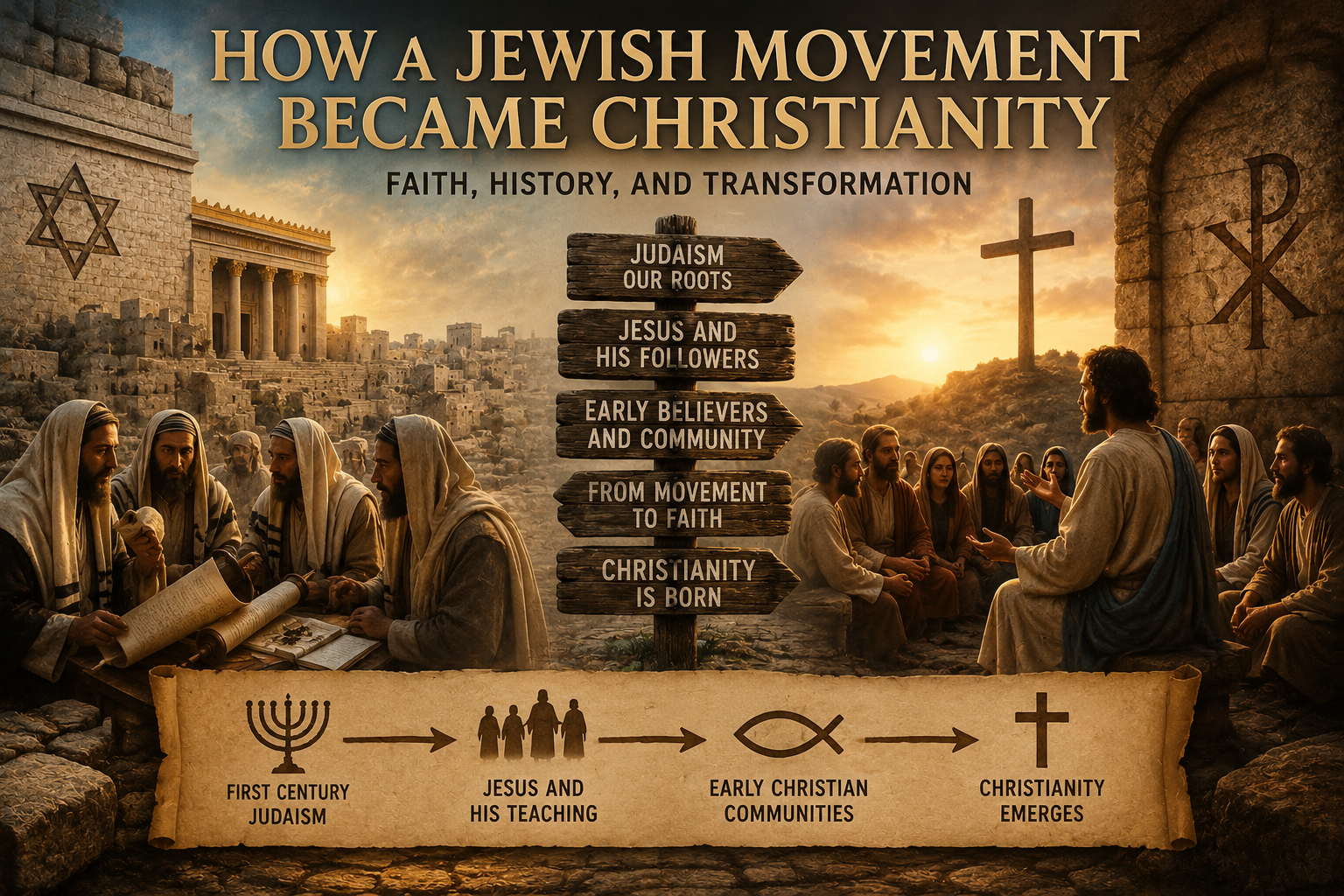
How a Jewish Movement Became Christianity: The History and Evolution of Jesus’ Movement
Opening
If Judaism had not been so structured, I wonder if Jesus’ message would have caught on the way it did. Looking back, it seems that his challenge to the religious leaders is what gave his message the strength to survive long after he was gone.
To understand the history, you have to start at the beginning. Jesus was born and raised Jewish. He lived and taught as a Jew, worshiping in the Temple in Jerusalem and in local synagogues. He was crucified around 30 AD (Anno Domini, meaning “in the year of the Lord”).
Jesus’ earliest followers were all Jewish and continued to worship as Jews after his death, believing Jesus was the promised Messiah; they did not see him as the founder of a new religion. At first, they saw themselves as Jews who believed the Messiah had come, not as members of a separate faith.
Since Jesus was Jewish, nobody used the word Christian during his lifetime. The term first appeared around 40 AD, and the movement remained largely Jewish in its earliest years. During the Council of Jerusalem around 50 CE, it was decided that Gentile converts did not have to follow the formal Jewish law. That decision marked the beginning of Christianity becoming a distinct religion rather than simply a movement within Judaism.
Around the same time, Paul the Apostle began spreading the message throughout the Roman world, carrying it far beyond Judea and opening the movement to people who had never been part of the Jewish faith.
Later, when the Romans destroyed the Second Temple in 70 CE, the event permanently widened the gap between those Jews who followed Jesus and those who did not. The destruction accelerated the separation of Rabbinic Judaism and Christianity into two distinct religions.
Looking at this timeline helps explain how a Jewish movement centered on Jesus slowly became what we now call Christianity.
The Religious Structure of First-Century Judea
To really understand what Jesus was saying, you have to know how Judaism worked at the time. There were several religious and political groups, each with its own beliefs about how Judaism should be practiced and how Jewish society should respond to Roman rule. When Jesus arrived, his message challenged much of that structure, and many ordinary people responded to what he had to say.
Pharisees: Their primary focus was personal piety, strict observance of the Law, and the oral traditions that interpreted it.
Sadducees: The priestly elite who controlled the Temple and maintained close ties with the Roman authorities.
Essenes: Ascetics who withdrew into the wilderness, believing mainstream Judaism had become corrupt.
Zealots: Political revolutionaries who sought to overthrow Roman rule through violent rebellion.
These groups were all part of Jewish society. They were not inherently corrupt, just different. Each believed it understood the proper way to practice Judaism and guide the Jewish people. They shared the same faith, but they interpreted and lived it in different ways.
Jesus was born a Jew and raised within Judaism. He participated fully in Jewish life. He attended synagogues, observed Jewish festivals, quoted the Hebrew Scriptures, and taught within the Jewish tradition. He made it clear that he had not come to abolish the Law of Moses but to fulfill it.
This became the turning point. Much of what Jesus taught did not fit within the Jewish religious structure, and that created conflict with the religious leaders. Jesus focused on mercy, forgiveness, humility, and concern for the individual rather than rigid legalism. Healing on the Sabbath, eating with tax collectors and social outcasts, and challenging religious hypocrisy threatened the authority of those who believed strict adherence to tradition defined righteousness.
How Did a Jewish Movement Become Christianity?
The common understanding is that Jesus started Christianity. He is unquestionably the central figure of the religion, but the history is more complicated than that. It is easy to imagine that Jesus appeared, founded a new religion, and was then executed by the Romans. That is not what actually happened.
The Romans were primarily interested in maintaining public order, not settling theological disputes within Judaism. Some Jewish religious leaders viewed Jesus as a threat to the existing religious establishment, while Roman authorities became concerned that his growing influence could contribute to unrest. Those interests ultimately converged in the events that led to his crucifixion.
If Jesus did not set out to found a new religion, then how did Christianity emerge?
Perhaps it happened because the existing religious structure gradually pushed the movement in that direction. History often shows that when institutions can no longer adapt to new ideas, reform movements eventually become something separate.
That process reached a turning point around 50 CE at the Council of Jerusalem. Early church leaders—including James, Peter, and Paul—concluded that Gentile converts did not have to follow the full Mosaic Law. Anyone, regardless of ancestry, could become part of the movement simply by believing in Jesus.
When the Romans destroyed the Second Temple in 70 CE, the structure of Judaism could no longer function. A new Judaism emerged, while Christianity continued on its own path. This is when two religions began down their own separate paths.
The Shift from Law to Relationship
This is when the movement truly began to stand on its own. It shifted away from being defined primarily by Jewish law and identity and became open to anyone who chose to follow its message. In my opinion, that was the defining change. It marked the transition from a movement within Judaism to a faith that welcomed people from every background.
Faith was no longer centered solely on following a set of laws or being born into the right family. It became something anyone could embrace, regardless of ancestry or social standing.
It is a bit ironic that today many churches and religious organizations often exclude or judge people because of how they live or what they believe. To me, that runs directly against the message Jesus preached.
Like many institutions where power is involved, religious organizations also created rules, structures, and blocks that help preserve their power and standing. Ironically, those are the very kinds of systems Jesus repeatedly challenged. As Christianity evolved from a small movement into the official religion of powerful empires, it gradually developed many of the same bureaucratic structures, doctrinal rigidity, and moral hypocrisy that Jesus spent his ministry speaking against.
The divisions, conflicts, and politics that were created left people doubtful about organized religion. Instead of helping people find peace, compassion, and acceptance, many institutions have become more concerned with protecting power and structure while preserving influence, and deciding who belongs rather than what religion promises to do for people.
Reconciling Structure, Power, and God
Shouldn’t religion ultimately be about helping people build a genuine relationship with something greater than themselves? Shouldn’t religious leaders exist to guide people toward that purpose?
When institutions become focused on rules, barriers, and preserving themselves, are they still bringing people closer to God, or are they simply creating another system built on power and control?
When human institutions place self-preservation above compassion, faith can slowly become tribal. Loyalty to the institution begins to matter more than love, humility, or service. History shows that people can take these ideas to political extremes, where religion becomes less about faith and more about identity, influence, and control.
In Judaism, the idea of the “chosen people” refers to a way of life and how to live, not a specific group that has a special claim to a piece of land at the exclusion of others.
One of the central themes within Jewish tradition is that every person possesses value before God, while the covenant placed particular responsibilities upon the Jewish people. In classical Jewish thought, non-Jews are not required to convert or observe the Mosaic Law to be considered righteous before God. They are called to live according to basic moral principles.
In the actual tradition, the land is always connected to responsibility. The prophets warned that injustice, corruption, and neglect of the vulnerable would bring judgment and exile. The Prophets stated that ancestry and possession of land meant little if justice, mercy, and righteousness were absent.
The “Promised Land” never takes into account the true meaning. Politics treat it as a guarantee of power or ownership; however, it is actually tied to justice, compassion, and morality.
When religious ideas such as “chosen people” or “Promised Land” become tools for political power rather than moral responsibility, history shows the consequences can be devastating. We have seen versions of this throughout history—in the Crusades, in conflicts throughout the Middle East, and in many other places where religion has been used to justify violence or domination.
If faith becomes a tool for politics, the purpose and meaning are lost. Being “chosen” should not mean superiority or ownership of any land or property. It was meant to describe a covenant that carried responsibilities and a way of living grounded in justice, mercy, and faithfulness.
Conclusion
I try to approach history logically while recognizing that faith and history are not always the same thing. Much of what religion teaches comes through stories, traditions, and beliefs rather than facts that can be independently verified. Faith and historical evidence serve different purposes, and I think it is important not to confuse them.
For me, some things are historically clear. Jesus was a real person, and what his earliest followers wrote gives us valuable insight into his life, his teachings, and the growth of the movement that followed. That does not mean every account should be read as literal history, but it does provide a remarkable window into how Christianity developed.
I think people often blur the line between faith and fact. Faith can bring comfort, hope, and purpose. But religious institutions, because they are run by human beings, can also use faith to justify authority, preserve power, or defend their own interests.
That may be the greatest irony of all.
A message centered on humility, compassion, forgiveness, and inclusion has, over the centuries, often been reshaped by the very human desire for power and control. The ideals Jesus preached have too often been overshadowed by institutions more concerned with preserving themselves than with living those ideals.
If we choose to follow the message, then we should also be willing to live by it. I believe that responsibility belongs to everyone, but especially to those who claim to lead others in faith.
Leave a Reply