There is a phrase that occasionally appears in political discourse, social media arguments, and everyday conversations:
“Go back where you came from.”
Every time I hear it, I am struck by the irony.
No matter our nationality, race, language, religion, or culture, every human being can ultimately trace their ancestry back to the same place: Africa. It is not simply another continent on a map. It is the birthplace of humanity itself.
Yet for many people, Africa exists in their minds only as a place associated with poverty, conflict, corruption, or crisis. What is often forgotten is that long before colonialism, long before modern nation-states, and long before many of the civilizations we commonly study in school, Africa was home to some of the world’s most sophisticated societies.
The more I learned about Africa’s history, the more I realized how much of the story I had never been taught. What surprised me was not only what existed, but the scale of what was lost.
The Forgotten Superpowers
When most people think about ancient civilizations, they often think of Rome, Greece, Egypt, or China. Rarely do they think of the great African kingdoms and empires that once dominated trade, scholarship, architecture, and culture.
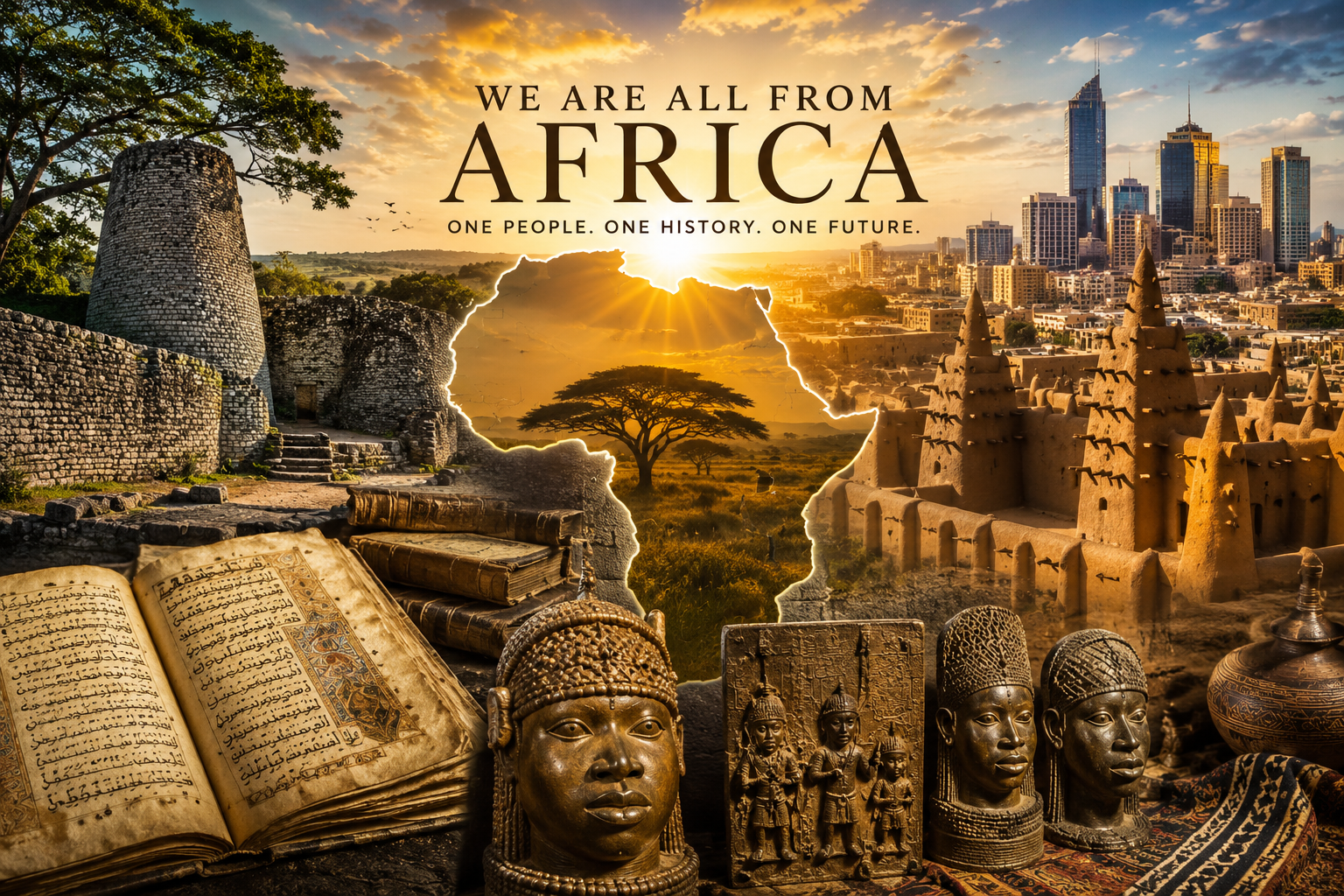
The Mali Empire became one of the largest and wealthiest empires in history. Under Mansa Musa, its influence stretched across vast portions of West Africa. Timbuktu became a center of learning, attracting scholars from across the known world.
The Kingdom of Aksum, located in present-day Ethiopia and Eritrea, was considered one of the great powers of the ancient world, conducting trade with Rome, India, and Arabia.
The Kingdom of Kush not only developed its own remarkable civilization but also, at one point, conquered Egypt itself. Today, more pyramids stand in Sudan than in Egypt, a fact many people never learn.
Great Zimbabwe demonstrated extraordinary engineering skill, constructing massive stone structures without mortar. Early European explorers often refused to believe indigenous Africans had built them because it challenged their assumptions about civilization and achievement.
Then there is the Benin Empire, located in what is now Nigeria, not the modern country of Benin. Its sophisticated urban planning, artistic achievements, and famous bronze sculptures reflected a highly developed society. The Benin Bronzes remain among the most remarkable artistic achievements in human history.
The existence of these civilizations challenges a misconception that still lingers today: that Africa’s history began when Europeans arrived.
It didn’t.
Africa already had a history thousands of years old.
More Than Wealth
What struck me most was not simply the wealth of these civilizations.
It was their knowledge.
The libraries and manuscripts of Timbuktu represent something deeper than gold or trade routes. They remind us that knowledge itself is a form of wealth.
I often wonder what was documented there that we will never fully recover.
What discoveries were made?
What histories were recorded?
What ideas were lost?
Buildings can be rebuilt. Roads can be repaved. Economies can recover.
Knowledge is harder.
Once lost, it can disappear forever.
The Great Disruption
The decline of many African civilizations cannot be understood without acknowledging slavery, colonialism, and the scramble for Africa.
The transatlantic slave trade was not simply the movement of people. It was the removal of generations of human potential.
Millions of people were taken from their homes. Families were separated. Communities were fractured. Entire societies lost farmers, craftsmen, scholars, leaders, and storytellers.
The greatest loss may not have been wealth.
It may have been knowledge.
The loss of people meant the loss of culture, memory, expertise, and history.
Later came the colonial partition of Africa. European powers divided the continent into territories that often ignored ethnic, linguistic, and cultural realities. Resources were extracted. Institutions were reshaped. Traditional systems were disrupted.
This history is uncomfortable.
It exposes greed, exploitation, and cruelty.
Many people prefer to avoid uncomfortable history because it challenges the stories nations tell about themselves. Yet understanding history requires honesty. Not selective honesty. Complete honesty.
Teaching only the good creates mythology.
Teaching only the bad creates resentment.
Teaching both creates understanding.
Humanity’s Recurring Problem
While studying Africa’s history, I found myself thinking about a larger question.
Why do humans keep dividing themselves?
Throughout history, we have organized ourselves into tribes, kingdoms, nations, religions, political parties, and social groups. Some of this is natural. People seek familiarity, security, and belonging.
But too often those differences become tools for exclusion.
Race.
Nationality.
Religion.
Language.
Politics.
We focus on what separates us rather than what unites us.
Yet the scientific reality remains unchanged: every human being shares a common origin.
The color of our skin, often used throughout history to justify division, reflects adaptation to different environments over thousands of years as humans migrated across the globe.
We are far more alike than different.
The deeper I looked into Africa’s story, the more I realized that it is ultimately humanity’s story.
Reclaiming the Narrative
One of the most encouraging developments today is the effort to reclaim and preserve African history.
Artifacts are being returned.
Historical narratives are being reexamined.
Museums, universities, and researchers are uncovering stories that were overlooked or ignored for generations.
The return of the Benin Bronzes represents more than the return of art.
It represents acknowledgment.
It represents memory.
It represents dignity.
It represents a recognition that history matters.
Across Africa, nations continue to invest in education, infrastructure, technology, and cultural preservation. Challenges remain, but so does progress.
The story is no longer simply about what was taken.
It is also about what is being rebuilt.
What I Learned
Before researching this topic, I understood slavery as a terrible chapter in human history.
What I did not fully appreciate was how much existed before it.
I had no idea of the scale of the wealth, scholarship, architecture, engineering, and culture that flourished across Africa.
I had no idea how much knowledge may have been lost.
I had no idea how extensive the disruption truly was.
But perhaps the most important lesson has nothing to do with Africa alone.
It has to do with humanity.
If we want a better future, we must be willing to confront the truth about our past—not to assign guilt, but to gain understanding.
The phrase “go back where you came from” misses a deeper truth.
If we go back far enough, every one of us arrives at the same place.
We are all part of the same human story.
And if there is one thing I learned from Africa’s story, it is this:
Humanity’s greatest strength is not what it builds, but what it preserves and rebuilds after others try to destroy it.
Sources and Further Reading
- UNESCO World Heritage Centre – Timbuktu
https://whc.unesco.org/en/list/119/ - UNESCO World Heritage Centre – Great Zimbabwe National Monument
https://whc.unesco.org/en/list/364/ - Encyclopaedia Britannica – Mali Empire
https://www.britannica.com/topic/Mali-empire-African-history - Encyclopaedia Britannica – Kingdom of Aksum
https://www.britannica.com/place/Aksum-ancient-kingdom-Africa - Smithsonian National Museum of African Art
https://africa.si.edu/ - British Museum – Benin Bronzes Collection History
https://www.britishmuseum.org/collection/term/x42939 - United Nations – International Decade for People of African Descent Archive
https://www.un.org/en/observances/decade-people-african-descent


Leave a Reply