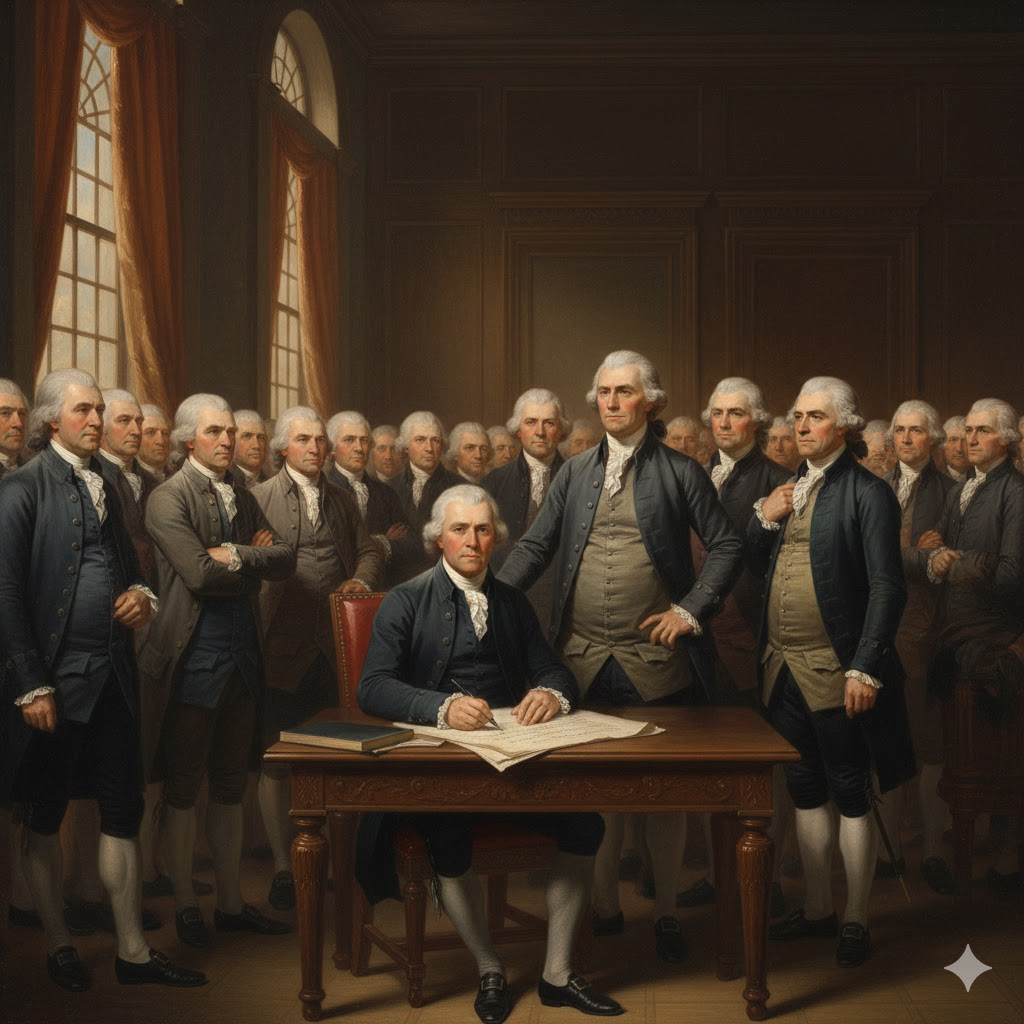
September: The Other Month That Created America
This is a follow-up to my earlier piece, “The Founders’ Greatest Moral Contradiction: Liberty, Slavery, and the Cost of Compromise.” That post looked at the contradiction between founding a country around liberty while allowing slavery to continue.
There is another part of the founding story that I find just as interesting.
We tend to think of July when we think about the birth of the United States. July 4th, 1776, the Declaration of Independence, Thomas Jefferson, and the famous words about life, liberty, and the pursuit of happiness.
But if you really want to understand how the United States came together, I think September is a more interesting month.
Two dates stand out:
September 3, 1783
September 17, 1787
One ended the Revolutionary War. The other created the Constitution.
And both tell us something about the compromises that helped create the country we know today.
September 3, 1783: The War Actually Ends
The British surrender at Yorktown in October 1781 is generally treated as the great victory of the American Revolution. And it was. But Yorktown did not officially end the war.
It took another two years of negotiations before the Treaty of Paris was signed on September 3, 1783, formally recognizing the United States as an independent nation. Britain also gave up a surprising amount of territory, extending the new United States west of the original thirteen colonies all the way to the Mississippi River.
On the surface, this was a tremendous moment.
The Americans had won their independence.
But peace agreements are rarely as simple as the headline and key players are left out.
There were people who had supported the British who now had to live with the consequences. There were Native American nations that had allied themselves with Britain and were effectively left out of the settlement. And there were thousands of Black people who had sought freedom by joining the British lines during the war.
The British had offered freedom to enslaved people who escaped to their side and supported the Crown. Thousands of Black Loyalists were eventually evacuated, with many going to Nova Scotia, Britain, and other British territories.
But there was a complicated and ugly side to this as well. The British took as many of these newly freed people as they could when they evacuated their forces, despite American demands that enslaved people who had belonged to American owners be returned. The final Treaty of Paris contained language saying Britain would not carry away enslaved people considered the property of American inhabitants.
So even here, the meaning of freedom depended on who was defining it. Liberty for the chosen.
Britain had promised freedom to people who escaped to its lines, but the Americans still considered many of those same people property. Thousands ultimately escaped slavery, but the dispute over who had the right to claim them shows just how complicated the idea of freedom was at the very moment the United States was becoming an independent nation.
For Native Americans, the situation was even more troubling. Many had supported the British because they believed British protection offered their best chance of resisting American expansion. Once the British made peace, those alliances did not protect Native lands from the new United States.
The new nation had won its independence, and now it had a huge continent in front of it.
That expansion would come at an enormous cost to Native peoples.
The story would continue for decades, through forced removals and ultimately the Trail of Tears.
The United States had won freedom from Britain.
It did not mean everyone living on the continent was about to become free.
And that brings us to the next September date.
September 17, 1787: Creating the Government
Four years after the Treaty of Paris, the country had another problem.
Winning independence was one thing.
Figuring out how to govern the new country was something else entirely.
The Articles of Confederation had created a national government that was too weak to deal effectively with many of the country’s problems. So in 1787, delegates gathered in Philadelphia expecting to revise the Articles.
Instead, they created an entirely new system of government. The Experiment.
On September 17, 1787, the Constitution was signed. Thirty-nine delegates signed it. Three men who were present refused.
Those three were:
- George Mason of Virginia
- Elbridge Gerry of Massachusetts
- Edmund Randolph of Virginia
And one of their biggest objections was something most Americans today take completely for granted.
There was no Bill of Rights.
The Bill of Rights Almost Didn’t Happen
Today, the First Amendment, Second Amendment, Fourth Amendment and the rest of the Bill of Rights are treated as fundamental parts of the Constitution.
In 1787, however, some of the people writing the Constitution didn’t think a Bill of Rights was necessary.
The argument was fairly simple: the federal government could only exercise the powers actually given to it by the Constitution. If the government wasn’t given a power, it didn’t have that power.
George Mason wasn’t convinced.
On September 12, George Mason and Elbridge Gerry proposed adding a bill of rights. The delegates rejected the proposal unanimously.
It is one of those moments in history that sounds almost unbelievable from our modern perspective.
The men were creating a new government designed to protect liberty, yet some of them didn’t think they needed to specifically spell out those liberties.
Mason, Gerry and Randolph refused to sign the final document.
The Bill of Rights would eventually come, but not until the Constitution had been ratified and the First Congress met. James Madison then became one of its principal architects.
When Madison finally introduced his amendments in 1789, he wasn’t starting from scratch. More than 200 amendment suggestions had come from the states during the ratification debate. Madison narrowed those ideas down to 12 proposed amendments. Congress approved all 12 and sent them to the states. Two were not ratified, leaving the 10 amendments we know today as the Bill of Rights, which became part of the Constitution on December 15, 1791.
So the Bill of Rights itself was another exercise in compromise. It started with more than 200 ideas, became 12 proposals, and ultimately became 10 amendments.
So once again, the United States was being created through compromise.
And slavery well that can was kicked down the road.
The Compromise Nobody Wants to Talk About
The Constitution had to solve another enormous problem.
How would states with very different populations and very different economic interests share political power?
The answer was the Great Compromise.
Every state would have two senators regardless of population, while representation in the House would be based on population.
That solved one problem.
Then slavery complicated everything.
The Constitution counted enslaved people as three-fifths for purposes of representation in the House and for certain direct taxes.
This is often simplified into the phrase “three-fifths of a person,” which is understandable but misses an important part of what the compromise actually did.
Enslaved people could not vote. They had no political rights. Yet counting them toward a state’s population increased the number of representatives that state could send to Congress.
And that leads to another important part of the story: the Electoral College.
The delegates debated several ways of choosing the president. One option was a direct popular vote. Another was having Congress choose the president. Neither had enough support.
The final solution was a compromise between those competing ideas.
Instead of Americans directly electing the president as a single national electorate, each state would receive a number of electors based on its representation in Congress: its members of the House plus its two senators.
That may sound like a minor technical detail.
It wasn’t.
Because the number of House representatives was based partly on the Three-Fifths Compromise, the compromise over slavery also affected the number of electoral votes a state received.
In other words, the same enslaved people who could not vote were nevertheless counted toward the political power of the states that enslaved them.
And this is where the story gets even more interesting.
James Madison had pointed out a problem with a direct popular vote. Enslaved people could not vote, yet their population was being counted toward representation. Madison recognized that a direct popular election would give the Southern states less influence because the enslaved population could not participate in the vote. Historical National Archives material identifies this concern as part of the thinking behind the electoral system.
The final proposal came from the Committee of Eleven, chaired by David Brearley of New Jersey. The committee proposed a system in which each state would have electors based on its representation in Congress.
So the Electoral College was not created solely because of slavery. The delegates had several reasons for rejecting a direct popular vote and several competing ideas for how the president should be chosen.
But the system they created tied presidential elections to congressional representation, and congressional representation was tied to the Three-Fifths Compromise.
A state’s electoral votes were based on its number of representatives plus its two senators. Since representation in the House included the Three-Fifths Compromise, that compromise also affected presidential elections.
Enslaved people could not vote.
They had no political rights.
Yet their numbers increased the political representation of the states where they were enslaved.
And that had another consequence.
Their population also increased the electoral strength of those states.
The Electoral College was a broader compromise over how to choose a president, but slavery and the Three-Fifths Compromise were part of the political calculation behind the system.
The result was a system in which enslaved people had no vote, no political rights, and no representation of their own, while their population nevertheless increased the political and electoral power of the states that enslaved them.
Oddly, the premise behind the Revolution was a lack of representation, and here we are forming a new country with a system built around the same problem.
That connection matters.
The Constitution was designed to balance large states against small states, federal power against state power, and popular influence against the concerns of the delegates who feared too much direct democracy.
And slavery became part of that balance.
That is another one of those contradictions that is difficult to explain away.
The country was trying to create a government based on representation and liberty while simultaneously protecting a system that denied both to millions of people.
So Who Actually Wrote the Constitution?
There is another interesting misconception here.
There wasn’t one person sitting down and writing the Constitution from beginning to end.
James Madison deserves enormous credit. He helped shape the Virginia Plan, was deeply involved in the debates, and kept extensive notes of what happened during the convention.
But the document was a group effort.
A five-member Committee of Detail produced the first full working draft. It included John Rutledge, Edmund Randolph, Nathaniel Gorham, Oliver Ellsworth and James Wilson.
Near the end of the convention, another five-member group, the Committee of Style, revised the document.
That committee included Madison and Alexander Hamilton, but Gouverneur Morris is generally credited with much of the final wording and literary form of the document, including the famous opening:
“We the People…”
So even the Constitution itself was a compromise between ideas, personalities and competing interests.
Maybe That Is the Real Story
This is why I find September more interesting than July.
July gives us the Declaration of Independence.
It gives us the ideal.
September gives us the reality.
On September 3, 1783, the United States officially became independent, but the settlement left Native Americans and Black Loyalists facing very different futures from the people celebrating American independence.
Four years later, on September 17, 1787, the Constitution created a government designed around representation and individual liberty.
But that government was also built through compromises involving slavery and political power.
None of this makes the founding of the United States unimportant.
If anything, it makes it more interesting.
The country wasn’t created by a group of people who all agreed on everything. It was created by people who disagreed about almost everything and somehow managed to build something that survived.
Some compromises were necessary.
Some were morally indefensible.
Some solved an immediate problem while creating a much larger one for the future.
And that may be the most important lesson in all of this.
History isn’t usually made by people sitting around a table knowing exactly how everything will turn out.
They make decisions based on what they believe is possible at the time.
Then future generations get to live with those decisions.
Sometimes for a very long time.
That is why I think September deserves a little more attention.
July tells us what America said it believed.
September tells us what America was actually willing to compromise to make those beliefs possible.
And sometimes, those are two very different things.
References
- National Archives: The Treaty of Paris (1783) — independence, territorial boundaries, and the provisions concerning enslaved people. National Archives: Treaty of Paris
- National Archives: The Constitution: How Did It Happen? — the Constitutional Convention, Great Compromise, Three-Fifths Compromise, and signing of the Constitution. National Archives: How the Constitution Happened
- Library of Congress: Demand for a Bill of Rights — the debate over the Bill of Rights and Mason and Gerry’s September 1787 proposal. Library of Congress: Demand for a Bill of Rights
- National Archives: Electoral College History — the development of the electoral system and the competing proposals for choosing the president. National Archives: Electoral College History
- National Archives: Garrison’s Constitution — historical discussion of the relationship between slavery, representation, Madison’s concerns, and the Electoral College. National Archives: Garrison’s Constitution
- Library of Congress: The Bill of Rights — the 12 amendments proposed by Congress in 1789 and the 10 ultimately ratified in 1791. Library of Congress: The Bill of Rights
Thanks for reading BeingKevin.
Thanks for reading BeingKevin.
In a world built on scrolling past everything in seconds, I genuinely appreciate you stopping here for a moment. If the post gave you something to think about, made you laugh, or even made you disagree, I’d love to hear from you in the comments. A quick rating helps, too, and goes a long way toward supporting the site. And if you’d like to help keep BeingKevin going, a small tip is always appreciated — never expected, but deeply valued. Thanks again for being here
September: The Other Month That Created America
This is a follow-up to my earlier piece, “The Founders’ Greatest Moral Contradiction: Liberty, Slavery, and the Cost of Compromise.” That post looked at the contradiction between founding a country around liberty while allowing slavery to continue.
There is another part of the founding story that I find just as interesting.
We tend to think of July when we think about the birth of the United States. July 4th, 1776, the Declaration of Independence, Thomas Jefferson, and the famous words about life, liberty, and the pursuit of happiness.
But if you really want to understand how the United States came together, I think September is a more interesting month.
Two dates stand out:
September 3, 1783
September 17, 1787
One ended the Revolutionary War. The other created the Constitution.
And both tell us something about the compromises that helped create the country we know today.
September 3, 1783: The War Actually Ends
The British surrender at Yorktown in October 1781 is generally treated as the great victory of the American Revolution. And it was. But Yorktown did not officially end the war.
It took another two years of negotiations before the Treaty of Paris was signed on September 3, 1783, formally recognizing the United States as an independent nation. Britain also gave up a surprising amount of territory, extending the new United States west of the original thirteen colonies all the way to the Mississippi River.
On the surface, this was a tremendous moment.
The Americans had won their independence.
But peace agreements are rarely as simple as the headline and key players are left out.
There were people who had supported the British who now had to live with the consequences. There were Native American nations that had allied themselves with Britain and were effectively left out of the settlement. And there were thousands of Black people who had sought freedom by joining the British lines during the war.
The British had offered freedom to enslaved people who escaped to their side and supported the Crown. Thousands of Black Loyalists were eventually evacuated, with many going to Nova Scotia, Britain, and other British territories.
But there was a complicated and ugly side to this as well. The British took as many of these newly freed people as they could when they evacuated their forces, despite American demands that enslaved people who had belonged to American owners be returned. The final Treaty of Paris contained language saying Britain would not carry away enslaved people considered the property of American inhabitants.
So even here, the meaning of freedom depended on who was defining it. Liberty for the chosen.
Britain had promised freedom to people who escaped to its lines, but the Americans still considered many of those same people property. Thousands ultimately escaped slavery, but the dispute over who had the right to claim them shows just how complicated the idea of freedom was at the very moment the United States was becoming an independent nation.
For Native Americans, the situation was even more troubling. Many had supported the British because they believed British protection offered their best chance of resisting American expansion. Once the British made peace, those alliances did not protect Native lands from the new United States.
The new nation had won its independence, and now it had a huge continent in front of it.
That expansion would come at an enormous cost to Native peoples.
The story would continue for decades, through forced removals and ultimately the Trail of Tears.
The United States had won freedom from Britain.
It did not mean everyone living on the continent was about to become free.
And that brings us to the next September date.
September 17, 1787: Creating the Government
Four years after the Treaty of Paris, the country had another problem.
Winning independence was one thing.
Figuring out how to govern the new country was something else entirely.
The Articles of Confederation had created a national government that was too weak to deal effectively with many of the country’s problems. So in 1787, delegates gathered in Philadelphia expecting to revise the Articles.
Instead, they created an entirely new system of government. The Experiment.
On September 17, 1787, the Constitution was signed. Thirty-nine delegates signed it. Three men who were present refused.
Those three were:
- George Mason of Virginia
- Elbridge Gerry of Massachusetts
- Edmund Randolph of Virginia
And one of their biggest objections was something most Americans today take completely for granted.
There was no Bill of Rights.
The Bill of Rights Almost Didn’t Happen
Today, the First Amendment, Second Amendment, Fourth Amendment and the rest of the Bill of Rights are treated as fundamental parts of the Constitution.
In 1787, however, some of the people writing the Constitution didn’t think a Bill of Rights was necessary.
The argument was fairly simple: the federal government could only exercise the powers actually given to it by the Constitution. If the government wasn’t given a power, it didn’t have that power.
George Mason wasn’t convinced.
On September 12, George Mason and Elbridge Gerry proposed adding a bill of rights. The delegates rejected the proposal unanimously.
It is one of those moments in history that sounds almost unbelievable from our modern perspective.
The men were creating a new government designed to protect liberty, yet some of them didn’t think they needed to specifically spell out those liberties.
Mason, Gerry and Randolph refused to sign the final document.
The Bill of Rights would eventually come, but not until the Constitution had been ratified and the First Congress met. James Madison then became one of its principal architects.
When Madison finally introduced his amendments in 1789, he wasn’t starting from scratch. More than 200 amendment suggestions had come from the states during the ratification debate. Madison narrowed those ideas down to 12 proposed amendments. Congress approved all 12 and sent them to the states. Two were not ratified, leaving the 10 amendments we know today as the Bill of Rights, which became part of the Constitution on December 15, 1791.
So the Bill of Rights itself was another exercise in compromise. It started with more than 200 ideas, became 12 proposals, and ultimately became 10 amendments.
So once again, the United States was being created through compromise.
And slavery well that can was kicked down the road.
The Compromise Nobody Wants to Talk About
The Constitution had to solve another enormous problem.
How would states with very different populations and very different economic interests share political power?
The answer was the Great Compromise.
Every state would have two senators regardless of population, while representation in the House would be based on population.
That solved one problem.
Then slavery complicated everything.
The Constitution counted enslaved people as three-fifths for purposes of representation in the House and for certain direct taxes.
This is often simplified into the phrase “three-fifths of a person,” which is understandable but misses an important part of what the compromise actually did.
Enslaved people could not vote. They had no political rights. Yet counting them toward a state’s population increased the number of representatives that state could send to Congress.
And that leads to another important part of the story: the Electoral College.
The delegates debated several ways of choosing the president. One option was a direct popular vote. Another was having Congress choose the president. Neither had enough support.
The final solution was a compromise between those competing ideas.
Instead of Americans directly electing the president as a single national electorate, each state would receive a number of electors based on its representation in Congress: its members of the House plus its two senators.
That may sound like a minor technical detail.
It wasn’t.
Because the number of House representatives was based partly on the Three-Fifths Compromise, the compromise over slavery also affected the number of electoral votes a state received.
In other words, the same enslaved people who could not vote were nevertheless counted toward the political power of the states that enslaved them.
And this is where the story gets even more interesting.
James Madison had pointed out a problem with a direct popular vote. Enslaved people could not vote, yet their population was being counted toward representation. Madison recognized that a direct popular election would give the Southern states less influence because the enslaved population could not participate in the vote. Historical National Archives material identifies this concern as part of the thinking behind the electoral system.
The final proposal came from the Committee of Eleven, chaired by David Brearley of New Jersey. The committee proposed a system in which each state would have electors based on its representation in Congress.
So the Electoral College was not created solely because of slavery. The delegates had several reasons for rejecting a direct popular vote and several competing ideas for how the president should be chosen.
But the system they created tied presidential elections to congressional representation, and congressional representation was tied to the Three-Fifths Compromise.
A state’s electoral votes were based on its number of representatives plus its two senators. Since representation in the House included the Three-Fifths Compromise, that compromise also affected presidential elections.
Enslaved people could not vote.
They had no political rights.
Yet their numbers increased the political representation of the states where they were enslaved.
And that had another consequence.
Their population also increased the electoral strength of those states.
The Electoral College was a broader compromise over how to choose a president, but slavery and the Three-Fifths Compromise were part of the political calculation behind the system.
The result was a system in which enslaved people had no vote, no political rights, and no representation of their own, while their population nevertheless increased the political and electoral power of the states that enslaved them.
Oddly, the premise behind the Revolution was a lack of representation, and here we are forming a new country with a system built around the same problem.
That connection matters.
The Constitution was designed to balance large states against small states, federal power against state power, and popular influence against the concerns of the delegates who feared too much direct democracy.
And slavery became part of that balance.
That is another one of those contradictions that is difficult to explain away.
The country was trying to create a government based on representation and liberty while simultaneously protecting a system that denied both to millions of people.
So Who Actually Wrote the Constitution?
There is another interesting misconception here.
There wasn’t one person sitting down and writing the Constitution from beginning to end.
James Madison deserves enormous credit. He helped shape the Virginia Plan, was deeply involved in the debates, and kept extensive notes of what happened during the convention.
But the document was a group effort.
A five-member Committee of Detail produced the first full working draft. It included John Rutledge, Edmund Randolph, Nathaniel Gorham, Oliver Ellsworth and James Wilson.
Near the end of the convention, another five-member group, the Committee of Style, revised the document.
That committee included Madison and Alexander Hamilton, but Gouverneur Morris is generally credited with much of the final wording and literary form of the document, including the famous opening:
“We the People…”
So even the Constitution itself was a compromise between ideas, personalities and competing interests.
Maybe That Is the Real Story
This is why I find September more interesting than July.
July gives us the Declaration of Independence.
It gives us the ideal.
September gives us the reality.
On September 3, 1783, the United States officially became independent, but the settlement left Native Americans and Black Loyalists facing very different futures from the people celebrating American independence.
Four years later, on September 17, 1787, the Constitution created a government designed around representation and individual liberty.
But that government was also built through compromises involving slavery and political power.
None of this makes the founding of the United States unimportant.
If anything, it makes it more interesting.
The country wasn’t created by a group of people who all agreed on everything. It was created by people who disagreed about almost everything and somehow managed to build something that survived.
Some compromises were necessary.
Some were morally indefensible.
Some solved an immediate problem while creating a much larger one for the future.
And that may be the most important lesson in all of this.
History isn’t usually made by people sitting around a table knowing exactly how everything will turn out.
They make decisions based on what they believe is possible at the time.
Then future generations get to live with those decisions.
Sometimes for a very long time.
That is why I think September deserves a little more attention.
July tells us what America said it believed.
September tells us what America was actually willing to compromise to make those beliefs possible.
And sometimes, those are two very different things.
References
- National Archives: The Treaty of Paris (1783) — independence, territorial boundaries, and the provisions concerning enslaved people. National Archives: Treaty of Paris
- National Archives: The Constitution: How Did It Happen? — the Constitutional Convention, Great Compromise, Three-Fifths Compromise, and signing of the Constitution. National Archives: How the Constitution Happened
- Library of Congress: Demand for a Bill of Rights — the debate over the Bill of Rights and Mason and Gerry’s September 1787 proposal. Library of Congress: Demand for a Bill of Rights
- National Archives: Electoral College History — the development of the electoral system and the competing proposals for choosing the president. National Archives: Electoral College History
- National Archives: Garrison’s Constitution — historical discussion of the relationship between slavery, representation, Madison’s concerns, and the Electoral College. National Archives: Garrison’s Constitution
- Library of Congress: The Bill of Rights — the 12 amendments proposed by Congress in 1789 and the 10 ultimately ratified in 1791. Library of Congress: The Bill of Rights
Thanks for reading BeingKevin.
Thanks for reading BeingKevin.
In a world built on scrolling past everything in seconds, I genuinely appreciate you stopping here for a moment. If the post gave you something to think about, made you laugh, or even made you disagree, I’d love to hear from you in the comments. A quick rating helps, too, and goes a long way toward supporting the site. And if you’d like to help keep BeingKevin going, a small tip is always appreciated — never expected, but deeply valued. Thanks again for being here
Thanks for reading BeingKevin.
In a world built on scrolling past everything in seconds, I genuinely appreciate you stopping here for a moment. If the post gave you something to think about, made you laugh, or even made you disagree, I’d love to hear from you in the comments. A quick rating helps, too, and goes a long way toward supporting the site. And if you’d like to help keep BeingKevin going, a small tip is always appreciated — never expected, but deeply valued. Thanks again for being here


Leave a Reply